Free market requires moral core

By Steve Brawner
© 2015 by Steve Brawner Communications, Inc.

Life, the pope is telling us, is about more than the bottom line. This past week has given two examples of why people should listen to his big economic message even if they disagree with some of his little ones. One involves a giant automaker. The other manufactures a little pill.

The automaker, Volkswagen, doctored its diesel engines so they would temporarily meet EPA emissions regulations while they were being tested, and then they would emit much higher levels when actually driven by car buyers. As a result, those cars performed better on the highways while releasing up to 40 times more pollution than the legal amount. Volkswagen did this in 11 million vehicles sold worldwide.

Environmental considerations aside, the company lied and cheated its competitors and its customers. People thought they were buying a clean vehicle that ran great. Rule-abiding competitors were selling products that had a disadvantage against Volkswagen in the marketplace.

The pill manufacturer is Turing Pharmaceuticals, which bought the rights to Daraprim, a niche drug that fights deadly parasitic infections. The drug has been on the market for 62 years and has no generic equivalent. Shortly after buying the rights, the company raised the price – from $13.50 per tablet to $750 each.

This is not the first time a drug has been purchased and then inflated recently. But the company’s owner, a 32-year-old former hedge fund manager, seemed particularly proud of himself. He said the price needed to be raised to make the drug profitable (which would mean the previous rights holder must have been losing a ton of money at $13.50). Frankly, the drug would be cheap at $750, he said.

If your only guiding principle is the bottom line, then those arguments make sense. Guy’s just charging what the market will bear, right? Everything he’s done is legal. Under traditional laissez-faire economics, the free market’s unseen hand will correct all wrongs, and somebody eventually will produce a generic version if they can make money doing it.

But humans are more than economic beings. We’re also spiritual, moral and social ones. In fact, we must be for the free market to function.

The free market is the greatest anti-poverty mechanism ever created by humanity. It allows entrepreneurs to produce goods and services valued by the marketplace, thereby creating jobs and raising a society’s standard of living. Those who do this exceptionally well – people like Steve Jobs and Warren Buffett – are celebrated and richly rewarded, as they should be.

But the free market is only as good as the values of its practitioners. It can be perverted by those who, instead of producing goods and services, merely play games with money and take advantage of others. While Jobs created world-changing products, Turing’s hedge fund manager produced nothing new. He just bought the rights to a pill and then jacked up the price knowing people had to pay or die, and knowing there probably won’t be a generic competitor soon, if ever.

I watched a brief cable “news” segment where the host and a couple of his guests either defended the hedge fund manager or expressed ambivalence about his actions. The host said this kind of situation is preferable to having the government in charge of health care.

Which is ironic, because if the free market isn’t governed by both the unseen hand and a moral core, then bigger government is unfortunately what we’ll get. Two days after Turing Pharmaceutical’s price hike came to light, Hillary Clinton announced a plan to limit drug price gouging. Supporters of a single-payer government health system can use this episode to bolster their arguments. Meanwhile, Volkswagen’s actions likely will add to the regulatory burden faced by all automakers. They’ll have to do more to prove they’re not cheating.

In these two cases, it’s all ending as it should. Volkswagen stock has tumbled, it faces huge fines, and its CEO, who said he knew nothing about the cheating, has resigned. Meanwhile, overwhelming public condemnation wiped the smirk off the young hedge fund manager’s face, and he announced he would reduce the price hike.

That happened because humans are still spiritual, moral and social beings, instead of merely economic ones. Most of us know it’s wrong to cheat, and we know it’s wrong to take advantage of the vulnerable, or to use the vulnerable as a tool to take advantage of society.

We’re going to be governed by something. Preferably, it’s a conscience.
Arkansas Democrats becoming simply Democrats

By Steve Brawner
© 2015 by Steve Brawner Communications, Inc.

There’s a relatively new phenomenon in Arkansas politics: Democrats are starting to run alongside their national party instead of running against it.

For the past few decades, in-state candidates have followed a formula perfected by Bill Clinton, Sen. Dale Bumpers and Sens. David and Mark Pryor: campaigning as “Arkansas Democrats,” meaning they supported popular government spending programs like Social Security but shied away from their national party on cultural issues such as guns and gays.

That tightrope has become difficult to walk. Nationally, the two parties have become so polarized – the Democrats moving to the left and the Republicans moving to the right – that few can occupy the center. It’s much harder for Arkansas Democrats running for Congress to tell voters they are culturally conservative these days because often they’ll have to vote along their party’s line in Congress.

Geographically, Democrats are now concentrated in coastal and urban areas and have a dwindling presence in the South outside of districts led by racial minorities. That process was happening throughout much of SEC country before President Obama was elected and then happened here afterwards. In 2008, Democrats controlled five of the state’s six congressional offices, all seven statewide constitutional offices, and 102 of the 135 seats in the Legislature. Now Republicans control all six congressional offices, all state constitutional offices, and 88 of the 135 legislative seats. It’s 88 because last month, Rep. Mike Holcomb, who had represented Pine Bluff as a Democrat, announced he had switched parties.

Amidst the mounting evidence that what they are doing isn’t working, some in the party have stopped trying to be Arkansas Democrats and instead just be Democrats. Unlike Republicans, the Democrats are united in support of the private option, the state’s program that uses Obamacare dollars to purchase private insurance for lower income Arkansans. Led by its chairman, Vince Insalaco, the state party has vigorously defended Planned Parenthood since the release of those videos, which Arkansas Democrats like the Pryors never would have done. Holcomb cited that defense as a factor in his party switch. In response, Insalaco basically said the party was glad to see him go.

Then at a campaign rally in Little Rock Monday, Hillary Clinton enthusiastically endorsed not only Obamacare but also President Obama, saying, “It gives me great joy to go around bragging about Bill Clinton and Barack Obama every chance I get.”

Everything Clinton says is for national consumption, of course, and she was speaking before a supportive crowd. But Clinton knows the polls in Arkansas as well as anyone, and she knows how unpopular Obama is here. Instead of running away from him while in Arkansas, she ran alongside him.

The state’s Democrats have not unanimously decided to embark on a new strategy. In announcing he was running as a Democrat for U.S. Senate against incumbent Sen. John Boozman, former U.S. Attorney Conner Eldridge took a page from the old Arkansas Democrat playbook and almost sounded like a Republican. I’m sure that’s partly a political strategy and partly a reflection of who Eldridge is and where he came from. It’s hard to run as a Democrat in Arkansas now. However, if you really are an Arkansas Democrat at heart, then you might not be comfortable in today’s Republican Party.

Prior to Clinton’s speech, Insalaco told the crowd that the state’s Democrats would gain seats in the 2016 elections. That’s probably wishful thinking. Some incumbent Democrats are vulnerable just because they’re Democrats. Republicans are finding candidates – including former Democrats – to run in places where they traditionally haven’t been competitive. Candidates like Holcomb – white, conservative, rural – who used to default to the Democratic Party are now running as Republicans. It’s probably going to get worse for Democrats before it gets better.

And it probably will not get much better for them for a long time. Democrats controlled Arkansas for a century and a half after the Civil War, and now Republicans will control the state for a while. Too many Arkansans now culturally identify with the GOP in ways that are more deep-seated than simple policy positions. Democrats in Arkansas must look to the long game and be patient. More and more, they’ll embrace positions such as supporting gay rights, which is a popular position among young, up-and-coming voters.

That topic came up more in Insalaco’s speech than it did in Clinton’s. In fact, she didn’t mention it. She spent too many years as an Arkansas Democrat.

Trump, Carson and the vaccine debate

By Steve Brawner
© 2015 by Steve Brawner Communications, Inc.

One of the most interesting moments in Wednesday’s l-o-o-ng Republican presidential debate came when two candidates sort of stopped debating.

Dr. Ben Carson, retired neurosurgeon, was asked about comments Donald Trump had made espousing a link between vaccines and autism. Carson responded that numerous studies have shown no link between the two. The only study that did show a link has been thoroughly discredited. However, he said children are vaccinated for many diseases and that parents should have some discretion for those not deadly or crippling.

Trump responded with a personal story about an employee whose child had developed autism shortly after being vaccinated. He said he favors vaccinations but would like to see smaller dosages stretched over a longer period of time. Carson again disagreed that vaccinations cause autism but suggested cutting down on the “number and proximity” of shots, not mentioning dosages.

Logic is a tough thing for human beings to achieve, which is one reason democracy is so hard. We have a difficult time separating correlation – things happening at the same time – with causation. We place too high a value on emotional personal anecdotes and not a high enough value on data. That’s why we need research.

On the other hand, researchers are human, too. For years, we’ve been told that silly old Mom was wrong and there’s no link between cold weather and people catching colds, other than the fact that we’re more likely to spread the disease while stuck indoors in the winter. The data was unequivocal, even though Mom’s personal experiences said otherwise. Now research indicates that cold temperatures in the nasal cavity might slow the body’s immune response to rhinoviruses after all.

The scientific process has resulted in an explosion of knowledge and a vast improvement in our living standards. But it is an imperfect way of arriving at truth. Instead of a straight line, it zigzags. It gets some things right and some wrong and then corrects itself.

It especially runs into trouble when generalizing about humans, which are extremely complex and similar but not identical. It’s very likely true that vaccines do not cause autism across the broad spectrum of humanity. But it is not necessarily true that vaccines do not ever cause autism – or some other adverse reaction – in a particular person. These many parents who say their child changed immediately after being vaccinated – are they all foolishly failing to see that it was just a coincidence? Every last one of them?

If you are a health professional, you might have responded to the Carson-Trump exchange (and that last paragraph) with horror. While studies show there’s no link between vaccines and autism, there’s clearly a link between a lack of vaccines and increased cases of childhood diseases.

But many parents are opting out of vaccines now, so maybe it’s time for the medical establishment to rethink its approach. An atmosphere of distrust is being created, which happens when people’s concerns about their children are summarily dismissed. Maybe it’s time to stop arguing with parents and start working with them. Certainly, medical professionals and not presidential candidates should determine dosages. But would alternative vaccination schedules really be completely unacceptable?

Carson and Trump are both Republicans, but they’re about as different as two candidates in the same party are going to be in this day and age. They addressed this issue from very different perspectives. Within three minutes, it was apparent that their positions actually were at least in the same ballpark.

The truth is that Americans are divided on a lot of issues, but on many of them, it’s a difference of degree or approach. Almost all Democrats enjoy making more money and do not enjoy paying more taxes. Very few Republicans favor completely dismantling the social safety net. Nobody wants Iran to develop a nuclear bomb.

None of us will get everything we want – even if we are completely right. The trick in a complex society is to find an acceptable common ground. Does one exist in the great vaccine debate? Isn’t it worth trying to find out?

In the most adversarial of circumstances, Trump and Carson, the two frontrunners standing next to each other, ended up not so far apart on an issue where they seemed at first to be totally at odds. If that can happen in a presidential debate regarding vaccines, maybe it can happen on other issues after the election, too.

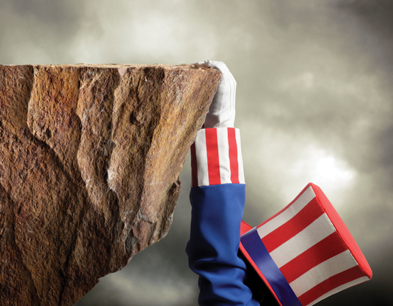
Who gets first dibs on Uncle Sam’s money? Its creditors, of course.

Uncle Sam hangs on for web
By Steve Brawner
© 2015 by Steve Brawner Communications, Inc.

Question: If the federal government were to reach the point where it couldn’t pay all its bills, who should be paid first?

A. Soldiers
B. Veterans
C. Investors, domestic and foreign, to whom the U.S. government owes money.

If you answered “C,” then you would agree with 24 Republicans on the House Ways and Means Committee. They voted last week to advance legislation that would allow the government to keep borrowing money to pay U.S. Treasury bond investors, even if the government reached its supposed debt limit. Payments to Social Security’s trust funds also would continue.

Unfortunately, all 25 of you would be right. The 15 Democrats who make up a minority of the committee voted no, but that’s politics. If the majority and minority roles were reversed, then the Democrats likely would have done what is necessary to keep the U.S. from defaulting on its obligations for the first time ever.

The topic has come up because Congress once again is approaching one of those entirely foreseeable and often manufactured financial crises that threaten the economy and cause the world to question if the United States still knows what it’s doing.

This time, the federal government will exhaust its ability to borrow money in late October, which means it would reach its debt limit in the weeks that follow. Supposedly, that would mean the government couldn’t create more debt. In reality, it just would mean the government temporarily would stop paying its bills – which, of course, would have to be paid later.

That probably won’t happen. What will probably happen is what almost always happens: In Washington, they’ll posture and threaten and argue right up until the last minute, each side accusing the other of “kicking the can down the road,” the most overused cliche in politics these days. And then they’ll pass some measure that keeps the government running for a while – probably until after the November 2016 elections. And then we’ll be stuck wherever that can stopped rolling.

So why even consider that bill approved by the 24 Ways and Means Republicans? The United States government is considered a very safe investment, which is why taxpayers are paying very low interest rates on the $18.2 trillion national debt. Investors – everyone from middle class Americans to the Chinese government – reason that if anyone will pay their money back plus a little interest, it’s Uncle Sam.

What would happen if investors started to doubt that? A U.S. government default would rattle world markets. Meanwhile, interest rates on the debt would rise because investors would see Uncle Sam as more of a risk and would demand a higher return. More of your tax dollars would go into the pockets of investors, domestic and foreign, to pay for the debt the government has already incurred. Less would be available for soldiers and veterans.

Bad things happen when you don’t pay your bills.

At some point, this nonsense must stop. It’s time for the country to stop tiptoeing up to these fiscal cliffs like a teenager trying to scare his girlfriend, One of these days the rocks will be less steady than they seem, and then … well, let’s not be too dramatic. Let’s just say the kid slips several feet down the slope, sprains his ankle, and barely makes it back up the ledge where his soon-to-be ex-girlfriend is waiting.

There’s a simple reason why this keeps happening: Because the voters tolerate it. In fact, they reward it. Members of Congress know that playing these games probably won’t cost them an election. They can always blame the other party and say they did their best as part of a dysfunctional institution. Voters don’t really expect them to do differently. Meanwhile, if they were really to try to balance the budget – by some combination of spending cuts and tax reform that would increase revenues – they’d risk being voted out. Voters like their government programs, but they don’t want to pay for them.

Ultimately, the investors who are financing the national debt will get their money. So will soldiers and veterans, though not enough.

Also pretty certain is that the costs will be passed on to our children and grandchildren. Kids don’t vote, and they don’t donate money to campaigns. They depend on older generations to look out for their interests.

We’ve all apparently decided not to vote for that.

Laws can’t fix tattletale nation

By Steve Brawner
© 2015 by Steve Brawner Communications, Inc.

“This is America. You’re going to be offended,” said my 13-year-old daughter and political philosopher.

Good thing she’s figured that out at 13. Can the rest of us?

Maintaining a peaceful society based on the rule of law is hard, which is why our Constitution includes very clear phrases such as these from the First Amendment: “Congress shall make no laws respecting an establishment of religion, or prohibiting the free exercise thereof.”

Unfortunately, such clarity only solves so much because societies are complex organisms made of complex people. This country values separating church and state but has a Judeo-Christian heritage – one that’s fading, which is troubling to many people, but it still matters. So what’s important to some is not important to others – or it may even be seen as a threat.

Moreover, how do you balance the bedrock guarantees of the First Amendment with those of the Fourteenth, which declares that no state shall “deny to any person within its jurisdiction the equal protection of the laws”? Lately, courts seem to be leaning toward the Fourteenth, even if it means violating the First.

So this is hard, and it will probably keep getting harder, as this past week has shown.

The obvious example from a national perspective is Kim Davis, the Kentucky county clerk who briefly went to jail rather than issue marriage licenses to gay couples.

Actually, this particular one was easy. A government magistrate receiving a government paycheck ($80,000 a year, in this case) must enforce the government’s laws. Otherwise, a police officer (or a president) could pick and choose which laws to enforce, which would be bad, right? If those laws so violate the official’s conscience that she can’t do her job, then she should resign, as did Cleburne Country Clerk Dana Guffey, who much more quietly left her job of 24 years earlier this year.

Where it gets harder is when it’s about private businesses such as bakers and wedding photographers. In Arkansas, those professions currently can’t be required to participate in a religious ceremony that violates their religion, but that could be changed by a legislative act (fat chance for now) or an unfavorable court ruling (looking more likely, eventually).

Fayetteville tried to settle the issue this past week. There, voters passed an ordinance prohibiting discrimination against gay people in many circumstances. The measure passed handily with support from the Chamber of Commerce after a similar one had failed with the Chamber opposing it, saying it was unclear. But the new measure may conflict with a state law passed earlier this year. Opponents sued after losing the election, so it’s not settled yet.

Meanwhile, Arkansas is dealing with another dispute – this one over a legislatively approved, privately funded monument to the Ten Commandments on the State Capitol grounds. Legislators who approved the monument argued that the Commandments are an important, historical basis of the law.

What has followed was entirely foreseeable. A group of Hindus requested a monument to their religion. Now Satanists want to erect a huge statue of a goat-like figure.

So we’re back to the issue posed at the beginning of this piece. What do you do in a country that values freedom of all religions but whose history is tied most closely to one of them, which is becoming less dominant? Accommodate only religions that the majority, for now, deems acceptable? Accommodate all, so that the Capitol grounds are littered with monuments? Try to push faith out of the public square entirely, and then squeeze it into houses of worship and tell it not to come out? When you value separating church and state, what do you do when the state is in so many places?

I don’t have the answers. I know this: Regardless of whether it’s a constitutional interpretation, as with the Kentucky case, or a state law, as with the Ten Commandments, or a local ordinance, as in Fayetteville, it’s impossible to codify into law a system that ensures that no one ever has to be exposed to beliefs and lifestyles with which they don’t agree. At some point, there has to be some give and take in our complex society. There is no legal remedy if this is going to be a nation of touchy tattletales running to the teacher over every issue.

This is America, after all, and we have to be willing to be offended.