
Drivers, can you spare a dime?

By Steve Brawner
© 2015 by Steve Brawner Communications, Inc.

Considering a gallon of gasoline is now $2 less than it was not long ago, is now the time to raise gas taxes a dime? Some say yes, if the state is committed to maintaining its highways. Others say no, including legislators and, in a recent poll, a clear majority of Arkansans.

Here’s the problem. Highways traditionally have been funded by the people who use them – drivers of passenger and commercial vehicles through gas and diesel taxes. However, those taxes have remained the same for a long time – effectively cut, actually, because they were not indexed to inflation. The federal gasoline tax of 18.4 cents per gallon has been the same since 1993 even though it costs more to maintain highways. The state gasoline tax of 21.5 cents per gallon hasn’t changed since 2001.

Inflation isn’t the only issue facing the Arkansas Highway and Transportation Department. Since 1993, vehicles have become more fuel efficient, which means drivers pay less in fuel taxes to drive on roads that are becoming more expensive to maintain. Because continuing to increase fuel efficiency is a national goal, the entire transportation infrastructure is funded by a revenue source that is destined to decline.

Even members of Congress agree this is a problem, though they can’t agree on a solution. The federal Highway Trust Fund, which funds 70 percent of Arkansas highway construction, is being kept on life support by yet another one of those half-baked measures passed this summer at the last minute that merely postpones a difficult decision. Faced with a similar situation last year, Congress paid for one year of spending by borrowing from the next 10 years’ worth of revenues. That year is over, and now Congress is trying to find a longer term solution on a short deadline. Its recent track record doesn’t inspire confidence.

In Arkansas, a bill this year by Rep. Dan Douglas, R-Bentonville, would have dedicated to highways the taxes collected from sales of new and used cars. Those taxes currently go into a big pot that pays for a lot of other things. The bill passed a House committee but then went nowhere. Gov. Asa Hutchinson was opposed, as were a lot of other interests funded by that big pot.

Hutchinson did, however, appoint a task force that has been trying to craft a solution. One idea by the Arkansas Good Roads Foundation, a business group, would increase fuel taxes by 10 cents per gallon and then gradually shift new and used car sales taxes to highways, with the fuel tax lowered back to current levels as that shift occurs.

Some legislators, including Douglas, say a fuel tax hike isn’t going to happen. Legislators won’t support anything that looks or even smells like a tax – not even a dime, and not even when fuel prices are low.

They’ve been hearing from their constituents, who voted for a half-cent sales tax for roads three years ago and don’t want to pay more taxes. A recent poll by the Arkansas chapter of Americans for Prosperity, an anti-tax group, found that two-thirds of Arkansans said fixing the state’s highways is a crisis (16 percent) or a major problem (50 percent). But almost that same percentage oppose raising the gas tax. In fact, 45 percent strongly oppose it. Half said a legislator’s support of a gas tax increase would make them less likely to vote for them.

In other words, they’re saying, “Fix the roads, but take the money from state government’s big pot – or at least, some other pot besides mine.”

There are other partial solutions. Only about two-thirds of state highway taxes go to state highways; most of the rest goes to city and county roads and some unnecessarily to state government administration. That formula certainly could be tweaked. Moreover, the state maintains a lot of highway miles that are really local arteries, such as busy Cantrell Road in Little Rock. There’s talk of letting cities and counties assume some of those responsibilities. Guess who’s opposed to that?

There’s one other argument: Some say enough money is devoted to highways, but it’s going to the wrong places. Some legislators say the money should better follow the cars.

That solution may not be affordable, either. Maybe the Highway Department should focus on maintaining what it has and let the cars follow the roads that are already laid. Those roads might be crowded, but at least they would stay paved, and paid for.

The private option ink blot

By Steve Brawner
© 2015 by Steve Brawner Communications, Inc.

You know those tests where therapists ask clients to describe an ink blot because people see what they’re inclined to see? This week, legislators were given a 450-page one.

That would be the report by The Stephen Group, the consulting firm hired by the Health Reform Legislative Task Force to help it decide what to do about the private option in particular and Medicaid in general.

Here’s the ink blot part: Legislators who support the private option can be encouraged by the report because it recommends changing it but not ending it. Meanwhile, opponents can point to a finding that 43,000 people served by Medicaid and the private option may not live in Arkansas, while the programs combined enroll 500 people who are deceased.

Here’s the background. Medicaid is the government health program serving the poor, the disabled, and the aged who live in nursing homes. It’s mostly but not entirely funded by the federal government and mostly administered by states. The Affordable Care Act, which created Obamacare, expanded Medicaid in all the states to cover more lower-income people. In 2012, the Supreme Court ruled that Obamacare is constitutional but that the Medicaid expansion must be only voluntary. Many states said no.

Arkansas created the private option. Instead of expanding Medicaid, it uses those dollars to buy private health insurance for Arkansans not covered by Medicaid and having incomes of no more than 138 percent of the federal poverty level. Republican legislators had the idea and worked with then-Gov. Mike Beebe, a Democrat, to implement it.

In some ways, it’s been a success. It’s currently serving about 200,000 Arkansans, give or take tens of thousands because the state is in the process of redetermining eligibility. According to a Gallup poll, the state’s uninsured rate fell from 22.5 percent in 2013 to 9.1 percent during the first half of 2015. That’s the best in the country, and the private option was a big reason why. Without the private option, hospitals would provide $1 billion in uncompensated care from 2017-21, according to the report. The private option is bringing $1 billion in federal funds to the Arkansas economy every year.

But that’s still a billion dollars in taxpayer money, opponents say, which increases the national debt. While the feds are paying for all of it now, Arkansas will be responsible for 10 percent of the cost in the next few years. It was supposed to serve the working poor, but 40 percent of its beneficiaries had no income last year, so it’s still a health care entitlement program. It’s still Obamacare.

The private option was created in 2013. It must be approved by 75 percent of legislators each year. It barely passed the first time and barely survived in 2014. We can’t keep doing this. So this year, Gov. Asa Hutchinson asked legislators to extend the private option through 2016 while it created the task force to decide what to do next.

Back to the ink blot. The small consulting firm found what the state’s huge Department of Human Services could not: 42,891 Medicaid and private option beneficiaries whose best addresses appear to be located out of state, including 3,220 whose best addresses are in California. Almost 500 on the rolls were dead before they even became a part of the program.

It’s unknown how much of this represents waste and abuse. It’s unclear how many actual dollars are going to the wrong places. A program this big will have challenges with its mailing list. Some people with California addresses may have moved to Arkansas recently.

Still, private option opponents can point to this report and say they were right all along, that government can’t do anything correctly, and the private option should be scrapped.

But the report didn’t recommend that. Instead, it said the private option should be retooled to become more of a transitional program that encourages work and personal responsibility – which, supporters would say, was the plan all along. Participants should look for work and meet health and wellness goals. Legislators might consider limiting participation in the private option to a few years. Meanwhile, the state should create an office that monitors the eligibility of all Arkansans seeking state services, including the private option.

Members of the task force must make their own recommendation by the end of this year. Will they vote to end the private option, or change it? It depends on what they see in the ink blot.

Cuba: Carrots and sticks

By Steve Brawner
© 2015 by Steve Brawner Communications, Inc.

There are two ways in politics to change behavior: power and influence. Power is the stick – using your greater strength to make someone do what you want them to do. Influence is the carrot – encouraging them to want to do it themselves. Sometimes you use both.

We’re somewhere in the middle of all that when it comes to Cuba, as shown in recent weeks by Arkansas’ political leadership.

As a congressman, Gov. Asa Hutchinson supported the Cuban embargo, and as undersecretary of the Department of Homeland Security he was part of an administration that enforced it.

But American policy – and American attitudes – are changing. This summer, President Obama announced the two countries were re-opening diplomatic relations that had ended in 1961. Many people who usually disagree with him don’t this time, including many Arkansans. The U.S. embassy is now open there, though the 55-year-old trade embargo will remain until Congress ends it.

Last week, Hutchinson returned from a trip to that island nation saying it’s time to gradually end the embargo as Cuba modernizes its economy and politics – especially when doing so would give Arkansas’ rice, poultry and pork producers access to a large, nearby market.

Hutchinson is hardly alone in this viewpoint. Traveling with him were business leaders from Tyson and Riceland Foods; Randy Veach, president of Arkansas Farm Bureau and a Mississippi County farmer; Dr. Donald Bobbitt, president of the University of Arkansas System, and others. In June, the Arkansas State Chamber of Commerce coordinated a trip to Cuba for about 40 Arkansans.

Two other Arkansas political leaders have been outspoken in support of more open relations with Cuba. Sen. John Boozman has passed through a Senate committee a bill that would allow goods to be sold to Cuba on credit rather than cash only, which is a challenge in an impoverished nation. He also is co-sponsoring the Freedom to Travel to Cuba Act, which would loosen travel restrictions but hasn’t moved much since its introduction. Rep. Rick Crawford, whose eastern Arkansas 1st District depends on agriculture, also supports opening up trade with that country.

On the other side is Sen. Tom Cotton, who opposes ending the embargo. He says a change in policy only rewards a dictatorship that hasn’t changed itself, and won’t have to change because it’s being propped up by trade with the United States. Cuba must become freer first, he says.

So Hutchinson, Boozman and Crawford’s position could be summarized as, “After 55 years of mostly stick, it’s time for more carrot.” Cotton’s position is, “Stick with the stick. The carrot becomes available if Cuba changes.”

Power is the language everyone understands, and sometimes it makes sense to use it. It’s not possible to come and reason together with the ISIS beheaders in Syria and Iraq. However, power should be focused on threats, which Cuba no longer is now that it’s lost its Soviet benefactor. Now it’s just a poor country with a population of 11 million – 1/29th the size of the United States.

Exercising influence is softer, subtler and harder. Sometimes the effort merely masks weakness, sometimes it can be an excuse for inaction, and sometimes it fails miserably. But it can do things that power alone can’t always do. Through influence, people enact permanent change because they realize it’s unquestionably in their best interest, not because they are trying temporarily to avoid the pain you inflict.

Consider what a more open relationship with Cuba would bring. American companies would flood the island. Local entrepreneurs who under communism have eked out a living through their wits would use their talents to become job creators. When 84-year-old Raul Castro dies or steps away from power, his successor will face great pressure to continue raising Cuba’s living standards. Because an international business can’t be run without the internet, Cuba will become increasingly wired, and, unlike China, it won’t have the means to control it. Missionaries will descend on that hungry Caribbean nation 90 miles from Florida’s Key West. Churches will sprout, as they have throughout China, and the Cuban government will not be able to stop it even if it tries.

Hutchinson, Boozman, Crawford and Cotton all want Cuba to reach that place. They only disagree about the right path. Stick with the stick? Or offer some carrots – and rice, and poultry, and pork, and ideas?

Congress gets an “F” in finances

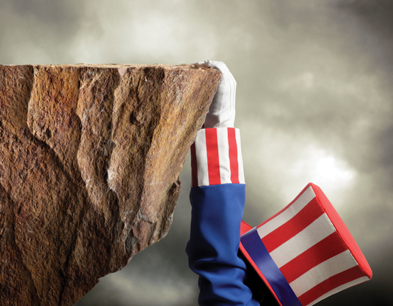
Uncle Sam hangs on for web
By Steve Brawner
© 2015 by Steve Brawner Communications, Inc.

This might only be early October, but for Congress, the fiscal year ended Sept. 30. If it were a school year, what kind of grade should Congress receive?

In math, probably an F.

In fiscal year 2015, the government spent $426 billion more than it collected, adding to a national debt that has now reached $18.2 trillion.

Congress should be looking for ways to improve those numbers. Instead, as pointed out by the Committee for a Responsible Federal Budget, this year it increased deficit spending over the next 10 years in a variety of ways.

Meanwhile, when it comes to its most important assignments, Congress gets an incomplete. The federal government is supposed to be funded through 12 appropriations bills dealing with various areas of spending. The 2016 fiscal year has started, and so far the House has passed six, and the Senate has passed zero.

Because the government has to be funded somehow, Congress this week passed a continuing resolution, which basically keeps things as they are. That’s a problem when the status quo is a $426 billion deficit. This latest one will keep the government functioning until December – just before an election year – when Congress probably will pass another last-minute deal that doesn’t solve much long term.

On some assignments, Congress didn’t score an incomplete, but it was tardy. It waited until Dec. 19, 2014, to extend a series of tax deductions that had expired at the end of 2013, which meant businesses and individuals spent the entire year uncertain if those deductions would continue. Waiting so late defeats the theoretical purpose of having deductions, which is to encourage behavior that is good for the economy.

Unfortunately, there is no way to hold back Congress a year until it learns the material. It must be promoted to the next grade, where it will face ever-growing challenges.

There are two ways of measuring the debt: the total debt; and the debt held by the public, which doesn’t include what the government owes itself as a result of activities such as raiding the Social Security Trust Fund. The total debt is $18.2 trillion. The debt held by the public is $13.1 trillion.

The second figure is 74 percent of the gross domestic product. That’s the highest it has been since World War II. Historically, since 1965 the average has been 38 percent.

How do we get back to just being average? The Committee for a Responsible Federal Budget says that, taking the long view and setting 2040 as a goal, lawmakers should reduce total deficits over the next 10 years by $5 trillion. That puts the country on a path to 38 percent. But remember, Congress actually made things worse this past year, not better. So it’s not headed in the right direction.

In the short term, Congress must make some tough decisions quickly. In December, the government reaches the debt limit, which by law sets a ceiling on how high the national debt can go. Ultimately, the limit will be raised. The government can’t just stop going into debt without changing its habits any more than you and I can. Over the next couple of months, Congress’ assigned project is to raise the debt limit responsibly by tying it to meaningful reforms. If it does that, it gets a passing grade. If it does what it usually does – bicker until the last second and then pass the buck – it flunks the test again.

It’s students’ fault when they fail to learn the material, but it’s also the schools’ and the parents’. Elected officials are failing to complete their assignments. However, the classroom where they operate makes success almost impossible. The two-party duopoly, campaign finance laws, the filibuster, political consultants, the media environment – they’re all conspiring to turn Congress into an unworkable institution. The Founding Fathers rightly designed a government that was not meant to run smoothly. In today’s political climate, it’s often not running at all.

Meanwhile, kids tend to do what their parents will allow, and certainly what their parents encourage. If voters demanded fiscal responsibility, then even the most ill-behaved members of Congress would oblige, and even this imperfect system could be made to work.

If that were to happen, there wouldn’t need to be a group called the Committee for a Responsible Federal Budget. We’d already have one, it would be composed of 535 members, and it would have a different name: Congress.

Why the GOP loses in a shutdown

By Steve Brawner
© 2015 by Steve Brawner Communications, Inc.

There’s been talk of two potential government shutdowns: one this week over funding Planned Parenthood that’s probably not going to happen, and one in December if the government reaches the debt ceiling. Whenever a shutdown occurs, Republicans will be blamed more than Democrats. That’s because of the brand Republicans themselves have created.

Branding is the process of creating a simple identity for a product, service or idea. It involves the entire organization’s efforts, from the product itself to the packaging to the advertising. Done correctly, it produce a powerful association with certain values and lifestyles (think Harley Davidson), overcoming temporary obstacles and even contrary facts.

How powerful is branding? At the beginning of the computer revolution, Apple branded itself as the company that sold easy-to-use personal computers. Its business model, however, was inferior to Microsoft’s, which copied Apple’s products and then made them widely available through Windows and Office. Apple almost went out of business.

Then Apple began a marketing campaign based on two words, “Think Different,” and introduced a series of revolutionary products and services, including the iPod, iTunes and the iPhone. In each case, Microsoft offered the same things, but none of them enjoyed great success. By then Apple didn’t just sell computer products; it sold thinking differently, while Microsoft just sold Windows and Office. Apple now is the world’s largest tech company.

But branding can backfire, as is currently the case with McDonald’s. For decades, McDonald’s branded itself as the place for a fast, inexpensive, tasty meal. It was the restaurant for families and kids. Its spokesman was a clown.

That brand still works with a lot of Americans, but for many, including many younger consumers, what once was considered inexpensive is now just cheap, and what once was considered a treat is now just fattening. Many American consumers would rather spend $8 for a better hamburger than spend $5 for a Big Mac. McDonald’s has tried to offer an upgraded menu, but it hasn’t caught on. If you have $8 to spend, you don’t spend it at McDonald’s.

Since 1980, Republicans have been better at branding than Democrats. Their message – “Less government” – fits neatly on a bumper sticker. Democrats, on the other hand, have been unable to sum up their message so succinctly. They don’t want to say they support a more activist government, so instead they’ve often simply branded themselves the “not Republican Party.” They need a better message. But that’s another column.

Whenever the government shuts down, it’s the result of decisions made by both parties. If the government were to shut down this week – which, as of this writing, it probably won’t – it would be because the Republicans forced the issue over Planned Parenthood. But Democrats also would be at fault. Republicans last week offered legislation that would run the government without funding Planned Parenthood, and Democrats blocked it.

But because of the two parties’ brands, whenever the government shuts down, casual observers of course will blame the Republicans. Who else would shut down the government but the anti-government party? Why would the Democrats shut down something they support?

At first, government shutdowns don’t have much of an effect. National parks close, but Americans can live without them for a while. Paychecks aren’t sent, so government workers take a few days off.

Over time, however, shutdowns start to sting. Paychecks are missed. National priorities go unfunded. Families cancel their once-in-a-lifetime trip to Washington, D.C., because the museums are closed. Credit agencies talk about downgrading the government’s rating. While anonymous members of Congress bicker from their little seats, the president steps off Air Force One and tells them it’s time to do their jobs.

Eventually, the anti-government activists capitulate, forced to concede that Uncle Sam really is necessary. The whole thing inevitably ends as a victory for big government. Then the blame games start.

A year before the election, voters would blame Republicans more than Democrats. Hillary Clinton’s campaign would tie the GOP nominee to the effort, knowing that, in the voting booth, casual voters tend to choose the party they think is least crazy.

So if Republicans force a government shutdown any time this year, they might as well call their efforts the “Hillary Clinton Employment Act.” When you’ve branded yourself the anti-government party, then you can’t use a government shutdown as a tactic. It looks a little clownish, which, as McDonald’s will tell you, isn’t working so well right now.