
What if the Republicans can’t pick a winner?

By Steve Brawner
© 2015 by Steve Brawner Communications, Inc.

In order to win the Republican nomination for president, one candidate must amass 1,144 delegates. What if no one does that?

That’s a possibility – not a probability, but a possibility – with 17 candidates splitting the vote. If that were to happen, the nominee would be chosen at the Republican National Convention in July. Instead of a boring speech-a-thon in Cleveland, such a “brokered convention” would be marked by candidates courting delegates and making deals.

Pundits bring up this possibility every election cycle, and every election cycle it doesn’t happen. The 2016 elections, however, could be different because of the number of viable candidates, their geographic distribution, and the resources available to them. The 17 candidates hail from 14 states, where many have strong political organizations. Meanwhile, because of the Supreme Court’s Citizens United decision removing many donor limits, candidates can stay in the race longer than in the past because they need only a few big contributors to pay the bills.

So here’s a possible scenario. Donald Trump or Dr. Ben Carson wins Iowa Feb. 1. Then Trump or former Florida Gov. Jeb Bush or Ohio Gov. John Kasich wins New Hampshire Feb. 9. Then on Feb. 20 comes South Carolina, home state of Sen. Lindsey Graham, who’s currently polling at only 5 percent there – far behind Trump, who has a big lead over everyone.

Then comes Nevada Feb. 23 and then the big one, March 1, when delegates are selected in about a dozen states, including Arkansas as part of a bloc of Southern states known as the “SEC primary.” Sen. Ted Cruz could be the big winner that day if he wins his home state of Texas and does well elsewhere in the South, while Gov. Mike Huckabee should win Arkansas. Four days later, Sen. Rand Paul could win his home state of Kentucky while struggling Gov. Bobby Jindal will try to turn things around and win his home state of Louisiana.

By that point, there’s usually a mass exodus from the race, leaving a clear front-runner with some diehard challengers. But candidates who have won a state will be able to tell their supporters (and themselves) that they can still win, so many may still be running.

Moreover, the campaign calendar and the party’s rules could give some candidates a reason to continue. Before March 15, most of the states will have awarded their delegates on a proportional basis. In other words, a candidate who wins 50 percent of the vote wins half the state’s delegates. Starting March 15, states can award their delegates on a winner-take-all basis, which is a big advantage for three candidates from big states whose elections occur that day: Ohio’s Kasich, and Florida’s Bush and Sen. Marco Rubio. If Bush loses Florida, he’s out.

By the end of that day, more than half the states will have had their primaries and caucuses. It’s conceivable that so many candidates will have won delegates that no one will have a big lead. From that point, it could be a long three months before June 7, when primaries are held in California, home state of former Hewlett-Packard CEO Carly Fiorina, and New Jersey, home of Gov. Chris Christie.

If 2016 is like previous elections, the race will be over before then. Someone will be on the way to a coronation, and the challengers will have dutifully given their endorsements.

Could that be Trump? Sure. Currently, he maintains a large lead that seems to get bigger whenever he says something controversial. Big poll numbers nationwide don’t necessarily translate to winning one state at a time – but he’s winning now.

I’ve always expected that Republican leaders eventually would pressure lesser candidates to leave the race so the party could coalesce behind an “anybody but Trump” alternative. But a recent poll by SurveyUSA found him beating not only Hillary Clinton but also other Democrats. At some point, Republican voters must seriously ask themselves if he’s really their best choice. But for now, he’s looking more and more legitimate, so instead of trying to stop him, the party may have to ride this wave wherever it goes.

Which could be all the way to a brokered convention in Cleveland. If that’s the case, there would be a lot of back room politics and dealmaking. And which of the candidates is the best at making deals? Trump, supposedly.

Confessions of a journalist

By Steve Brawner
© 2015 by Steve Brawner Communications, Inc.

I’m going to let you in on a secret: There is no media conspiracy.

Certainly there’s not one in Little Rock, where I spend a lot of my time, and I’m pretty sure not elsewhere, either. Bigwigs with CNN, Fox News, and the New York Times do not gather in a smoky room to decide what to propagandize and what to hide from the American people.

What there are, are tendencies. And I’m going to confess to some of them.

We journalists often suffer from a herd mentality. We chase after the same people, sometimes literally. We choose what to cover based on what other journalists cover. We worry too much about what other journalists think.

We’re too close to the people we cover, and not close enough to you. We try to keep our distance from the politicians – they’re not our friends – but sometimes we like them, which shows in our reporting. Sometimes, in fact, we take jobs working for them, as I have twice. If we don’t like them, it can affect our reporting as well.

Being part of an insider culture affects our priorities. Who’s up, who’s down – it becomes too important to us, so we’re writing about the latest poll while you want to know about what’s actually in the Common Core.

We’re often in too big of a hurry. There’s pressure to get stories on the web or on the air before others do. In some ways this is good, because consumers get the news fast and because it forces reporters to get to the point quickly. But it also leads to mistakes and shallow reporting.

It also weds us to writing formulas. A story often is composed of a lead (spelled “lede,” for some reason), a few explanatory paragraphs, a quote from one side, a quote from the other, and then a rewrite of yesterday’s story beneath it.

We’re biased. Of course we are. Everyone has a way of looking at the world, and that includes journalists (and readers and viewers). Most journalists are liberal, though that’s not necessarily so in Arkansas.

Journalists often try to overcome their biases, but sometimes not hard enough. Sometimes those biases are obvious, but sometimes they show up in more subtle ways based on what’s important to us. For example, I really care about the national debt, so if there’s an opportunity, I’ll work it into an article, perhaps by pointing out that it’s grown from $1 trillion in 1980 to $18 trillion now. See how I did that?

Here’s a big one: We’re dependent on our advertisers. We provide a service that you, the consumer, expect to be free or very cheap. Advertisers are who really pay for our time and expenses, and that leads to compromises. Some things don’t get reported. Many journalists may be liberal, but big business rarely is.

So why would you trust anything you read in this newspaper after reading this column? Judge it by its own merits. Read the front page stories from beginning to end, and you’ll probably find most are presented fairly and objectively. Flawed human beings produce them, but nobody wants to be called a hack, and there are processes and pressures that encourage balance. That probably can’t be said for some guy’s internet blog.

The media is governed by what governs most industries in America: competition. On the negative side, the winners of this competition are often those best able to get news consumers’ attention through sheer loudness and by appealing to their biases and fears. On the plus side, news providers compete to be the first and best at informing the public about important things.

That’s why stories like Hillary Clinton’s emails are reported – so people can decide for themselves if they want to to vote for her. In fact, the media has covered in depth many stories that have made it less likely she will be elected: Benghazi, Whitewater, and, of course, Monica Lewinsky. You think you don’t like the mainstream media? Clinton probably hates it. If there’s a conspiracy to elect her, it’s an inept one.

News consumers today have access to enormous amounts of information, some of it very bad and some of it very good. When you have enough time and interest, you often can watch the actual speech, study the actual report, or read the actual bill.

When you don’t, there’s the media’s summary, flawed as it may be. There’s no conspiracy among reporters, but they have many tendencies. Be aware of them. I am.

Flustrated America

By Steve Brawner
© 2015 by Steve Brawner Communications, Inc.

You hear people say the word “flustrated” sometimes. Is that a word? It should be.

English needs a word that blends “flustered” and “frustrated.” “Flustered” means “confused,” while “frustrated” means you’re angry about something you can’t accomplish or control.

So what if you’re both angry and confused about it? Then you’re flustrated.

Times of great, rapid change can leave a lot of us feeling that way. In recent years, the economy has shifted from a manufacturing economy, to a service economy, to an information economy where many jobs are best performed overseas or by automation. Workers, no longer able to grow their own food or fix their own cars, have been forced to adjust in order to be a small cog in a giant machine. That’s flustrating.

The character of American demographics is changing as well. Since 1950, the population of the United States has doubled, according to the Census Bureau. Eight percent of us then were 65 years and older, compared to today’s 14.1 percent, a number that is rapidly growing. Back then, immigrants were twice as likely to have come from Europe as from this side of the Atlantic, and half of those from this hemisphere came from Canada. Today, the United States has the second highest Spanish-speaking population in the world, after Mexico. That’s not necessarily a bad change, but it is a big one.

Values are changing, too. A woman in 1950 was 27 times more likely to be married than to be divorced. Today, more than half of all women under age 30 who are giving birth aren’t married. Earlier this year, the Supreme Court ruled that couples of the same sex have the right to marry, only a few years removed from some 30 states passing laws making gay marriage illegal. On these important issues, Americans simply don’t see eye to eye, and that can be flustrating for all of us.

While the definition of “marriage” is changing, so is the definition of “community,” which once referred to geographic proximity. Few of us had access to the internet 20 years ago and none of us owned an iPhone in 2006. Today, “friend” is a verb and it’s something you do on Facebook. We can connect with people all over the world but no longer know our neighbors.

These rapid changes can leave us flustered and frustrated. We want some of those old definitions back – the ones we understood – but the consensus has broken down. The American conversation has become one big argument that hardly anybody ever wins. Try as we might, we can’t make the world in our image.

Amidst all this, we don’t even know who to be mad at, or to fear. During the Cold War, Americans could unite against a single enemy that was easy to find and was as scared of us as we were of it, and for many of the same reasons. Today, the enemy can be ISIS in the Middle East or a hacker in China.

But we’ve got to blame somebody we recognize, right? So it’s all the president’s fault, or the Democrats’, or the Republicans’, or the media’s, or the rich’s, or the poor’s. We create conspiracy theories to explain which individuals are really in charge because the reality is harder to accept – that no one is, at least no human being, and that if something really goes wrong, none of us knows how to fix it.

To some degree, this flustration is reflected in the Republican presidential campaign. Donald Trump is a lot of things, but flustrated he is not, though he certainly is flustrating Jeb Bush and some of the other conventional candidates. For many voters, Trump offers an alternative to a system that has both angered and confused them. It’s no coincidence that he has been joined at the top of the latest Iowa poll by Dr. Ben Carson, another nonpolitician, each with 23%, while former Hewlett-Packard CEO Carly Fiorina was third with 10%. In fact, those three candidates who haven’t been part of the political system together are polling higher than the 14 candidates who have been.

How to deal with such a time as this? One option is simple humility. What if I admitted I can’t understand the world, much less decide how it all should work? I might focus on what I can understand and control. I might grant a little mercy to those who see things differently.

I’d definitely be less flustrated, if that’s a word.

Squashing the wrong problems

By Steve Brawner
© 2015 by Steve Brawner Communications, Inc.

You know when you’re on your porch, and you notice a spider crawling by, but then you look closer and realize it’s not a black widow or a brown recluse, so it’s not poisonous, but then you wonder if maybe you could be wrong, so therefore it could be a threat, and plus it’s a nuisance? Those things multiply, and maybe they’ll get into the house, so you squash it just to be sure.

That’s kind of what the state’s establishment has done to independent candidates in Arkansas.

This past week, District Judge James Moody ruled in a case, Moore v. Martin, in favor of a 2013 law that requires independents to submit their required signatures – 3 percent of the voters in the last election, or 10,000 in statewide races – to the secretary of state by the end of the filing period. In a typical year, that’s the beginning of March.

Before the law was passed, independents could file at the same time as Democrats and Republicans and then collect their signatures while party candidates were campaigning for their May primaries.

The practical effect of the new law is that independents can’t survey the landscape like party candidates can do and then jump in the race. They must have already gathered their signatures to qualify for office by the same deadline that major party candidates sign up to run. They have to be walking the streets months in advance asking people to sign a petition. And instead of walking those streets in March and April as before, they now have to do it in January and February.

Except not this coming election. Because the Legislature moved next year’s primary elections to March 1, the filing deadline this year is Nov. 9. Independents have only 90 days to collect signatures, which means they would have to be beating the streets now for an election that won’t occur until November 2016.

The lead plaintiff in the case, Mark Moore of Pea Ridge, who ran for the state Legislature in 2012 as an independent, filed suit. Judge Moody agreed that the law creates a burden for independent candidates, but he accepted the state’s argument that it’s too difficult to verify those signatures in time, considering all the other things the state must do in an election cycle.

Which is a stretch. In 2014, there was one independent candidate for the Legislature, requiring the secretary of state’s office to verify only hundreds of signatures. In 2012, before the law was passed, there were seven. There’ve been a few other independent candidates run for other offices, but not many. Meanwhile, the secretary of state’s office will verify 67,887 signatures for each voter initiative and 85,859 signatures for any constitutional amendment that will be on the ballot in 2016.

What independents usually are is a nuisance for the establishment. In a given election, combined they represent a few thousand signatures that the secretary of state’s office has to verify. Meanwhile, for the major party candidates, they’re a variable they’d rather avoid dealing with. They’d rather just have one opponent, if it can’t be none.

I wish the halls of the Legislature and the Congress would become infested with independents scurrying around doing the people’s business without regard to party politics. But that’s not going to happen. Despite George Washington begging us to do otherwise, we’ve created a political system that almost guarantees that candidates will be a member of one of two parties. That’s the way it’s been for more than 200 years.

So why even bother with independents at all? Because there needs to be an option for candidates and voters who don’t agree with the two big parties or any of the smaller ones. The other reason is because the system needs an occasional nuisance – in fact, sometimes even a threat.

In the 1992 presidential campaign, Ross Perot won 19 percent of the vote campaigning as an outsider on one issue: the need to reduce the national debt, which at that point was $4 trillion. In the years following that election, President Clinton and Congress actually sort of balanced the budget. Was Perot the only reason? No, but he certainly helped. He changed the conversation, and 19 percent was a number even the major parties couldn’t ignore.

No candidate since then – Republican, Democrat or other – has been so effective at calling attention to the national debt. Few have even really tried. It’s now more than $18 trillion.

I think we’re trying to squash the wrong problems.

Welcome to your country

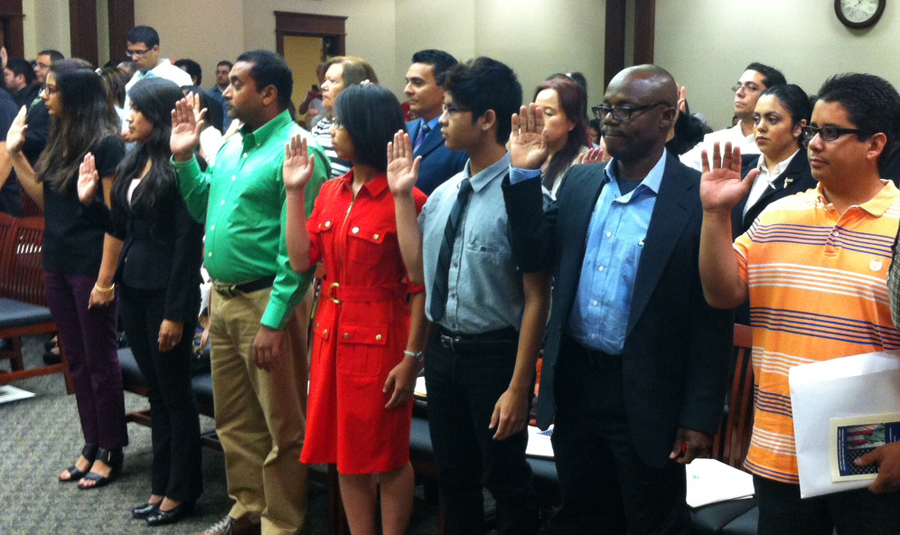
New Americans take the Oath of Allegiance in Little Rock Friday. Aristides Urdaneta is in the blue jacket with blue tie behind the woman in the red dress. Wife Jeannette is to his left.

New Americans take the Oath of Allegiance in Little Rock Friday. Aristides Urdaneta is in the blue jacket with blue tie behind the woman in the red dress. Wife Jeannette is to his left.

By Steve Brawner
© 2015 by Steve Brawner Communications, Inc.

Fifty people from 22 countries raised their right hands Friday in U.S. District Judge Beth Deere’s courtroom. Journeys that had taken decades were ending in an 11 a.m. ceremony. The participants had been examined by the Immigration and Naturalization Service, met English language requirements, and passed a citizenship test that many native-born Americans would fail. After taking the Oath of Allegiance, they were no longer from 22 countries. They were from one.

Afterwards, each came forward to receive a certificate and a small American flag, and to introduce themselves and their countries of origin. Their foreign accents ranged from thick to nonexistent. Eleven were from Mexico, including one who finished his introduction with “Woo, pig sooie.” Another said, “I’m from Egypt. No, I’m from USA. USA! USA!” Afterwards, U.S. Rep. French Hill said in a brief speech, “My fellow Americans … welcome to your country.”

Among the 50 were Aristides and Jeannette Urdaneta, immigrants from Venezuela. They came to the United States in 2003 on a work visa with their son, Kevin, now a teenager who also became an American citizen that day by virtue of his parents’ new citizenship. He’s an Eagle Scout and the state president of Health Occupation Students of America, and he wants to be a doctor someday. While in the United States, the Urdanetas had a daughter, Albanie, who will be 10 next month and is an American by birth. She’s about to join a dance company, she said.

The Urdanetas are the second and third generations in their family to escape oppression. Jeannette’s father had immigrated to Venezuela from Albania years earlier to escape its communist dictatorship. (That’s where the name “Albanie” comes from.) As socialist dictator Hugo Chavez grabbed more and more power in Venezuela, her father would predict with eerie accuracy the government’s next move based on his own experiences. “Things were getting worse by the month, by the day,” Aristides said.

In search of a better life, Aristides began looking for jobs where he could put his computer skills to work in America, Canada, Australia or Spain. The best opportunity came with CAT Squared, a Conway-based software company serving the food industry and founded by immigrants from South Africa. They spent six years under a work visa and then applied for permanent residency. Eventually, Jeannette became a Spanish teacher at Maumelle Charter High School.

By taking the Oath of Allegiance, the new American citizens declared that they “absolutely and entirely renounce and abjure all allegiance and fidelity” to their home countries.

That’s a powerful statement – to say that you’re no longer associated with the country of your birth. I asked them how difficult it was to take that step. Their Venezuelan heritage will always be a part of who they are, they said, but they’re not looking back. “We made a decision that this is our country, and we have to stand for the United States now,” Aristides said.

Yes, I asked them about illegal immigration – specifically, about their level of sympathy for those who didn’t do it the right way, like they did. They did not have an easy answer. They said it is unacceptable for people to do things illegally, but the situation is complex, and individual situations need to be considered.

From the front of the room, the 50 people taking the oath of office seemed to be a stoic group. Not many showed much emotion, although one new Ukranian-American shed quite a few tears, perhaps related to the turmoil her homeland is experiencing. I picked out Aristides because his face seemed the most joyful of anyone I saw. Both he and Jeannette said they got a little emotional. Kevin said he did, too. “I had a moment when the judge first said, ‘My fellow Americans,’ I was holding back the tears. … At that moment, I felt just all the history in my family, from oppression to freedom back to oppression back to freedom,” he said.

Albanie feels the same weight, and she has plans to do something about it. “When I grow up, what I would like to do is, I would like to get a job where I could get a lot of money and I could buy tickets for the rest of my family to move here and experience what freedom is like,” she said.

I hope she can, and I hope Kevin becomes a doctor. Welcome to your country, Urdanetas family. It’s your home now.