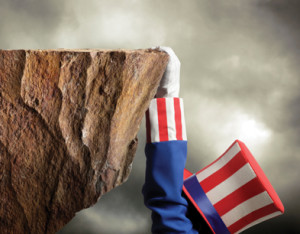
Executive orders, congressional disorder

U.S. Capitol for blogBy Steve Brawner
© 2016 by Steve Brawner Communications, Inc.

This past week saw two big news events that weren’t actually very “new”: President Obama’s announcement that he is issuing yet another executive order, this one related to gun restrictions, and Republicans in Congress voting to repeal Obamacare.

Obama’s executive order, which attempts among other things to close the gun show loophole, doesn’t seem to be that significant a policy move or even a bad proposal. Sellers should all play by the same rules, and I’m not opposed to there being one less avenue for crazy people, convicted felons and terrorists-in-waiting to be able to purchase military-grade weapons.

The problem is the process. Congress has not voted to accomplish what Obama wants to accomplish. More concerning, executive orders are becoming a habit of his, the most obvious example being his attempt to completely bypass Congress on immigration policy. That effort is now being tied up in court, where it should be. And I write that despite the fact that, as with the gun show issue, I agree with Obama in principle that the United States should focus on deporting dangerous illegal immigrants while finding a path to legalization for those who have been here awhile and are otherwise obeying the law.

But that’s another column. This is about misusing the presidency’s powers.

I guess this is the part where I’m supposed to write about Obama in hysterical, apocalyptic terms. Let’s instead have a calm, rational discussion, shall we? President Obama is exceeding his constitutional authority. He should stop doing that.

Actually, Obama is doing exactly what the Founding Fathers anticipated a chief executive would do, which is try to exercise power. They knew that was a bad thing, even if the president’s goals were agreeable.

So they included in the Constitution a system of checks and balances to keep that from happening. Congress makes the law; the president enforces the law; the judiciary interprets the law.

Unfortunately, Congress is failing to check and balance the president, and it’s time for congressional Democrats to step up.

Members of Congress are supposed to place their branch above their political parties – which, by the way, are not even mentioned in the Constitution. Throughout American history, senators and representatives have stood up to presidents who have tried to usurp their role. Instead, with exceptions, congressional Democrats today too often are behaving as if this is a British parliamentary system, where a prime minister leads the government and most everybody falls in line most of the time.

Because I’m determined to offend everyone in this column, congressional Republicans share blame as well. The system is supposed to work through a system of checks and balances, not unending dysfunction. Republicans made a political decision from the beginning of Obama’s presidency to make him fail, no matter what. It’s worked for them – politically. They’ve made huge gains in Congress, in governor’s offices, and in state legislatures. But a more constructive approach would have been better for the country.

Now we’ve had yet another vote to repeal Obamacare – one that actually will make its way to Obama’s desk, where he will veto it.

This is happening because Republicans believe it will help them in November prove once again that President Obama supports Obamacare, along with Democrats, as if there were any doubt about all that. Meanwhile, Republicans still haven’t coalesced behind a plan to replace the system they would repeal. The bill they sent to his desk would give policymakers a couple of years to create an alternative, but if they don’t, or can’t, would we all go back to the days when insurance companies denied coverage to people because of pre-existing conditions, or cut them off when they became too expensive to cover? At the moment, I guess we would.

No one’s the hero, and no one is the villain. What’s happening is that a lot of officeholders are caught up in the big game up there, which is one reason why Obama’s approval ratings are only 45 percent, according to Gallup, while Congress’ are at 13.

Anyway, it’s 2016, and time for us regular folks to vote. If we do our jobs better, maybe they will too.

What Dale Bumpers was

Dale Bumpers By Steve Brawner
© 2016 by Steve Brawner Communications, Inc.

In 1992, I interviewed the late Sen. Dale Bumpers while working my first reporting job for the Arkadelphia Daily Siftings Herald. As we sat on the hood of his gray Pontiac Bonneville outside Ouachita Baptist University’s football field, I asked him why he had never run for president despite once being included as a possible contender on the cover of Time magazine. He looked wistful for a moment, munched some popcorn, said I didn’t have enough space to print the reasons, and then talked about the strain that being president would cause for his family.

His campaign tagline that year while being challenged by future Gov. Mike Huckabee was, “What a senator should be.”

Bumpers, who died last week, would never be president. But even though I was a fan of Huckabee’s at the time and not covering the race as objectively as I should have, I remember thinking that the tagline was appropriate.

The important word in that tagline was “be,” not “do.” I can’t always agree with what Sen. Bumpers did, which is no criticism of him. For example, he voted against President Reagan’s military buildup, which many say hastened the end of the Cold War, which needed to be hastened. I buy their argument.

But more important than what Bumpers did was who he was. He was an orator and a statesman who respected the Constitution and appreciated history. Because of who he was, he took unpopular stands – against banning flag desecration, for handing the Panama Canal to the Panamanians – and then trusted that voters would understand his reasoning and be fair. Back when he was a country lawyer, he advised the Charleston School Board to obey the Supreme Court’s decision in Brown v. Board of Education of Topeka to let black students go to school with white students. Charleston became the first school district in the former Confederacy to do so.

He had common sense and understood simple math – specifically, that if you want to spend more, you’ll have to collect more. As governor of Arkansas, he increased teacher salaries, which he funded by raising taxes, not by financial trickery or by the state accepting money from Uncle Sam.

He was one of three senators to vote for the Reagan budget cuts but against the Reagan tax cuts of 1981, believing that the numbers did not add up in the midst of the defense buildup described a few paragraphs above.

Boy, was he right on that one. In 1981, the national debt, accumulated over nearly two centuries, was $1 trillion. By 1986, it had more than doubled. In the years since then, it’s grown to $19 trillion.

A big reason why is that a grand, unspoken bargain was created during the 1980s. The Republican Party had come under the spell of a theory, supply side economics, whose adherents promised that tax cuts would more than pay for themselves because of the increased economic growth they would spur. One unfortunate consequence of that thinking was that cutting government, while laudable, became not really necessary. That combination of growing government without paying for it obviously appealed to Democrats as well. No one had to make tough decisions because economic growth supposedly would fill in the gaps.

Only it didn’t. Government spent more, and tax receipts didn’t cover it. It was a great deal for officeholders in both parties and current taxpayers who’ve gotten a lot more government than they’ve paid for. But it’s been a terrible bargain for tomorrow’s taxpayers who will make up the difference or else follow our example and load up their own kids with debt. More than most in Congress, Bumpers refused to participate in the bargain.

Bumpers told me that day in 1992, “I want to be remembered as a guy who was proud of being a politician and who stood up for what he believed and what he felt was best for his country, even at times when it was very unpopular to do it.”

That is how he’ll be remembered – because of who he was, even more than what he did.

Looking ahead to an eventful 2016

Calendar turning copyBy Steve Brawner
© 2015 by Steve Brawner Communications, Inc.

Happy new year. In Arkansas politics, it’s going to be an eventful one.

In January, Gov. Asa Hutchinson will meet with U.S. Department of Health and Human Services Secretary Sylvia Burwell to request a waiver for “Arkansas Works.” That’s his version of the private option, the program that uses federal Medicaid dollars to purchase private insurance for lower-income individuals. He’s asking for changes that will require more personal responsibility on the part of recipients, and which will make it more acceptable to Republican legislators. Those legislators will vote on Arkansas Works, or something like it, in a special session focused on health care in the middle of the year.

Continue reading

Next year’s health care ‘cage fight’

CapitolBy Steve Brawner
© 2015 by Steve Brawner Communications, Inc.

In mid-December, I wrote that legislators would decide how to reform health care in Arkansas by the end of the month. As the TV character Maxwell Smart used to say, “Missed it by THAT MUCH.”

What legislators actually did was give Gov. Asa Hutchinson a few months to negotiate with the federal government – and then sometime next year they’ll decide how to reform health care. It will be a “cage fight,” in the words of Sen. Jim Hendren, R-Sulphur Springs, chairman of the Health Reform Legislative Task Force (and Hutchinson’s nephew).

The task force was created last year to determine what to do about Medicaid and the private option. Medicaid is the health care program for the poor, the aged and disabled. The private option is the Medicaid program that buys private insurance for Arkansans with incomes up to 138 percent of the federal poverty level. The private option, which was created in 2013, currently is funded entirely by the federal government, but Arkansas begins paying 5 percent in 2017 and 10 percent by 2020.

The private option provides health insurance for about 200,000 Arkansans. It is the primary reason the state has cut in half its number of uninsured residents, lessening the unpaid care provided by hospitals. But critics believe it is an unacceptable concession to Obamacare that eventually will cost the state a lot of money. It must pass with 75 percent support from each house in the Legislature each year, which means nine senators can kill it.

Hutchinson, who wants to keep it, persuaded lawmakers this year to fund it through the end of 2016 while his administration and the task force create an alternative. He’s proposed a sequel, “Arkansas Works,” that like many sequels looks a lot like the original. It would, however, involve more personal responsibility on the part of beneficiaries, including requiring those with higher incomes to shoulder part of the cost for what is now essentially free health care.

Those changes will require a waiver from the federal government that Hutchinson has already started seeking. In January, he’ll meet with Sylvia Burwell, secretary of the Department of Health and Human Services. He’ll probably get part of what he wants because Burwell will know the private option is on shaky ground. But he already knows he won’t get everything he’d like.

He requested and received the task force’s blessing to proceed. During a voice vote on a motion supporting his efforts Dec. 16, zero legislators voted no.

But legislators weren’t necessarily endorsing Hutchinson’s overall goals. Sen. Cecille Bledsoe, R-Rogers, a private option opponent who had led the task force in applauding Hutchinson the day before, didn’t vote at all. She’s not opposed to seeking waivers because it can’t hurt to ask. But she remains deeply concerned about the program, whatever it’s called. Among her fears is that the federal government won’t hold up its end of the bargain of paying 90 percent, forcing Arkansas to pay more.

The next few months will be eventful. Hutchinson will request and then await the waiver. On March 1, Arkansas’ party primary elections could reduce the number of pro-private option lawmakers, though the new officials won’t take office until January 2016. There will be a fiscal session after the primaries and then a special session regarding health care that could be a doozy.

Somewhat surprisingly, the biggest debate for now is not about the private option but about adopting a managed care model where a private company would be contracted to manage parts of Medicaid. Even the Arkansas Department of Human Services’ director, John Selig, says private companies could better manage some services than DHS can.

But DHS’ record on contracts has been disappointing lately – the most notable example being a computer system for tracking Medicaid re-enrollments that is $100 million over budget. And not everyone supports managed care, anyway. Opponents include a group of mostly Republican legislators who make their livings in health care and believe Arkansas would be better served expanding the reforms it’s already undertaken. So the same day the task force gave Hutchinson its blessing on the waiver, it also instructed its consultant, The Stephen Group, to see if it could find enough savings over five years using the current model to cover the state’s 10 percent in 2020. Then lawmakers will decide if that route is better than managed care.

So changes are still coming to Arkansas health care. It’s just the cage fight will be next year, not this past one.

***

For additional reading: Is health care a commodity or an entitlement? Neither.

For legislators, The Stephen Group report was an ink blot test.

Arkansans of the year

arkansasFlagBy Steve Brawner
© 2015 by Steve Brawner Communications, Inc.

Time magazine names a “Person of the Year.” Sports Illustrated has a “Sportsperson of the Year.” Who are the Arkansans of the year?

In politics, it’s not even close. On issue after issue, Gov. Asa Hutchinson either achieved his objectives or appointed a study commission to buy time to achieve his objectives. He wants to continue but change the private option, the controversial program that uses Medicaid dollars to buy insurance for lower-income Arkansans, so he asked the Legislature to fund it two years while a replacement can be found. That’s what’s happened – so far. He and the State Board of Education butted heads over the Common Core-related PARCC exam. He wanted to replace it; the Board wanted to keep it. It’s gone. In the debate over the Religious Freedom Restoration Act, Hutchinson was perhaps the only elected official who pleased (too strong a word?) both sides. His signature education issue, requiring high schools to teach computer coding, has resulted in 4,000 students taking a class. The only downside to Hutchinson’s year is that next year can’t be this good.

Honorable mention: Baker Kurrus, superintendent, Little Rock School District. A non-educator in one of the state’s most high-profile education jobs, he’s trying to smooth ruffled feathers while telling hard truths. Does the Little Rock school superintendent belong in the “politics” category? He certainly does at the moment.

In business, I’m going with Donnie Smith, president and CEO of Tyson Foods. He and his company were questioned last year when Tyson bought Hillshire Brands for $7.7 billion. That was a lot of money, but buying the makers of Jimmy Dean Sausage and Ball Park Franks expanded Tyson’s already considerable reach. Tyson’s operating income rose 37 percent this year to $2.25 billion, and its sales of $40.6 billion are an increase of 9 percent over last year. That’s not chicken feed.

Honorable mention: George Gleason, CEO of Bank of the Ozarks. The $800 million purchase of Georgia-based Community & Southern Bank was the largest bank buy in Arkansas history and made Bank of the Ozarks an instant major player in Georgia. Full disclosure: I own a journalist-sized amount of stock in the company – meaning, not much.

In health care, I’m making New Hampshirite John Stephen an honorary Arkansan. Hired by the Health Reform Legislative Task Force to consult on reforming Medicaid, he and his firm, The Stephen Group, have offered information, insight and solutions, and as a result have much influence over Arkansas policymakers. They’ve argued the state shouldn’t completely ditch the private option while also shining a light on Medicaid’s problems. When he speaks, lawmakers listen, and he’s been speaking a lot.

Honorable mention: Hospital CEOs Troy Wells (Baptist Health), Dan Rahn (UAMS) and Chad Aduddell (CHI St. Vincent) are leading three of the state’s big institutions in a consolidating industry. You know how other areas of the economy such as banking and retail are increasingly dominated by a few players? It’s happening in health care, too.

In sports, it’s Brandon Allen, Arkansas Razorbacks quarterback. Has an athlete ever made such a quick turnaround from supposed “choker” to “clutch”? After missing late-game passes early in the season, he’s become one of the SEC’s most reliable quarterbacks and was one of the main reasons the Razorbacks won five of their last six games.

Honorable mention: Bret Bielema, Razorbacks football coach. He stuck with Allen and never lost faith in the team even when some were losing faith in his coaching ability. The Hogs have improved every year since he was hired.

In charities and nonprofits, The CALL and Project Zero are finding foster and adoptive homes for kids who really need them. The issue attracted attention this year when a report detailed problems with the state’s foster care system, and when Hutchinson spotlighted those children’s needs at his faith-based summit. Since 2007, The Call has brought 758 foster and adoptive families into the system, its website says, with more on the way. Project Zero, meanwhile, raises awareness through its Heart Gallery photos of waiting children.

Honorable mention: Too many great ones to name.

So who is the Arkansan of the year? There’s no way for me to know. What seems noteworthy today will be forgotten tomorrow, while seemingly minor events will have lasting consequences. (“Baby born in manger” probably didn’t make many headlines.) Maybe the names I’ve listed were important, or maybe they were just important to me.

At any rate, that’s my list. What’s yours?