Red ink rising

Uncle Sam hangs on for webBy Steve Brawner
© 2016 by Steve Brawner Communications, Inc.

Let’s start this column with two words that sound like they might mean the same thing, but don’t.

“Deficit” and “debt” both refer to when the government spends money it does not have. The big difference is that “deficit” refers to a yearly shortfall, whereas “debt” refers to the government’s accumulated shortfalls. “Deficit” is the money the government added to its credit cards just this year. “Debt” is the money that was already there, plus the new deficit. Add it all together, and the national debt now equals $18.96 trillion, or $58,700 for every American man, woman and child.

Another difference is that sometimes the deficit goes down, but the debt almost never does. In fact, the last time the United States government owed less than it did the year before was 1957 under President Eisenhower.

The one-year credit card additions, on the other hand, have been mostly shrinking since 2009, when the red ink hit $1.4 trillion, or more than $4,600 for every American. That was the year the economy was tanking, the banks were being bailed out, and the United States was still very much involved in Iraq and Afghanistan. Fiscal year 2009 started Oct. 1, 2008, when President George W. Bush was still in office. Under President Obama, yearly deficits stayed above $1 trillion each year until 2013, when the deficit dipped to $680 billion. In 2015, it was $439 billion.

As Obama pointed out in his State of the Union address, deficits have been cut by almost three-fourths since their peak. But with that $439 billon deficit, the government in 2015 still added about $1,400 in debt for every American.

Here’s another way to look at those numbers. As illustrated on the Department of the Treasury’s website, www.treasurydirect.gov, the $1.4 trillion in 2009 was equal to all the debt accumulated over the years from 1790 until 1983 – almost two centuries of combined borrowing. The $439 billion the president bragged about was equal to all the debt accumulated from 1790 until 1972.

That’s better. But no, the state of the union is not strong in this area.

Have I depressed you yet? Here’s the kicker. This brief period of falling deficits is now ending, and the yearly red ink will start rising faster again. On January 19, the Congressional Budget Office projected that the 2016 deficit will increase to $544 billion. From there, yearly deficits will keep expanding so that by 2026, a decade from now, we’ll be back to $1.4 trillion, and that’s assuming Congress doesn’t do anything to make the situation worse, that the United States isn’t in the middle of another recession or war, or that interest rates don’t spike. At that point, the deficit will be 4.9 percent of the nation’s gross domestic product, double what it is today.

This is occurring for several reasons. In December, Congress increased spending for defense and other areas while making permanent numerous tax breaks that were “temporary” but routinely extended every year. Meanwhile, the debt is being driven over the long term by Social Security, government health care programs such as Medicare and Medicaid, and interest payments for the money already owed.

People don’t like to read sentences like that last one. Aside from interest payments, those programs are generally very popular because they are seen as benefitting the needy and/or deserving.

But I’m just telling you where the money goes. The government is increasing spending by $2.7 trillion from 2015 to 2026. Ninety percent of that increase is in those areas.

So that’s where we are: The debt is still increasing, and now, so are the deficits. For the foreseeable future, the government will keep going deeper in debt, and it will do so faster and faster.

There are two types of debt that don’t show up on a balance sheet. One is the debt we owe to our ancestors, who sacrificed much and sometimes everything to build a better life for us. We owe it to them to do the same for our children.

The other debt is to those children. We owe them better than this.

Related columns: Tax-cut-and-spend Congress.

The solution to the birther debate

Ted Cruz, in blue shirt, in Little Rock Aug. 12.

Ted Cruz, in blue shirt, in Little Rock Aug. 12.

By Steve Brawner
© 2016 by Steve Brawner Communications, Inc.

At the base of the Statue of Liberty are poet Emma Lazarus’ words: “Give me your tired, your poor, Your huddled masses yearning to breathe free, The wretched refuse of your teeming shore. Send these, the homeless, tempest-tost to me, I lift my lamp beside the golden door!”

That’s a wonderful description of a country, and the current debate about which candidates are eligible to run for president is not worthy of it.

The subject has come up because the Constitution says the president must be a “natural born citizen,” a term that has never been legally defined. Donald Trump and some others are making an issue of the fact that Sen. Ted Cruz was born in Canada to an American mother and a Cuban father and then moved to the United States at age 4. A suit has been filed in Texas asking the Supreme Court to rule on his eligibility.

Many say the argument is nonsense, and it probably is, but there are some constitutional scholars saying Cruz is not eligible because of what “natural born citizen” meant in English common law in the 18th century, when the Constitution was enacted.

So now the “birther” issue has returned. Yay. Going back to the 2008 campaign, we’ve just spent eight years hearing people question the citizenship of President Obama, who was born of an American mother and a Kenyan father in Hawaii, a fact that some refuse to accept despite the birth certificate (It was Photoshopped!) and the birth announcements in Hawaii newspapers. (There could have been another Barack Obama born in Hawaii that day? Mom phoned it in from Africa because she knew her baby would run for president 47 years later?)

Obama and Cruz are not the only candidates whose American-ness has been doubted. A lawsuit has been filed questioning the eligibility of Sen. Marco Rubio, who was born in Miami to Cuban immigrants who were not then citizens. There were questions about Sen. John McCain’s eligibility in 2008 because he was born in the Panama Canal Zone, where his military father was stationed. That would be the same John McCain who spent five-and-a-half years in a Hanoi prison because he believed accepting an early release would betray his father, his fellow prisoners and his country.

All of this is occurring because of three words in the Constitution that no longer need to be there. Someone is less American because they or their parents long ago chose to come here rather than by chance were born here? That’s inconsistent with the ideals of a nation founded by immigrants.

My solution would require a constitutional amendment, which means it won’t happen, but you’ve already read this far, so here goes: The president must have been a citizen for 35 years, regardless of birthplace. That would equal the current minimum age requirement. A 35-year-old born in this country has been a citizen that long, so why not ask the same, and no more, of those who are Americans by choice? Fair enough?

That leaves open, of course, the possibility that a foreign-born immigrant could be elected president while holding a secret allegiance to his or her home country (as if domestically born Americans’ motives are always unquestionable). To prevent that from happening, the system, and the voters, would just have to run these candidates through the wringer, as happens with other candidates. If John McCain’s American-ness can be questioned, anyone’s can.

Under the Constitution, a habitual liar or a complete dummy born in Seattle is eligible to be president, but an ideal candidate born a ferry ride away in Vancouver to Canadian parents is not – even if brought to America as an infant. It would be illegal for businesses to disqualify their best CEO candidates that way. And dumb.

Immigrants choose to come here – often at great sacrifice. They learn the language, excel academically, serve in the military, and pass a citizenship test that would stump most domestically born citizens. They take an oath to renounce their homelands and pledge loyalty to the United States. When they do, they should be fully American, with no asterisk or “yes, but.”

In other words, they have walked through Emma Lazarus’ golden door. We could do worse than electing a president who once yearned to breathe free.

It’s the social issues, stupid

A pro-life supporter expresses his opinion at the Capitol in Little Rock during the March for Life January 17.

A pro-life supporter expresses his opinion about Planned Parenthood at the Capitol in Little Rock during the March for Life January 17.

By Steve Brawner
© 2016 by Steve Brawner Communications, Inc.

Current events are demonstrating that what moves political elites and what moves normal people often are two different things.

The big debate among the political elites is over the size and role of government, particularly regarding the economy. That’s why they donate hundreds of millions of dollars to an establishment candidate like Gov. Jeb Bush who promises to cut spending and taxes, and why they assume, like I did, that Donald Trump would eventually go away. As President Clinton’s 1992 campaign said, “It’s the economy, stupid,” right?

Well, not always. What really moves people often are social and cultural issues: guns, gay rights, abortion, etc. Economic issues are mostly about what people do. Social issues are about who they are.

The prevailing national example of this reality is this year’s presidential race, where Trump is driving conservative elites crazy because he’s never been one of them. He has a history of supporting liberal and moderate political positions and has given money to many Democrats, including the Clintons. During this campaign, he’s not really talking that much about cutting government, the Republican elites’ favorite topic.

But he’s established a connection with many voters talking about illegal immigration, which for elites is merely an economic issue but to average people is also a social and cultural one. He’s going to build a wall and make Mexico pay for it. That’s not an economic policy. And he’s made political correctness, which is definitely a social issue, part of his campaign by pushing the envelope with his words time and again and never apologizing for it.

Closer to home, on Sunday, thousands of Arkansans opposed to abortion participated in the annual March for Life at the Capitol. They carried handmade signs. They prayed. They donated money to Arkansas Right to Life, which has won a lot of victories in recent years and will push this next legislative session for a ban on dismemberment abortions, where the fetus is torn apart and then extracted from the womb.

Thousands of conservative Arkansans do not march on the Capitol to cut the capital gains tax.

This upcoming Saturday, the Arkansas Coalition for Reproductive Justice will respond with a pro-choice rally. Because this is Arkansas, and because abortion is already legal, there won’t be thousands of participants. But, weather permitting, there will be hundreds.

During the 2015 legislative session, the most far-reaching public policy debate was over Arkansas extending the private option, the program that uses federal dollars to purchase health insurance for 200,000 lower-income individuals.

But what really grabbed everyone’s attention was the Religious Freedom Restoration Act, which some saw as an effort to protect religious belief while others saw it as a tool for discrimination against gays. Activists chanted “Shame on you!” at legislators and then lined the steps inside the Capitol. Corporate interests like Wal-Mart also were opposed. Gov. Asa Hutchinson, who initially supported it, sent it back to the Legislature when it reached his desk, and a milder version mirroring federal law was passed.

With economic issues, a lot of people care a little. With social issues, a few people care a lot. In politics, the second is often more powerful than the first. In an October CBS News/New York Times poll, 92 percent said they support background checks for all gun buyers, but Republican candidates know the other 8 percent will base their votes on that issue alone. So no background checks for all gun buyers.

While compromise is doable when it comes to economic issues, it’s very difficult with social ones. If one side says a tax should be 10 percent and the other 14 percent, the two can meet in the middle. With social issues, where the debate is over absolute right and wrong, finding the gray middle ground is harder. Then those deep-seated social divisions bleed into other areas. Elected officials can’t make the difficult compromises needed to balance the budget, for example, after the trenches have been dug over gay rights and guns.

I guess it doesn’t matter that much. Few candidates are seriously talking about balancing the budget, anyway. Maybe they would, if someone could figure out how to turn it into a social issue.

Reducing debt and cures for cancer

By Steve Brawner
© 2016 by Steve Brawner Communications, Inc.

During the president’s State of the Union address Tuesday, there was an elephant in the room, and I’m not talking about the Republican Party, whose mascot is the pachyderm.

The elephant would be the $19 trillion national debt, ignored by President Obama during an hour-long speech, which was otherwise pretty good, and alluded to a couple of times by South Carolina Gov. Nikki Haley in her Republican response, which was also pretty good.

What was good about the State of the Union speech was its optimistic tone and its call for reason on issues both at home and abroad. The United States should identify and respond to threats, not inflate them so that it makes bad decisions out of fear. Its politics should be messy, not ugly.

However, the president’s only referral to the government’s red ink was to say that annual budget deficits have been reduced amidst other aspects of an improving economy.

That’s true, but while deficits have decreased, they’re still occurring each year, and still adding to the national debt. At the tail end of the Bush administration and the first half of Obama’s, the United States government was spending more than $1 trillion more than it collected each year – more than $3,000 per American per year, and at its worst, $4,000. According to the Congressional Budget Office, the deficit for fiscal year 2015 was $439 billion, or almost $1,400 per American.

Yes, that’s an improvement. We’re adding to the debt less quickly than we were before.

But during this prolonged period of economic growth, policymakers have failed to act to reduce future deficits. They haven’t make changes to the government’s retirement and health care programs that soon will help drive those annual deficits back to $1 trillion levels. They’ve failed to reform a tax code to juice the economy by, if nothing else, reducing the time we all spend doing our taxes. They haven’t created a sustainable method to fund the country’s infrastructure.

The economy is much better than it was in the midst of the Great Recession. Unfortunately, it remains dependent on debt – and worse, the kind caused by in-and-out spending, not investment.

That’s why potentially one of the most important paragraphs in Obama’s speech was tucked in the middle, when he said the United States should cure cancer.

That’s exactly the kind of investment that can make life better for Americans and help reduce all that red ink described earlier in this column. According to the National Institutes of Health, cancer cost the health care system $124.6 billion in 2010 and will cost $158 billion in 2010 dollars in 2020 – and that’s not including the impact of each invaluable life lost, nor the financial and emotional losses suffered by cancer patients and their loved ones. The disease often strikes people during their most productive years, or before they’ve even reached those years. All those things slow the economy, cost taxpayer dollars, and add to the debt.

At the same time we’re spending that kind of money to treat the disease, Congress recently appropriated $5.2 billion for cancer research this fiscal year, which is actually a raise from the previous $4.9 billion. That’s pretty good, but we could do better.

Since 2009, the national discussion over heath care has been about bureaucracies – what kind and how much. At some point, it would be helpful to talk about health care when we’re talking about health care. Curing the various types of cancer would be one of the greatest investments America could ever undertake. It would increase Americans’ ability to enjoy their inalienable rights of life, liberty and the pursuit of happiness. It would be a far greater service to the world than many of the things we’ve been doing since 2001. It would be a wonderful gift to future generations and sort of make up for the debt we’re passing down to them.

The research must take into account not only medical effectiveness, but cost-effectiveness. The NIH assumes in its analysis that new technologies and treatments will cost more, not less. So not only must cures be found, but costs must be affordable – both for Americans and for poorer countries.

We can do it. Americans put a man on the moon. Let’s find cures for cancer next.

Related: Who gets first dibs on Uncle Sam’s money? Its creditors, of course.

Dividing the divisive King-Lee holiday

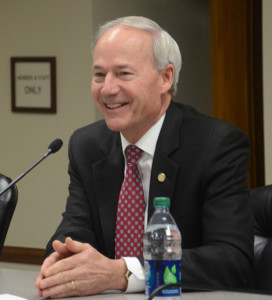
Gov. Asa Hutchinson

Gov. Asa Hutchinson

By Steve Brawner
© 2016 by Steve Brawner Communications, Inc.

Gov. Asa Hutchinson is still at the point in his young administration where legislators tend to give him much of what he wants, so it will be interesting to see if he gets this: separating the state’s commemorations – this year on Jan. 18 – of the birthdays of Dr. Martin Luther King, Jr., and Confederate General Robert E. Lee.

In response to a question during a press availability in his office Jan. 6, Hutchinson left no doubt where he stood on the issue, which flared and then faded in the 2015 legislative session. “It’s important that that day be distinguished and separate and focused on that civil rights struggle and what he personally did in that effort,” he said of King.

Hutchinson said lawmakers should vote to separate the holidays when they meet in their next regular session in 2017. “As to this year, I’m certainly going to be celebrating Martin Luther King’s special day. I’ll be attending Martin Luther King events and celebrating the great contributions that he has made to this country,” he said.

He did not say anything about Lee.

The legislation last year to give King his own holiday was pushed by Reps. Fred Love, D-Little Rock, and Rep. Nate Bell of Mena, then a Republican and now the Legislature’s only independent. Asked last January about the issue when he was still brand new in his office and was looking at a very full plate, Hutchinson said, “I haven’t thought about it, so I’d have to give it some more thought. History is important to me, and we’ve just got to balance those, obviously,” according to the Associated Press.

As the legislative session continued, Hutchinson did support separating the commemorations but focused on other issues, such as his tax cut package and the private option, the controversial government health care program that today purchases private health insurance for 200,000 Arkansans.

Clearly, Hutchinson is more willing to confront the issue now. On July 7, 2015, he wrote in a letter to Dale Charles, president of the Arkansas NAACP, “The acts of violence in Charleston have sparked national debate on numerous issues. In Arkansas, the state’s dual celebration of Dr. Martin Luther King Jr. and General Robert E. Lee on the same holiday has reemerged as an issue that must be addressed. As Governor, I will do what is in my power to strive for an exclusive Martin Luther King Jr. Day, as well as develop a strategic plan with valuable stakeholders, including the NAACP and state legislators.”

Hutchinson is sensitive to issues that affect Arkansas’ image and could affect its economic development efforts. Last year, he originally supported the Religious Freedom Restoration Act, which, depending on your perspective, either defended the consciences of traditional believers or allowed for discrimination against homosexuals. When a national firestorm erupted and businesses like Wal-Mart expressed their opposition, he sent the bill back to the Legislature so that a new one could be written that attempted to split the difference by mirroring federal law.

There has been no such firestorm with the King-Lee holiday, but there could be someday. Arkansas is one of only three states, the others being Alabama and Mississippi, that combine the holidays. Even Lee’s beloved home state of Virginia separated the days in 2000. Regardless of the intentions, Arkansas’ pairing, which occurred in 1985 two years after the King Holiday was created nationally, seems like a poke in King’s eye. It’s like the state is saying, “Yes, we’ll give the civil rights leader his day, along with the rest of the nation. But we’ll also honor the Confederate general, just to make it clear that we’re not 100 percent sold on this.”

The King Holiday is meant to bring people together. In Arkansas in 2015, its pairing with Lee’s birthday was a source of division. Is the answer therefore to divide the holiday, with one day remembering King and another recalling Lee? It could be after the Legislature meets in 2017.

Related: The Confederate star on Arkansas’ flag: a history lesson, or a celebration?