Category Archives: State government

Less government, not no government

By Steve Brawner
© 2016 by Steve Brawner Communications, Inc.

At the State Capitol this week, a high-profile Republican talked about reforming an important but imperfect government service, rather than complain about it being there.

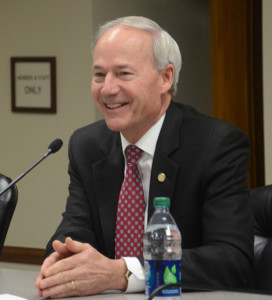
Lt. Governor Tim Griffin recently completed an extensive review for Gov. Asa Hutchinson of the Department of Human Services, the sprawling state agency that handles human needs such as health care for Arkansans with low incomes or disabilities, paying for nursing home residents, and serving foster children.

Meeting with reporters in his office, Griffin said he found an agency that’s poorly organized into divisions that don’t communicate with each other, leading to waste, inefficiency and less effective services. An Arkansan served by more than one division must talk to each separately, with little help.

Griffin, who previously served four years as Arkansas’ 2nd District congressman, said this kind of organization exists in other agencies. Addressing it in DHS is most critical because it serves what he said are “vulnerable” Arkansans.

The presentation was completely constructive. He offered solutions. He was genuine in wanting better services for DHS clients. He didn’t dismiss the department as another example of hapless government. He didn’t blame anybody.

Griffin’s presentation was not the only example this week of Arkansas Republicans trying to make government work better and smarter, when it would be easier to just criticize it. On Monday, the Republican-dominated Health Reform Legislative Task Force voted to endorse Republican Gov. Asa Hutchinson’s Arkansas Works program, which is a continuation of the private option, which was created largely by Republican legislators.

The private option uses federal Medicaid dollars to purchase private health insurance for Arkansans with incomes up to 138 percent of the federal poverty line. It now provides insurance for 200,000 people.

It unquestionably is a government expansion, so many Republicans understandably don’t support it. Republicans who do are trying to make government work at the state level to address problems not being fixed at the federal level or through the private sector. It’s a tough call, and the Legislature may yet choose to end it. However, Louisiana at first said no to the Medicaid money, and now it’s changing its mind.

Republicans have long been more comfortable with government at the state and local levels than at the federal level. State and local governments are closer to the people. In Little Rock, constructive work does get done.

But the party’s rhetoric often doesn’t reflect that, at any level. While it’s the party of less government, it often sounds like it’s the party of no government.

Unfortunately, it’s painting itself in a box. The GOP says it wants to cut or end government programs it can’t cut or end. That means it breaks a lot of promises and disappoints a lot of people. Meanwhile, its base includes a lot of people age 60-plus who depend on government or soon will. So what does the GOP do with that?

So here’s where we are. One party says it wants to cut government unrealistically. The other party too often wants to grow government. What’s not being said enough is that government is sometimes the best bad answer we have, but that it should be smaller and that it should work better. Instead of ending government, or growing it, there should be more talk about reforming it. What Griffin did at DHS should be done everywhere.

In the presidential race, you know who’s sort of filling that niche now? Donald Trump. He doesn’t seem to have a well developed political philosophy, but he’s talking about bringing his supposed business competence to government. He certainly doesn’t talk much about cutting government, aside from repealing Obamacare. He doesn’t want to cut Social Security or Medicare. He wants to build up the military and enact tariffs on Chinese goods. He wants to build a wall along the border funded by Mexico, which can’t afford it, so American taxpayers would pick up the tab.

This election may have been an eye-opener for the GOP. It opposes government, but its voters are nominating a candidate who doesn’t.

Maybe, somewhere in our political discourse, there’s room for responsible candidates to talk knowledgeably about smaller, cheaper, smarter government – reforming it, in other words, because sometimes that’s the best an imperfect society can do.

That’s not pro-government. It’s pro-honesty, and it can happen, even in politics.

Hutchinson’s ham and egg election

Gov. Asa Hutchinson

Gov. Asa Hutchinson

By Steve Brawner
© 2016 by Steve Brawner Communications, Inc.

You know that old saying about the difference between ham and eggs? The chicken is involved but the pig is committed. Gov. Asa Hutchinson was both during this year’s primary elections.

With the presidential race, he was merely involved. He endorsed Sen. Marco Rubio for president eight days before the vote. He made a couple of appearances and a TV commercial. Donald Trump won Arkansas. Rubio was third, which he was going to be anyway.

Hutchinson, however, was committed in the state legislative races, where his political action committee, ASA PAC, donated money to eight Republican candidates who had Republican opponents.

This happened because the eight he supported also support, or at least would consider supporting, Hutchinson’s Arkansas Works. That’s the continuation of the private option, the state program that uses federal Medicaid dollars through Obamacare to purchase private insurance for adults with incomes up to 138 percent of the federal poverty level.

Created in 2013 by Republican legislators and Gov. Mike Beebe’s administration, it now covers 200,000 Arkansans. It brings a billion dollars in federal money to the state’s economy annually and has saved hospitals from providing millions of dollars in uncompensated care. But some Republicans are opposed because of its association with Obamacare, because it’s another government entitlement, and because they say neither the state nor the country can afford it.

Because it involves spending money, it requires a three-fourths vote for passage every year, which means nine senators can kill it. It barely reached three-fourths in 2013 and in 2014.

In 2015, Hutchinson persuaded legislators to accept a truce: Fund the private option through 2016, when it would end, and he and a task force would look into creating something else. That alternative is Arkansas Works, which is like the private option except that it requires a bit more personal responsibility on the part of beneficiaries. He says it’s a real change. Opponents say it’s cosmetic.

Hutchinson says Arkansas needs it. His budget depends on it. He doesn’t want to take insurance from 200,000 people. He needs $50 million in extra money for highways so the state will be eligible for $200 million in matching federal dollars. Take away the private option, or Arkansas Works, and that money’s hard to find without a tax increase, which isn’t happening.

On April 6, legislators will meet in special session to vote on Arkansas Works, or something. It can pass with a simple majority, which isn’t that high a bar. Then they’ll meet in the fiscal session, which occurs every even-numbered year, to vote on funding. And because a three-fourths majority will be needed, that session could be a doozy.

Arkansas Works was a central issue in those eight Republican primaries, which left Hutchinson a choice: Do nothing so as not to offend the potential winners; get involved like the chicken; or be committed like the pig. He was committed. He openly supported candidates. He held a press conference defending them. His political action committee gave each of them $5,400.

His job would have become much harder had those candidates lost. While the winning candidates would not take office before the special session, the current legislators would see Arkansas Works as a losing bet. Then Hutchinson next year would be dealing with as many as eight new legislators he’d worked to defeat.

Instead, six of the eight won, including all three in the Senate, where Hutchinson has no votes to spare. On the House side, three of his five candidates won, and one who lost was challenging an incumbent, Rep. Josh Miller, R-Heber Springs. Miller was already in the House, so Hutchinson’s situation didn’t change there.

The next day, Hutchinson addressed the Political Animals Club at the Governor’s Mansion. His mood was not quite jubilant, but it was definitely somewhat north of relieved.

“I think everybody in this room knows that if those three state senators had lost their race, it would not be a pleasant day for me in this room,” he said. “I would have to be explaining. It would have been considered a referendum on me and my leadership.”

Yes, it would have been, in a way that the presidential race was not. He was merely involved with Rubio for eight days, but he’s staking a big chunk of his first term as governor on Arkansas Works. That’s commitment.

Related: Coming health care debate a “cage fight,” says leading legislator.

Presidential and private option politics

Hand with ballot and boxBy Steve Brawner
© 2016 by Steve Brawner Communications, Inc.

Primary elections were moved this year from May to March 1 to give Arkansans a voice in the presidential election and to help former Gov. Mike Huckabee win an early state. The more important result will be that state lawmakers will make a lot of decisions about Arkansas’ future with an election in their rearview mirrors instead of in their windshields.

Legislators wanted Arkansas’ primary to occur earlier in the election calendar, on the same day as votes in other states in the South, to create an “SEC primary.” With contests in 11 states across the country, Republicans will award 595 delegates – a fourth of the total. The big prize is Texas, with 155 delegates, while Arkansas will award 40. Democrats will award 957 delegates – again, Texas leads with 252 votes, while Arkansas has one of the smallest totals with 37.

The move appears to have achieved its goals. Arkansas is relevant, or is at least among a relevant group of states, so it’s warranted a few visits from candidates, if that means anything. It won’t help Huckabee, who has suspended his campaign, but, among the Democrats, it does help the state’s former first lady, Hillary Clinton. At least Arkansas is in the game, though mostly watching from the bench.

More important is what’s happening in state politics. During even-numbered election years, the Arkansas Legislature typically holds a fiscal session early in the year to vote on budget-related issues. Because of the early primary, that session was moved to April, after the primary. Meanwhile, Gov. Asa Hutchinson has announced plans to call two special sessions, one to vote on health care reform that will occur shortly before the fiscal session, and one to vote on his highway funding proposals.

The highway session will be big but not huge. Hutchinson has proposed a plan to increase highway money using a variety of means, including shifting some dollars from the state’s general revenue budget, but without raising taxes. There will be shouts of anguish from those who might be affected, but the average Republican primary voter won’t be mad.

The health care special session, however, will be a doozy. Legislators will vote on a package that will include Arkansas Works, which is Hutchinson’s version of the private option with important but not earth-shattering changes.

The program, whatever it’s called, uses federal dollars to purchase private health insurance for Arkansans with incomes up to 138 percent of the poverty level. It’s been hugely controversial since it was created in 2013 because it’s an extension of Obamacare passed by legislators who decided Arkansas might as well get its share. Unlike some states that turned down the money, Arkansas’ uninsured adult population has been more than cut in half, 200,000 people have health insurance, and its hospitals are providing a lot less unpaid care.

Republicans either don’t like it or, often, don’t like saying they’re for it. Its roots are in Obamacare, which is enough for many voters to oppose it. Opponents say it’s unsustainable. Sometimes, candidates sincerely oppose it on the campaign trail, but then they come to the Capitol and, seeing the numbers, decide they have to support at least something.

The health care special session is occurring in early April-ish because of the federal government’s timelines. Then we’ll have the fiscal session starting April 13, where legislators will vote to spend the money. Had the primaries not been moved, candidates would have had to vote for the private option in the special session, and then fund it in the fiscal session, and then campaign in a Republican primary. Naturally, their opponents would have accused them of selling out to President Obama.

Now, they can finesse the issue on the campaign trail and then come to Little Rock to vote on Arkansas Works – either as newly re-elected incumbents or as defeated lame ducks with nine months left to serve and nothing left to lose.

Presidential politics is what drove this decision to move the primaries, but at least some legislators were also thinking about private option politics.

Of course, if several legislators who support Arkansas Works lose March 1 to private option opponents, it will affect others currently on the fence. They won’t want to be losers next time.

So politics would have been involved no matter when the primary would have occurred. Oh, well. It’s a democracy, after all.

Steve Brawner is an independent journalist in Arkansas. Email him at brawnersteve@mac.com. Follow him on Twitter at @stevebrawner.

Why Supreme Court races matter: Lake View

golden balanceBy Steve Brawner
© 2016 by Steve Brawner Communications, Inc.

How important are the two Arkansas Supreme Court races on your ballot March 1? Two words provide the answer: “Lake View.”

In a case that drug out over 15 years, the Lake View school district, which no longer exists, argued that the state’s school funding system didn’t meet standards set forth by the Arkansas Constitution. The Constitution requires that the state “shall ever maintain a general, suitable and efficient system of free public schools and shall adopt all suitable means to secure to the people the advantages and opportunities of education.” The Lake View district said the state wasn’t doing that because it didn’t fairly serve small, poorer districts like itself. The Supreme Court repeatedly agreed, demanding that the state revamp its system to provide an “adequate” and “equitable” education for all students.

The state complied. Education went from being a local responsibility to being a state one. Hundreds of millions of taxpayer dollars were spent improving school facilities. School districts were consolidated. The Legislature ensured that before anything else is funded, schools get their money. In the midst of the Great Recession, when other states were cutting education funding, Arkansas schools always got more, and it’s made a positive difference.

As in years past, members of the House and Senate Education Committees this year will prepare an adequacy report for the full Legislature. The guiding principle will be the same as it’s always been since the Lake View case: How much more must be spent on schools to keep the state out of court? Once the report is done, it likely will be accepted by the rest of the Legislature without a lot of serious debate.

In other words, about 42 percent of the state’s general revenue dollars will be directed largely in obedience to rulings made years ago by Supreme Court justices.

The Lake View case ultimately was about more than just education. Because so much money was dedicated to schools, some tax cuts weren’t even considered. Meanwhile, less remained for other state needs, including health care.

In fact, it’s possible that the Lake View case is one of the reasons why the state has the private option. That’s the program that uses federal Medicaid dollars to purchase private health insurance for lower-income Arkansans. It was created after the U.S. Supreme Court ruled that states could choose whether or not to use Obamacare dollars to expand their Medicaid populations. A lot of Republican-leaning states said no. Arkansas said yes by creating the private option in 2013.

It’s hugely controversial. Opponents say it’s Obamacare, which it is.

Why does it exist here? Lake View may be one of the reasons. Because so many state dollars were tied up in schools, perhaps Arkansas was a little more willing to accept federal dollars for health care.

The decisions made by Supreme Court justices in the Lake View case have colored every area of state government for much of two decades, and will do so moving forward. That why Supreme Court justice races are so important.

So let’s return to March 1, when voters will have four choices for two slots. In the chief justice’s race, current Associate Justice Courtney Goodson faces Circuit Judge Dan Kemp of Mountain View. Goodson has been an associate justice since she was elected in 2010 (and is now one of four female justices on the seven-person court). She previously served two years on the Arkansas Court of Appeals. Before that, she was a law clerk at the Arkansas Court of Appeals from 1997 to 2005. Kemp has served 29 years as a circuit judge and 12 years as a drug court judge. He also served nine years as a municipal court judge.

For associate justice position 5, Circuit Judge Shawn Womack of Mountain Home faces attorney Clark Mason of Little Rock. Womack was elected a circuit judge in 2008. Prior to that, he served 10 years in the Arkansas Legislature, including as chairman of the Joint Budget Committee. Clark Mason is an attorney and former president of the Arkansas Trial Lawyers Association.

By the way, after this election, there will be no justices left on the Court who ruled in the Lake View cases. The issue of school funding – again, 42 percent of the state’s general revenue budget – might come up again. Just saying.

Related: Still want to elect judges?

Priorities and the Hogs

Football on tee - transparentBy Steve Brawner
© 2016 by Steve Brawner Communications, Inc.

Merriam-Webster’s online dictionary defines “juxtaposition” as “the act or an instance of placing two or more things side by side.” On January 27, an interesting one occurred at a University of Arkansas System Board of Trustees meeting.

The trustees were led on a tour of the University of Arkansas for Medical Sciences hospital campus in Little Rock. While parts are new and gleaming, what once was the main hospital needs $13 million just to become fire code-compliant, and even then it would be badly outdated and inefficient. UAMS would like $97 million to spruce up that building and other facilities, all for administrative space. Tearing the building down and replacing it would cost $250 million.

Board members later heard from the University of Arkansas at Pine Bluff. Students there enjoy a new science and technology building and a new fitness center, but in the middle of campus is an unused old multistory facility with weeds growing from the roof, and not as part of a science experiment. The campus security headquarters is an aging house, which can’t be reassuring to parents, and after a good rain, parts of the campus are underwater. UAPB would like money, too.

Then came the University of Arkansas Athletic Department, which seeks a $160 million expansion of its football stadium that would include 3,200 premium seats along with other amenities, such as a video board. The project would be funded through $40 million in donations and a $120 million bond issue repaid through higher ticket prices, paid mostly by fans not sitting in those 3,200 premium seats.

The trustees gave Athletic Director Jeff Long their blessing to continue gathering information, but not before former Sen. David Pryor had questions and abstained from voting. He said he was not necessarily opposed, but priorities should be discussed. This would be, he said, “the largest single bond issue in the history of higher education in the state of Arkansas.” He asked who would benefit, and how much of the costs students would bear.

“A bond issue is a debt of the University of Arkansas,” he said. “It is a debt of the people of Arkansas, and ultimately if something goes wrong, who’s responsible? And that’s the people.”

This is where the columnist perches in his ivory white tower and wags his finger at the trustees, right? Well, not necessarily. Pryor had it right. A discussion is needed.

True, it was quite a juxtaposition to see the state’s teaching hospital and one of its universities asking for money that’s currently not available for boring but necessary stuff like medical administration and drainage, which was then followed by a mostly celebrated $160 million request for football seats used six or seven times a year by rich people, along with other amenities.

However, the needs UAMS and UAPB are seeking to fill would be met partly by tax dollars that haven’t yet come from the Legislature. Moreover, it should never be assumed that public entities are spending the money they already have as efficiently as can be expected (or that they’re not).

Long, in contrast, was asking to pursue money paid voluntarily by donors and fans who, if they don’t like the higher ticket prices, could choose to watch the games on TV, which is what I do. The UA Athletic Department is one of the nation’s few big time college programs that turns a profit and is self-sustaining. In fact, it’s given money back to the university for academics for the newly built Champions Hall.

Finally, at what point do the Razorbacks add to the university, and at what point do they distract from it? The head football coach, Bret Bielema, is by far the highest paid state employee, including the doctors saving lives at UAMS. That seems like a misplaced priority. On the other hand, the Razorbacks are the university’s best marketing tool and a tie that binds the state together. And on the third hand, does all this send a message to young people that while we adults tell them to hit the books hard so they can become doctors, what we really value is how hard the Razorbacks hit the opposing players in the SEC?

It’s a complicated discussion, and it’s worth having before letting people spend $160 million of their own money on a football stadium, and making taxpayers responsible if something goes wrong.