
Category Archives: State government

Why governor thinks the private option is the best option

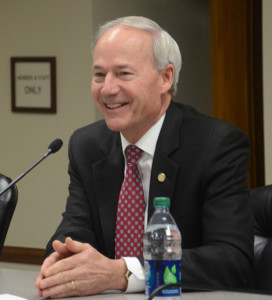
Gov. Asa Hutchinson

Gov. Asa Hutchinson

By Steve Brawner
© 2016 by Steve Brawner Communications, Inc.

The question came to mind as Gov. Asa Hutchinson addressed reporters Tuesday: “Governor, when you were a young man fighting to make the Republican Party more than a tiny minority concentrated in the state’s northwest corner, did you ever think it would eventually dominate state politics, and you would lead it, and your most important priority, for a time, would be saving a government health care program?”

The question was not asked. It wasn’t the time or place. Hutchinson makes himself available to reporters and respectfully tries to answer questions. But he’s not a soul-barer.

At issue is Arkansas Works, Hutchinson’s version of the private option. That’s the program created in 2013 after the Supreme Court ruled states under Obamacare could choose whether or not to expand Medicaid coverage to adults with incomes up to 138 percent of the poverty level. Arkansas bucked the trend of other Republican states by accepting the money, but instead of expanding Medicaid, it used it to buy private insurance for that population. As of the end of January, 267,590 Arkansans were eligible.

In the recent special session, Arkansas Works passed 70-30 in the House and 25-10 in the Senate, with support from majorities of Republicans and Democrats in each chamber. But while those votes made it the law of the land, it still must be funded during the Legislature’s current fiscal session. Those majorities fell a little short of the 75 percent needed in each chamber to fund the Department of Human Services’ Medical Services Division, which includes Arkansas Works and other Medicaid programs, including nursing home care.

Opponents, all Republicans, say the private option/Arkansas Works is another health care entitlement for able-bodied adults that neither the state nor an indebted nation can afford. The talk around the Capitol has been whether they will successfully hold up the entire Medical Services Division budget to stop Arkansas Works.

Going into Thursday, the program had enough votes in the House for funding, but none of the 10 Senate opponents had publicly said they were budging. On Thursday, a plan was hatched where legislators would fund Medicaid without Arkansas Works, but Hutchinson would veto just that part of it, and legislators wouldn’t override the veto. But that idea failed, at least temporarily, to advance out of the Joint Budget Committee. So we’re still stuck.

It’s too much to say Hutchinson’s governorship depends on this government health care program, but it is really important to him – important enough that he’s never going to allow 10 senators to stop him. Over the next five years, Arkansas Works is projected to bring $9 billion into the state’s health care economy at the same time the state will lose $5 billion because of other aspects of Obamacare. The state has 19 hospitals that are considered financially vulnerable. Dropping the program would add $1 billion to the amount of uncompensated care they and other providers would provide their uninsured patients.

It also would have a $757 million impact on the state budget, which was one reason why Hutchinson spoke before reporters Tuesday. He wants to call legislators back into special session after this current one to increase funding for highways. The state needs to find about $50 million a year to become eligible for $200 million in federal funding. Hutchinson said that without Medicaid dollars, the state can’t find the matching money for those highway dollars – without raising taxes, which he won’t do.

Like all Republicans, Hutchinson takes pains to declare he opposes Obamacare, even as he depends on Obamacare money. He’s been accused by some of being hypocritical.

He says he’s playing the cards he was dealt. He’d prefer the federal government send those Medicaid dollars to the states as a block grant – still federal government money, by the way – and let the states use that money as they choose without all the strings attached.

Currently, the federal government under President Obama won’t do that. However, you may have noticed we’re in the middle of a presidential election. Maybe the next president will be more open to that idea. That being the case, Arkansas had better stay in the game, Hutchinson says.

That means putting his office on the line, and grappling with members of the party he helped build, so he can save a government health care program that depends on an idea he doesn’t support. Does that make sense? In politics, sometimes yeah.

Related: Arkansas Works and the private option: What’s all the fuss about?
The debt, the private option, and the painter

CapitolBy Steve Brawner
© 2016 by Steve Brawner Communications, Inc.

If you’re helping a lot of people but contributing a few drops in the bucket to a big problem, should you stop helping those people? That’s one of the issues confronting legislators.

What’s helping people is the private option, which Gov. Asa Hutchinson is trying to rebrand as Arkansas Works.

Created in 2013, the program provides health insurance for Arkansans with incomes up to 138 percent of the federal poverty level, which is $11,880 for a single person. It uses Medicaid dollars – Medicaid being a federal-state program that serves lower-income people – that were made available by the Affordable Care Act (a.k.a. Obamacare). When the U.S. Supreme Court said states could choose whether or not to participate, many Republican states said no. Arkansas instead received federal permission to use the Medicaid money to buy private insurance.

It expires this year. On Thursday, legislators voted to extend it as Arkansas Works. But it lacked the 75 percent margins it will need to be funded in a fiscal session that begins next week. So we’ll see.

As of the end of January, 267,590 Arkansans were eligible. About 40 percent of recipients have no income. The others do, but many can’t get insurance. Speaking to legislators April 6, Hutchinson pointed to a pregnant mother employed at a West Memphis sandwich shop, and a 60-year-old painter and handyman from Jonesboro whose heart condition reduced his income so he couldn’t afford coverage. They’re both on the private option.

However, the program also is a few drops in the bucket of another problem. If it survives, Arkansas Works will bring about $9 billion in federal funds into Arkansas from 2017-21. During that time, the White House Office of Management and Budget projects another $3.766 trillion will be aded to the national debt, which is already more than $19 trillion. The math says Arkansas’ $9 billion would be one quarter of one percent of the new debt being created.

Opponents say Arkansas should do its part and say no to the money. The country already owes $19 trillion because too few will say no.

Sen. Terry Rice, R-Waldon, the lone no vote against Arkansas Works in a committee meeting Wednesday, made that point, saying, “I want to be as helpful to people as I can, but we are enslaving future generations, our children and grandchildren, to debt that we are irresponsibly putting on their credit card.”

But while the Affordable Care Act giveth, it also taketh away. The various taxes and changes to the law will take $5 billion out of Arkansas over that same time period. If Arkansas says no, it loses that money with nothing to offset it. Nineteen Arkansas hospitals are considered financially vulnerable, and without Arkansas Works, some will close. It’s happened in other states that rejected the money.

If Arkansas says no, there’s no guarantee the national debt will be $9 billion smaller. The federal budget is a huge, swirling pot of money. Meanwhile, the majority of other states – including those much richer than Arkansas – are taking the money. Louisiana, which first said no, recently elected a Democratic governor promising to say yes. So Californians and Louisianans will get health coverage, but the West Memphis working mom and the Jonesboro painter probably will lose theirs.

That’s why Rep. Charlie Collins, R-Fayetteville, a sponsor of the Arkansas Works bill, said in committee, with passion and emphasis, that he would support killing the program, but only on one condition: “Not only punishing our people.”

Perhaps the bigger issues are how the private option/Arkansas Works indirectly affects the national debt. You can say it grows government and contributes to a culture of dependency, which adds to the debt.

You also can say it’s a more honest way of paying for health care. The uninsured still seek care, but they wait until they are sicker, and then they can’t afford to pay for it. Then the costs are passed on to taxpayers, current and future, through government reimbursements to hospitals. At the same time, people who have insurance pay higher premiums. Local taxes are raised to save the hospital that’s been giving free care. The system shuffles money around like a streetside shell game scam artist. That process steals money from the future, too. It’s just not as obvious.

Lawmakers will need the wisdom of Solomon on this one. The bucket is filling up, but in this case, the drops are painters and sandwich shop employees.

Related:
Cynicism, watchfulness, the presidential campaign and Arkansas Works.

Arkansas Works and the private option: What’s all the fuss about?
Cynicism, watchfulness, the presidential campaign and Arkansas Works

CapitolBy Steve Brawner
© 2016 by Steve Brawner Communications, Inc.

Watchfulness is a cornerstone of a free society. Cynicism leads to the decay of it. There’s a huge difference between them, but not much distance.

What’s the difference? Watchfulness means being aware that people are sinful and selfish, that we seek our own glory and power and riches, and that we abuse and misuse other people and institutions. But it also takes into account that people make choices, and often the right ones. So it does the hard thing: It gathers facts about each individual situation and then makes a determination of what is happening, knowing that it’s probably neither all bad nor all good.

Cynicism sees bad qualities in others but often doesn’t see it in the mirror. Instead of gathering many facts to form a belief, it takes the lazy shortcut of forcing a few facts into a predetermined belief. It substitutes mockery for joy, and it builds its own worth on the shaky foundation of other people’s flaws.

Cynicism leads to inaction. Because cynicism says that nothing can be fixed, then there’s no reason to try. That’s why everyone who ever did anything great was optimistic about something. Worse, cynicism can lead to scorn, and scorn can lead to blaming, and blaming can lead to dehumanizing, and dehumanizing can lead to a lot of terrible things.

The challenge with watchfulness, on the other hand, is that it requires a delicate and difficult balance. Tip too far in one direction, and it falls into naivete. Tip too far in the other direction, and it leads to cynicism. There’s a huge difference between the two, but not much distance.

So let’s try to look, not on the bright side, but on the true side. It is true that the presidential race includes four candidates who for many people elicit strong negative emotions: Donald Trump, Sen. Ted Cruz, Secretary Hillary Clinton, and Sen. Bernie Sanders. (I wish Gov. John Kasich would elicit some negative emotions, too, but alas.) It would be easy to watch what has happened in this campaign and become cynical. Very easy.

But remember that watchfulness doesn’t take that easy route. It looks at the whole picture. So while it can be dismayed that the system isn’t working as well it should, it doesn’t ignore that the system is working much better than it could. For all the system’s flaws, we can be virtually certain there will be an orderly transfer of power come next January, and that’s a pretty uncommon thing in world history. The next president of the United States, far from seizing power with a sword, is traversing the country begging little ole’ you and me to vote for him or her and, to some degree, listening to our concerns. Yes, the watchful person says, money has far too much influence. On the other hand, Jeb Bush had a lot of it.

Closer to home, legislators during the next month will be engaged in a fierce debate about extending the private option, the program that uses federal dollars through Obamacare to purchase private health insurance for Arkansans with incomes up to 138 percent of the federal poverty line. It serves about a quarter of a million Arkansans. It expires at the end of this year, but Gov. Asa Hutchinson is trying to save it by making some changes and calling it “Arkansas Works.”

It’s a very divisive issue. Democrats unanimously support it; Republicans are split. Cynicism from one direction says it’s all part of a movement to nationalize the health care system. Cynicism from the other direction says some people don’t care enough about the poor or simply oppose whatever President Obama supports. There are elements of truth to all those charges, and they should not be ignored.

But the rest of the truth is that a legitimate debate is occurring about the role of government in imperfectly addressing a problem that can’t be perfectly solved. Health care is hard. It’s a product we naturally think should be cheap and limitless, and that’s just not possible. So we try to find that delicate balance between spending enough and spending too little, and doing it the right way.

Where is that balance? No one knows. But we’ll come a lot closer to finding it by being watchful than we will by being cynical.

Related: What exactly is Arkansas Works?

Arkansas Works and the private option: What’s all the fuss about?

Gov. Asa Hutchinson

Gov. Asa Hutchinson

By Steve Brawner
© 2016 by Steve Brawner Communications, Inc.

This next month, legislators will debate whether or not the private option should continue as Gov. Asa Hutchinson’s version, Arkansas Works.

What’s all the fuss about? I’ll try to answer your questions.

What exactly is the private option?

Let’s start with the background. The Affordable Care Act, which created Obamacare, expanded the number of Americans eligible for Medicaid, the program that pays for medical care for poor people. Americans with incomes up to 138 percent of the federal poverty level became eligible. Meanwhile, the act cut the federal government’s reimbursements to hospitals that serve a high number of uninsured patients, who often don’t pay for their own care. The assumption was those people would be on Medicaid.

But then the Supreme Court ruled that states could choose whether or not to participate in the Medicaid part. Most Republican-leaning states said no, but their hospitals’ reimbursements are still to be cut. Arkansas in 2013 said “Yes, but.” Instead of putting people on Medicaid, a government program, it used those dollars to purchase private insurance. Republican legislators and Gov. Mike Beebe’s administration created it, and the federal government approved it.

What have been the results?

As of the end of January, 267,590 Arkansans had qualified. A Gallup poll last year found Arkansas’ adult uninsured rate had dropped from 22.5 percent in 2013 to 9.1 percent in 2015 – the country’s biggest improvement. Hospitals are treating fewer patients who don’t pay.

Other states that turned down the Medicaid money have faced consequences. Rural hospitals have closed. Oklahoma this week proposed cutting what Medicaid pays doctors and hospitals by 25 percent. That’s huge because Medicaid already doesn’t pay much, which is why many doctors won’t treat Medicaid patients. Louisiana, which first said no to Medicaid expansion under a Republican governor, recently elected a Democrat who promised to take the money.

What do opponents say?

The private option as it currently exists would cost $1.63 billion in 2017. Currently, the federal government pays for almost all of it, but next year the state starts picking up 5 percent, which increases to 10 percent by 2020 – assuming Congress doesn’t change the rules and make the state pay more. So the state will have to find that money.

Some legislators have a major philosophical problem with the private option. They say it’s a health care entitlement with roots in Obamacare that increases government dependency and adds to the national debt. Those federal dollars aren’t a gift; they come from American taxpayers, current and future.

So what’s Arkansas Works?

Last year, Hutchinson convinced legislators to approve the private option through the end of 2016 while the state figured out what to do next. In the meantime, he’s proposed Arkansas Works, which changes the program in a few ways. Beneficiaries with incomes from 100 to 138 percent of the federal poverty level would pay up to 2 percent of their income for insurance premiums – about $19 a month. Private option recipients would be referred to work and work training opportunities, though they wouldn’t be required to take advantage of them. Hutchinson would like to do more in that area, but the Obama administration won’t let him.

Is it really that different from the private option?

No.

Why does the Republican governor support government-funded health care?

He says he opposed and still opposes Obamacare, but he inherited this situation. If Arkansas does nothing, the private option would go away at the end of this year, and then all those people would lose their health insurance, and hospitals would have to go back to providing all that uncompensated care. Also, losing those federal dollars would blow a $100 million hole in the state budget.

What does the next month look like?

Legislators are meeting starting April 6 in a special session to vote on Arkansas Works. Then starting April 13, legislators meet in the fiscal session that occurs every even-numbered year. Because Arkansas Works will cost money, it requires a three-fourths vote in both the House and Senate. In other words, 26 representatives or nine senators could kill it.

What’s the vote count look like?

Hutchinson doesn’t have a three-fourths majority yet in either the House or the Senate. But he’s trying.

What will the outcome be?

I don’t know.

Related: The private option ink blot.

Cuba: trade embargo, or free trade?

Rick Crawford

Rick Crawford

By Steve Brawner
© 2016 by Steve Brawner Communications, Inc.

U.S. Rep. Rick Crawford’s 1st District in eastern Arkansas is home to half the nation’s rice acres. Cuba imports 400,000 tons of rice a year, mostly from Vietnam. So yeah, he’s for opening up trade to Cuba.

Speaking by Skype last week to a pro-trade-with-Cuba gathering at the Winthrop Rockefeller Institute on Petit Jean Mountain, Crawford said the trade embargo, in place since Oct. 19, 1960, has punished American producers instead of the Castro regime. Shipping rice from Vietnam take 36 days, versus the 36 hours it would take to ship Arkansas’ better, fresher rice, but the market is closed. Crawford, a member of a pro-Cuba trade congressional working group, has sponsored legislation that, among other provisions, would let Cuba buy rice on credit rather than requiring it to pay cash, which it doesn’t have. He’s traveling April 5-9.

Crawford isn’t the only Arkansas policymaker favoring a new approach to the communist country 90 miles off Florida’s shore. Sen. John Boozman also supports a change. He says the 55-year embargo hasn’t removed the Castro brothers from power, so it’s time to try something else – trading goods and ideas. The United States does business with worse regimes, he says, including Saudi Arabia and China. Last year, Gov. Asa Hutchinson – who helped enforce the embargo as undersecretary of the Department of Homeland Security, led a delegation of about 50 Arkansas business and government leaders to Cuba. He favors more trade without completely lifting the embargo.

Naturally, these policymakers have allies in the business community, including Arkansas Farm Bureau and Riceland Foods, both of whom see Cuba as a huge market.

Two Arkansas policymakers disagree. U.S. Senator Tom Cotton criticized President Obama as he traveled to Cuba last week, pointing out that the Castro regime arrested a human rights activist shortly before the trip. Rep. Bruce Westerman, who represents the 4th District, says opening up trade with Cuba rewards a regime that is still in power and still guilty of human rights abuses.

The state’s two other congressmen are still on the fence, sort of. Rep. French Hill, who represents the 2nd District, told KARN radio the other day that Arkansas will benefit from opening up the Cuban rice market, but he needs to see a path toward democracy and a market economy, and he’s concerned that there doesn’t appear to be a plan to make reparations to those who lost their businesses to the Castro regime. Rep. Steve Womack, from the state’s 3rd District, is still weighing the benefits and pitfalls of opening up trade, his office said.

The trade embargo began more than 55 years ago under President Eisenhower. In that time, all that’s been accomplished is that an ailing Fidel Castro was replaced by his brother, Raul. During that time, the United States has had 11 presidents. Meanwhile, the Soviet Union has gone from world superpower to historical artifact (for the moment); China has gone from closed communist country to manufacturing powerhouse; Europe’s economic borders have largely been erased; and the two Germanies have become one.

So the world has changed a lot – all except Cuba, where the Castros are still in charge.

And yet even Cuba’s past doesn’t necessarily limit its future. At the Winthrop Rockefeller Institute, Ruben Ramos Arrieta, Cuba’s minister counselor at its Economic and Trade Office in Washington, said the country has been undergoing a “transformation” since 2008. He said 80 percent of its agricultural land is state-owned, but 70 percent of that is now being used by private farmers and cooperatives. Whether or not that’s accurate, it’s notable that he described the private sector positively and that he spoke of “transformation” rather than “revolution.” Michael Bustamante, a Yale University professor with family in Cuba, said Cubans have an entrepreneurial spirit that helps them maintain an “a-legal economy” that is often ignored by the government authorities. Who knows what they could accomplish given freedom and a free market?

It’s said in sports that Father Time is undefeated. The same is true in politics. Raul Castro has said he’s leaving office in 2018, and even if he doesn’t, he’s 84 years old. Fidel Castro is 89. In the near future, somebody else is going to be Cuba’s leader.

The question for policymakers is, would that person be more influenced by a trade embargo, or by free trade?

Related: Make Cuba thirsty.