Category Archives: State government

Schools: Local control without local voters?

Education Commissioner Johnny Key, left, and Little Rock School District Superintendent Baker Kurrus speak to reporters after Key did not renew Kurrus' contract. Because of the state takeover of the LRSD, Key, who entered office after the takeover, effectively serves as the district's school board.

Education Commissioner Johnny Key, left, and Little Rock School District Superintendent Baker Kurrus speak to reporters after Key did not renew Kurrus’ contract. Because of the state takeover of the LRSD, Key, who entered office after the takeover, effectively serves as the district’s school board.

By Steve Brawner
© 2016 by Steve Brawner Communications, Inc.

There’s a lot of talk in Little Rock about ending the state takeover of the school district and returning it to local control. If that’s to happen, these numbers must be improved: 2.78; .71; 4.51; and .51.

Those are the percentages of registered voters who voted in school elections in Pulaski County from 2014 back to 2011.

To be fair, those numbers encompass the entire county, not just Little Rock, and reflect elections where at most two of the seven positions were contested.

Still, the last time Little Rock held competitive school elections, a city with a population of 200,000 elected one school board member with 485 votes, and another with 379.

With that kind of turnout, a school election can be decided by one active civic club, business organization, union – or just a small group with an axe to grind.

One wonders how significant these public demonstrations about the school district really are. Did these people vote in those elections as the district was nearing a state takeover, or have they been newly energized? And are there enough of them to matter once the district is returned to local control?

It’s probably harder to engage voters in a school election in a big city than it is in a town of 8,000, where candidates know a lot of the voters personally. Many of Little Rock’s voters are completely disconnected from their school district. Most everything west of I-430 is Privateschoolville.

But extremely low voter turnout is a problem in many school districts. A decent minority of voters go to the polls if they are asked to decide a school millage increase, but school board elections attract little attention. A few years ago, I interviewed a Fayetteville School Board member who lamented that he had recently been re-elected by a count of 115-113 in a zone with 8,000 voters.

Why such low turnouts? School elections occur in September, when no one else is on the ballot. Unlike in some states, school board members aren’t paid for their service, so they have no financial incentive to invest seed money in their campaigns or advertise much. They don’t run with party labels and don’t attract big donations, yet.

Each legislative session, a lawmaker runs a bill to try to move school elections to November. Last year a bill passed that made November elections a voluntary option for districts. No doubt lawmakers will try to make it mandatory in 2017, or at least move the elections to the party primaries in the spring.

School board members don’t want to run on those crowded ballots. They’re afraid they’ll get lost in the shuffle, leaving school policies dependent on the decisions of voters guessing among a list of unfamiliar names. They’re afraid their positions will become politicized. They don’t want to run as Republicans or Democrats, or make the kind of campaign promises other elected officials make.

I must disclose that I publish a magazine, Report Card, in partnership with the Arkansas School Boards Association. It’s entirely supported by ads that I sell. ASBA doesn’t pay me for it, although I am paid a fee for one small project I do every year.

That relationship has probably helped bias me against moving school elections to November – that and the fact that the ballot is already too crowded then. Why am I voting on the county coroner? At the same time, the turnout issue should become a higher priority for everyone.

If Donald Trump has shown us anything, it’s that you don’t have to have a big organization or even spend that much money to win an election. He’s won the Republican Party’s nomination through his skillful use of the media and Twitter, all of which is free. That doesn’t mean school board members should campaign like Trump, but surely local media outlets could more aggressively cover the candidates, while candidates could make better use of Facebook.

Citizens must play their part, too. September comes every year, and it should not be a surprise that school elections occur then. School districts are many communities’ largest employer and, more importantly, the entity that educates and takes care of children all day. It matters who makes policy there.

A democracy doesn’t require massive voter turnout, but surely it must do better than 1 percent. After all, can you have local control without local voters?

Related: Why did Key replace Kurrus?

Trading an empty nest for a full house

By Steve Brawner
© 2016 by Steve Brawner Communications, Inc.

Maria and her three younger sisters needed a home, while John and Tricia Goyer had too many empty bedrooms. Thankfully, they solved each other’s problems.

The story starts 27 years ago, when Tricia, 44, had her first child as an unwed 17-year-old. She’d been born to a single mom, would not know her biological father for another 11 years, and didn’t have much of a relationship with her stepdad.

Then she married John. He adopted her first child, and they had two of their own, the youngest when Tricia was 22. She’s a successful author and novelist, while he’s a computer security analyst for a large international company. Set to be empty-nesters by the time she was 40, they were thinking about traveling, scooting around in a convertible, and then coming home to their six-bedroom house.

That’s when their story had a plot twist. They had a heart for girls in tough situations. She’d started a group for teen moms at the family’s Mosaic Church in Little Rock. Through the ministry, she’d watched five girls age out of foster care and then quickly become pregnant. She knew from experience they were looking for love in the wrong places because they hadn’t found it in the right ones. So the Goyers started adopting – first a baby privately, and then two more through the Department of Human Services.

Then came Maria, 16, and her three sisters, who come from an abusive and neglected background. Their mother was a meth user. They spent six years in the foster care system, sometimes apart. At times Maria thought she would never have a family.

She’s not alone. Arkansas’ foster care system oversees more than 4,900 children, 1,200 of whom are waiting for a foster family to give them a temporary roof over their head, much less a permanent one. They’re staying in group homes and wherever the Department of Human Services can find a place for them. Six hundred children have had their parents’ rights terminated and are waiting to be adopted. The older they are, the less likely that will happen.

On April 30, the need for caring families was spotlighted at the Walk for the Waiting at Little Rock’s War Memorial Stadium. The annual faith-based event is sponsored by The CALL and Project Zero, two groups that work with DHS to recruit families, and Immerse Arkansas, which supports some of the 250 teenagers who age out of the system every year without being adopted.

The Goyers were there, though they were late. It can be hard getting seven children to a football stadium by 9 a.m. on a Saturday, and these children have some extra challenges. Foster kids have been taken from troubled parents and shuttled from home to home and from school to school. The Goyers’ children have gone through failed adoptions where they thought they had a home, and then didn’t.

Even being in a loving family requires an adjustment. As Maria explained, “It took a while to get used to the fact that I actually finally had a family and that I was finally out of foster care.”

John offers the family’s comic relief, and Tricia and he work together to manage the home. They have rules, but the kids have been through a lot, so the focus is on love, not discipline.

“By the time they come to us, they’re hurt and they’re broken, and it just takes that daily reinforcement,” Tricia said. “Even when things don’t go well, we still love you. You’re not going anywhere. We’re not going to abandon you. And they need to hear that over and over and over again.”

It can be tough. John’s professional world is ordered and based on predictable computer algorithms. Then he comes home to seven kids. Tricia’s writing career has become a part-time endeavor. They could have been traveling the world and driving around in a convertible. Instead, they’ve traded an empty nest for a full house.

“There are days when we definitely question, like, why did we do this?” Tricia said. “But that lasts 30 minutes, and we get over ourselves, we get over our self-pity, and we’re like, OK, we’ll just keep loving these kids. And so now we’re so thankful. We wouldn’t change it for the world.”

Related: Adoptions turn blue balloons red

Why did Key replace Kurrus?

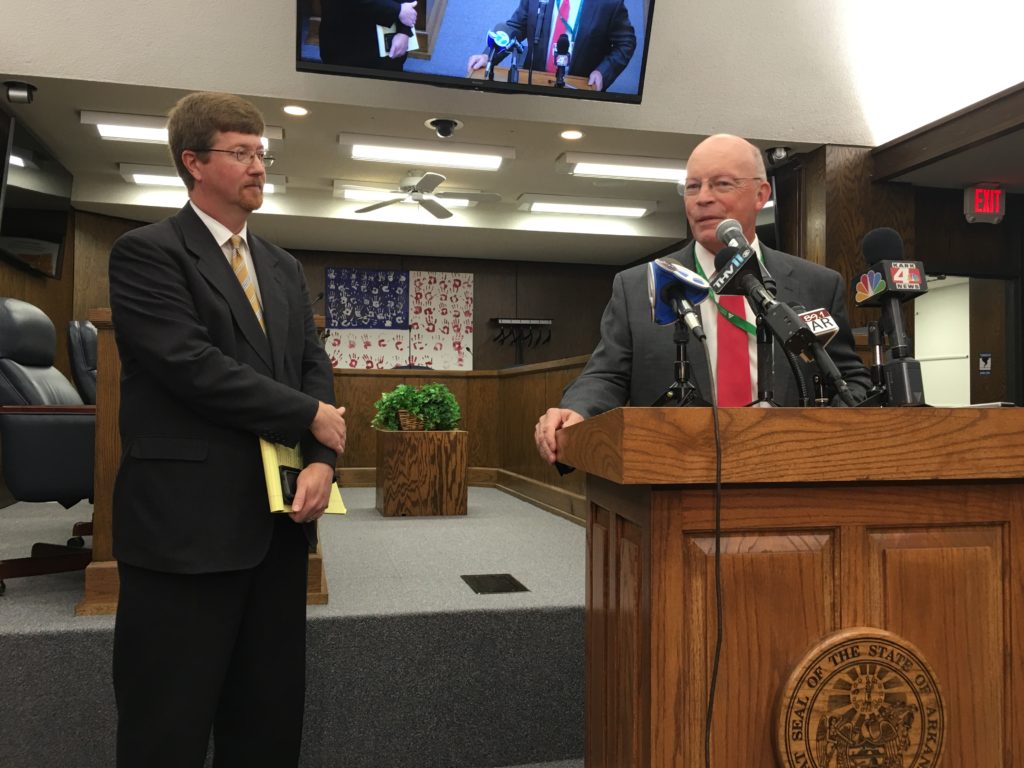
Johnny Key, left, and Baker Kurrus speak to reporters Tuesday.

Johnny Key, left, and Baker Kurrus speak to reporters Tuesday.

By Steve Brawner
© 2016 by Steve Brawner Communications, Inc.

Reporters have biases, and I’ll admit to mine: Two of the government officials I like the most are Johnny Key, the state’s education commissioner, and Baker Kurrus, the soon-to-be-former Little Rock School District superintendent.

The two have been linked together for the past year. Key is a former state senator, not an educator, which a lot of unhappy people noted when Gov. Asa Hutchinson picked him for the state’s leading public schools post. Because the State Board of Education had taken over the Little Rock School District, Key became its de facto school board when he became commissioner, and he appointed Kurrus as superintendent.

Kurrus is also not an educator – which, again, a lot of unhappy people noted when Key appointed him – though he had served for a while on the Little Rock School Board. He’s an attorney and a businessman, as well as a competent, passionate, driven individual. He went to work organizing things, talking to people, and showing that he cared. He brought hope, and people warmed up to him.

Earlier this month, Key decided not to renew Kurrus’ one-year contract, which clearly disappointed and surprised Kurrus. His replacement is Mike Poore, who currently is superintendent of the Bentonville School District and led a large, urban district out of academic trouble when he was working in Colorado.

In an interview in his office Tuesday, Key said the Kurrus hiring was always supposed to be temporary, though “temporary” was never defined. He said that while the state took over the district because of academics, there were fiscal and foundational problems that needed to be addressed first, and Kurrus was uniquely able to do that because of his organizational skills.

Key’s decision surprised and angered a lot of people and put the governor in a tough spot with some of the Little Rock legislators.

I also was surprised. I watched Key as a well-liked legislator carefully, even unnecessarily, build a coalition to pass a school choice plan.

How could such an accomplished bridge builder act so arbitrarily? In a press conference with Kurrus last Tuesday and during the interview the following Tuesday, Key explained that Kurrus had accomplished his mission of righting the ship, but now it’s time to focus on the academic distress that caused the state takeover in the first place. Poore has experience that Kurrus lacks. In between on Friday afternoon, Key issued a statement admitting he had erred in how he went about making the change.

In our interview, Key explained this is the time of year when superintendents are replaced. Little Rock has five years to get out of academic distress, and one of those years is gone. He didn’t want to wait another year and believes Poore is better suited to move Little Rock out of, and well past, academic distress.

“The broader issue was, Baker’s got us where we need to be right now. Who can come in and take us to that next level?” he said.

Some people aren’t buying it. They’re saying this is about the two men disagreeing about charter schools, which, in some cases, involve a private entity operating a school funded with taxpayer dollars. In Little Rock, two of these in particular are popular: eStem and the LISA Academy. Kurrus has publicly worried those schools will take students from the Little Rock School District, further disadvantaging it. Key tends to believe competition makes schools better, as do certain school reform types such as the Walton Family Foundation.

Some are saying that Kurrus publicly questioned charter schools, but Key and his big business overlords like charter schools, so Kurrus was shown the door. Everything has to be a conspiracy these days.

Key told me in his office that the two did disagree about charter schools, but it was not a “determining factor” and that the charter disagreement was a “minimal” consideration. When I pressed him on what “minimal” meant, he held his thumb and pointer finger an inch apart and repeated that it wasn’t the issue. The issue was that Poore had the skill set he wanted.

Remember, I’m biased towards Key and Kurrus. It’s possible that Key was spinning me, of course. But if he were, I would think he would have said “none” instead of “minimal.”

Key said it was time for an academic type to fix a school district in academic distress. That part is easy to understand, even if suddenly replacing a man who was succeeding isn’t.

The real goal of the private option: Changing U.S. health care

CapitolBy Steve Brawner
© 2016 by Steve Brawner Communications, Inc.

Arkansas is the land of the Hogs. When it comes to health care reform, it’s also offered itself up as a guinea pig.

Here’s why. The American health care system was a mess long before President Obama was elected. Costs were skyrocketing, and people were denied insurance based on pre-existing conditions, or they lost their insurance if they got sick. It’s long been unjust and unsustainable.

Along came the Affordable Care Act, which created Obamacare. Among its provisions was expanding Medicaid coverage for Americans with incomes up to 138 percent of the federal poverty level. Medicaid is a federal-state partnership that serves the poor, the aged and the disabled.

When the Supreme Court said states could choose if they participated in that expansion, many Republican-led states said no. In 2013, a group of Arkansas Republican legislators along with Gov. Mike Beebe’s administration instead said, “We’ll take that money, but instead of expanding Medicaid, we’ll purchase private health insurance.” The Obama administration agreed, and thus was created the “private option.”

It’s been a huge controversy that split Republicans between those who support it and those who see it as an unsustainable expansion of Obamacare.

Why would some Republicans support it? For one, a quarter of a million Arkansans now have health insurance because of it. Taking it away would be a state-changing event – for them, of course, but also for hospitals who would have to provide a lot of free care, and for the state, which would lose a lot of federal government money.

However, there’s another reason some Republicans support the idea: They’re trying to reform the entire health care system – which, as noted previously, has been messed up a long time.

Many Republicans have long advocated a “premium assistance” model for certain needy populations – basically, giving them money for insurance instead of putting them on a government program. But as state Sen. David Sanders, R-Little Rock, explained, the idea hasn’t been tried. If they could demonstrate in Arkansas that the idea could work, then they could change the entire national health care system starting in Arkansas.

What have been the results? There are more people on the program than were anticipated, and it hasn’t been managed well by the Department of Human Services. Coverage has been bought with taxpayer dollars for people without Arkansas addresses or, in some cases, a pulse. But a lot of poor people are covered, hospitals are saving money on uncompensated care, and costs per beneficiary have been lower than expected. The addition of a quarter of a million poor people to the insurance market has attracted providers to Arkansas, increasing competition and the choices available to us all.

As the experiment has continued, new elements have been included. Supporters hope to help people transition into self-sufficiency rather than trapping them in a big government program.
Hutchinson’s Arkansas Works program, which is the private option with a new name and some new wrinkles, includes work training referrals and a $19 per month contribution from better-off beneficiaries. He’d like to do more, but the Obama administration won’t let him. But next year, there will be a new administration.

So Arkansas has offered itself up as sort of the guinea pig in this experiment to see if the premium assistance model works. Since then, a number of other states have followed Arkansas’ lead and tried their own experiments. During hearings this past year, Arkansas legislators heard about some of those results, which could lead to changes here. States are the laboratories of democracy, and laboratories work best when they share what they learn.

Lawmakers hope the changes Arkansas has demonstrated could have other far-reaching effects. Sanders thinks the premium assistance model could be used effectively with the Veterans Administration – which, goodness knows, needs help. Rep. Charlie Collins, R-Fayetteville, thinks that, long-term, the model would work even for the biggest government health care program, Medicare.

There are those who say none of this will fix the health care system. Opponents from the right say government messes everything up. Opponents on the left say health care should not be a profit-earning enterprise, so the United States should do as other Western countries have done and just put the government in charge of paying the bills.

Sanders said something on which everyone should agree: This is an ongoing process. Health care isn’t going to be reformed. It’s going to be reforming, always. It must be.

Related: The debt, the private option and the painter

The larger debate: How Arkansas works

arkansasFlagBy Steve Brawner
© 2016 by Steve Brawner Communications, Inc.

This debate at the Capitol over health care is difficult to write about day to day because things change quickly. So let’s talk about what it might mean for the future.

First, the background. Legislators are debating the private option, which uses federal Medicaid dollars to purchase private health insurance for Arkansans with incomes up to 138 percent of the federal poverty level. It came about as a result of the Affordable Care Act, which created Obamacare. As of the end of January, 267,590 adults were eligible. It has helped Arkansas reduce its number of uninsured adults and gotten hospitals paid more often for their services – probably saving some of them, in fact.

However, some Republican legislators say it’s an unsustainable expansion of Obamacare leading to more government dependence and a bigger national debt. Gov. Asa Hutchinson is trying to make the program more agreeable to them by requiring more from recipients while changing the name to Arkansas Works. For many, it’s still not agreeable enough.

During the recent legislative session, Arkansas Works passed, but just short of the three-fourths majority needed for any kind of state spending. Arkansas Works is part of the larger Medicaid budget, which also funds nursing homes and other programs. So at least five members of the House and two in the Senate who voted against Arkansas Works must now vote to fund the entire Medicaid budget, including Arkansas Works.

This has been a huge debate. There’s been talk about how close to the cliff the state would get. The opponents haven’t wanted to fund Medicaid with Arkansas Works, and the supporters haven’t wanted to fund Medicaid without it.

The three-fourths requirement for funding is a high bar. It means that any nine senators can block anything.

So in the future, will they? If some nine senators don’t support the Common Core next year, will they threaten to withhold funding for public schools? What if nine senators want to spend more money on programs for poor people and threaten to withhold their votes for something else?

In fact, the Arkansas Constitution gives one-fourth of either House the ability to shut down the entire state government. It requires that, before anything else is funded, funding must be secured for general appropriations, which includes legislative reimbursements and such. So it’s possible for that one-fourth minority to refuse to fund general appropriations, and then nothing happens. In fact, as part of the political brinksmanship being played at the Capitol, House Democrats did just that while saying that Arkansas Works must be settled first.

Nine senators can exert their will over potentially the other 126 legislators. That’s a powerful weapon. But it’s perfectly legal and constitutional.

Is it the wave of the future? If so, it would require a complete change in the culture of the Capitol, which is a remarkably collegial place where legislators generally like each other, regardless of party. Arkansas Democrats and Arkansas Republicans, after all, are much more alike than Massachusetts Democrats and Alabama Republicans. In a body dominated by Republicans, the Senate chair of the powerful Joint Budget Committee is the universally popular Sen. Larry Teague, a Democrat from Nashville. That kind of thing wouldn’t happen in Congress. Moreover, legislators don’t want to be seen as obstructionist because they want to pass their own legislation.

Legally, nine senators can block anything, but culturally, they would pay a heavy price if they did. When cultures shift, the law remains. On the other hand, laws are always interpreted through the lens of culture.

Ultimately, Arkansas Works probably will be funded. On Tuesday, supporters pushed through the Joint Budget Committee an amendment that would end the program at the end of the year. The governor has said he will veto the amendment but not the bill, and the Legislature won’t be able to override. Voila! Arkansas Works passes without anyone having to convince two of those senators to go on the record voting for it.

Where will this lead? The Legislature is supposed to fund with a three-fourths majority, not a simple majority. It might get Arkansas Works funded, but it probably will draw a legal challenge.

Got all that? While the debate today is about Arkansas Works, the larger debate is about how Arkansas works.

Related: Arkansas Works and the private option: What’s all the fuss about?