Category Archives: State government

Still want to elect judges?

Hand with ballot and boxBy Steve Brawner
© 2016 by Steve Brawner Communications, Inc.

There are times when the work of journalists doesn’t really change much, and there are times when it might help. This might be one of those times when it helps.

I’m referring to the Arkansas Democrat-Gazette’s recent series detailing how six class action law firms, all but one based out of state, have contributed $296,000 in campaign funds to current Arkansas Supreme Court justices, and then argued cases in front of those justices, winning more than they lose. A partner in the one Arkansas firm, John Goodson, is married to Associate Justice Courtney Goodson, who recuses from cases involving his firm.

Justices must raise money like any other candidate, and most probably don’t like it and do the best they can within an imperfect system. Still the series has called into question whether they are being unduly influenced by those donations. 

The larger question is whether judges should be elected at all.

Americans have come to accept that legislators and executive branch officials raise money from interest groups and then give them something in return. We don’t like it, but we apparently can live with it.

But the idea of the judicial branch potentially being for sale is a little harder to accept. Someday we might be the one sitting in a courtroom facing an opponent who gave that judge a big donation. And now, thanks to the U.S. Supreme Court, judges can receive even more of those helpful dollars, and from more sources that can remain as anonymous as they want to be.

Electing judicial candidates has always been awkward because it’s the branch that’s supposed to worry about the law rather than popular opinion. Traditionally, candidates have refrained from describing their specific views in order to maintain their impartiality when they hear a case. That practice made it hard for voters to make an informed choice, but at least it lessened the politicization of the courts.

But with more at stake and more dollars involved, the justice system is becoming more political. For example, a 2014 Supreme Court race involved an ugly and misleading ad funded by an outside group against the losing candidate who had once done his duty as a court-appointed attorney for a sex offender. Another example occurred last year, when the Supreme Court stalled in making a potentially unpopular ruling on the state’s gay marriage law until the U.S. Supreme Court bailed it out and made the decision for it.

The issue is especially timely because, in less than a month, Arkansas voters will elect two Supreme Court justices. For chief justice, Goodson faces Circuit Judge Dan Kemp of Mountain View. For associate justice position 5, Circuit Judge Shawn Womack of Mountain Home faces attorney Clark Mason of Little Rock.

These two races together are arguably as important to Arkansans as the 2014 governor’s race. But in that race, most voters probably had a pretty good idea who they were voting for. Enough dollars are flowing into judicial candidates’ races to call their impartiality into question, but not enough to really introduce the candidates to the voters.

What should be done about all this? The Arkansas Bar Association has appointed a task force to study the issue. A group of legal types, including two retired Supreme Court justices, has created a privately funded effort to try to correct misleading advertisements and to provide information about candidates through a website, www.arkansasjudges.org, that doesn’t offer much yet. Gov. Asa Hutchinson has questioned if appellate judges – the Arkansas Supreme Court and the Court of Appeals – should be appointed, as they are at the national level.

That’s an imperfect solution, too, because it could give the governor a lot of power. However, there are ways to make it less imperfect. In Missouri, the governor appoints from a list of three candidates provided by a judicial commission, and then, at the next election, the voters decide if the judge should be retained. If not, which has only happened twice, then the process begins anew.

State Rep. Matthew Shepherd, R-El Dorado, introduced a constitutional amendment in the 2015 legislative session to create a similar system in Arkansas, but it didn’t make it. Maybe 2017 will be different.

For now, we’ll still elect our Supreme Court justices the same way we do now – two of them, in fact, on March 1. Know which ones you want to vote for yet?

It’s the social issues, stupid

A pro-life supporter expresses his opinion at the Capitol in Little Rock during the March for Life January 17.

A pro-life supporter expresses his opinion about Planned Parenthood at the Capitol in Little Rock during the March for Life January 17.

By Steve Brawner
© 2016 by Steve Brawner Communications, Inc.

Current events are demonstrating that what moves political elites and what moves normal people often are two different things.

The big debate among the political elites is over the size and role of government, particularly regarding the economy. That’s why they donate hundreds of millions of dollars to an establishment candidate like Gov. Jeb Bush who promises to cut spending and taxes, and why they assume, like I did, that Donald Trump would eventually go away. As President Clinton’s 1992 campaign said, “It’s the economy, stupid,” right?

Well, not always. What really moves people often are social and cultural issues: guns, gay rights, abortion, etc. Economic issues are mostly about what people do. Social issues are about who they are.

The prevailing national example of this reality is this year’s presidential race, where Trump is driving conservative elites crazy because he’s never been one of them. He has a history of supporting liberal and moderate political positions and has given money to many Democrats, including the Clintons. During this campaign, he’s not really talking that much about cutting government, the Republican elites’ favorite topic.

But he’s established a connection with many voters talking about illegal immigration, which for elites is merely an economic issue but to average people is also a social and cultural one. He’s going to build a wall and make Mexico pay for it. That’s not an economic policy. And he’s made political correctness, which is definitely a social issue, part of his campaign by pushing the envelope with his words time and again and never apologizing for it.

Closer to home, on Sunday, thousands of Arkansans opposed to abortion participated in the annual March for Life at the Capitol. They carried handmade signs. They prayed. They donated money to Arkansas Right to Life, which has won a lot of victories in recent years and will push this next legislative session for a ban on dismemberment abortions, where the fetus is torn apart and then extracted from the womb.

Thousands of conservative Arkansans do not march on the Capitol to cut the capital gains tax.

This upcoming Saturday, the Arkansas Coalition for Reproductive Justice will respond with a pro-choice rally. Because this is Arkansas, and because abortion is already legal, there won’t be thousands of participants. But, weather permitting, there will be hundreds.

During the 2015 legislative session, the most far-reaching public policy debate was over Arkansas extending the private option, the program that uses federal dollars to purchase health insurance for 200,000 lower-income individuals.

But what really grabbed everyone’s attention was the Religious Freedom Restoration Act, which some saw as an effort to protect religious belief while others saw it as a tool for discrimination against gays. Activists chanted “Shame on you!” at legislators and then lined the steps inside the Capitol. Corporate interests like Wal-Mart also were opposed. Gov. Asa Hutchinson, who initially supported it, sent it back to the Legislature when it reached his desk, and a milder version mirroring federal law was passed.

With economic issues, a lot of people care a little. With social issues, a few people care a lot. In politics, the second is often more powerful than the first. In an October CBS News/New York Times poll, 92 percent said they support background checks for all gun buyers, but Republican candidates know the other 8 percent will base their votes on that issue alone. So no background checks for all gun buyers.

While compromise is doable when it comes to economic issues, it’s very difficult with social ones. If one side says a tax should be 10 percent and the other 14 percent, the two can meet in the middle. With social issues, where the debate is over absolute right and wrong, finding the gray middle ground is harder. Then those deep-seated social divisions bleed into other areas. Elected officials can’t make the difficult compromises needed to balance the budget, for example, after the trenches have been dug over gay rights and guns.

I guess it doesn’t matter that much. Few candidates are seriously talking about balancing the budget, anyway. Maybe they would, if someone could figure out how to turn it into a social issue.

Dividing the divisive King-Lee holiday

Gov. Asa Hutchinson

Gov. Asa Hutchinson

By Steve Brawner
© 2016 by Steve Brawner Communications, Inc.

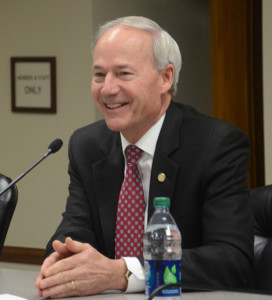
Gov. Asa Hutchinson is still at the point in his young administration where legislators tend to give him much of what he wants, so it will be interesting to see if he gets this: separating the state’s commemorations – this year on Jan. 18 – of the birthdays of Dr. Martin Luther King, Jr., and Confederate General Robert E. Lee.

In response to a question during a press availability in his office Jan. 6, Hutchinson left no doubt where he stood on the issue, which flared and then faded in the 2015 legislative session. “It’s important that that day be distinguished and separate and focused on that civil rights struggle and what he personally did in that effort,” he said of King.

Hutchinson said lawmakers should vote to separate the holidays when they meet in their next regular session in 2017. “As to this year, I’m certainly going to be celebrating Martin Luther King’s special day. I’ll be attending Martin Luther King events and celebrating the great contributions that he has made to this country,” he said.

He did not say anything about Lee.

The legislation last year to give King his own holiday was pushed by Reps. Fred Love, D-Little Rock, and Rep. Nate Bell of Mena, then a Republican and now the Legislature’s only independent. Asked last January about the issue when he was still brand new in his office and was looking at a very full plate, Hutchinson said, “I haven’t thought about it, so I’d have to give it some more thought. History is important to me, and we’ve just got to balance those, obviously,” according to the Associated Press.

As the legislative session continued, Hutchinson did support separating the commemorations but focused on other issues, such as his tax cut package and the private option, the controversial government health care program that today purchases private health insurance for 200,000 Arkansans.

Clearly, Hutchinson is more willing to confront the issue now. On July 7, 2015, he wrote in a letter to Dale Charles, president of the Arkansas NAACP, “The acts of violence in Charleston have sparked national debate on numerous issues. In Arkansas, the state’s dual celebration of Dr. Martin Luther King Jr. and General Robert E. Lee on the same holiday has reemerged as an issue that must be addressed. As Governor, I will do what is in my power to strive for an exclusive Martin Luther King Jr. Day, as well as develop a strategic plan with valuable stakeholders, including the NAACP and state legislators.”

Hutchinson is sensitive to issues that affect Arkansas’ image and could affect its economic development efforts. Last year, he originally supported the Religious Freedom Restoration Act, which, depending on your perspective, either defended the consciences of traditional believers or allowed for discrimination against homosexuals. When a national firestorm erupted and businesses like Wal-Mart expressed their opposition, he sent the bill back to the Legislature so that a new one could be written that attempted to split the difference by mirroring federal law.

There has been no such firestorm with the King-Lee holiday, but there could be someday. Arkansas is one of only three states, the others being Alabama and Mississippi, that combine the holidays. Even Lee’s beloved home state of Virginia separated the days in 2000. Regardless of the intentions, Arkansas’ pairing, which occurred in 1985 two years after the King Holiday was created nationally, seems like a poke in King’s eye. It’s like the state is saying, “Yes, we’ll give the civil rights leader his day, along with the rest of the nation. But we’ll also honor the Confederate general, just to make it clear that we’re not 100 percent sold on this.”

The King Holiday is meant to bring people together. In Arkansas in 2015, its pairing with Lee’s birthday was a source of division. Is the answer therefore to divide the holiday, with one day remembering King and another recalling Lee? It could be after the Legislature meets in 2017.

Related: The Confederate star on Arkansas’ flag: a history lesson, or a celebration?

Looking ahead to an eventful 2016

Calendar turning copyBy Steve Brawner
© 2015 by Steve Brawner Communications, Inc.

Happy new year. In Arkansas politics, it’s going to be an eventful one.

In January, Gov. Asa Hutchinson will meet with U.S. Department of Health and Human Services Secretary Sylvia Burwell to request a waiver for “Arkansas Works.” That’s his version of the private option, the program that uses federal Medicaid dollars to purchase private insurance for lower-income individuals. He’s asking for changes that will require more personal responsibility on the part of recipients, and which will make it more acceptable to Republican legislators. Those legislators will vote on Arkansas Works, or something like it, in a special session focused on health care in the middle of the year.

Continue reading

Next year’s health care ‘cage fight’

CapitolBy Steve Brawner
© 2015 by Steve Brawner Communications, Inc.

In mid-December, I wrote that legislators would decide how to reform health care in Arkansas by the end of the month. As the TV character Maxwell Smart used to say, “Missed it by THAT MUCH.”

What legislators actually did was give Gov. Asa Hutchinson a few months to negotiate with the federal government – and then sometime next year they’ll decide how to reform health care. It will be a “cage fight,” in the words of Sen. Jim Hendren, R-Sulphur Springs, chairman of the Health Reform Legislative Task Force (and Hutchinson’s nephew).

The task force was created last year to determine what to do about Medicaid and the private option. Medicaid is the health care program for the poor, the aged and disabled. The private option is the Medicaid program that buys private insurance for Arkansans with incomes up to 138 percent of the federal poverty level. The private option, which was created in 2013, currently is funded entirely by the federal government, but Arkansas begins paying 5 percent in 2017 and 10 percent by 2020.

The private option provides health insurance for about 200,000 Arkansans. It is the primary reason the state has cut in half its number of uninsured residents, lessening the unpaid care provided by hospitals. But critics believe it is an unacceptable concession to Obamacare that eventually will cost the state a lot of money. It must pass with 75 percent support from each house in the Legislature each year, which means nine senators can kill it.

Hutchinson, who wants to keep it, persuaded lawmakers this year to fund it through the end of 2016 while his administration and the task force create an alternative. He’s proposed a sequel, “Arkansas Works,” that like many sequels looks a lot like the original. It would, however, involve more personal responsibility on the part of beneficiaries, including requiring those with higher incomes to shoulder part of the cost for what is now essentially free health care.

Those changes will require a waiver from the federal government that Hutchinson has already started seeking. In January, he’ll meet with Sylvia Burwell, secretary of the Department of Health and Human Services. He’ll probably get part of what he wants because Burwell will know the private option is on shaky ground. But he already knows he won’t get everything he’d like.

He requested and received the task force’s blessing to proceed. During a voice vote on a motion supporting his efforts Dec. 16, zero legislators voted no.

But legislators weren’t necessarily endorsing Hutchinson’s overall goals. Sen. Cecille Bledsoe, R-Rogers, a private option opponent who had led the task force in applauding Hutchinson the day before, didn’t vote at all. She’s not opposed to seeking waivers because it can’t hurt to ask. But she remains deeply concerned about the program, whatever it’s called. Among her fears is that the federal government won’t hold up its end of the bargain of paying 90 percent, forcing Arkansas to pay more.

The next few months will be eventful. Hutchinson will request and then await the waiver. On March 1, Arkansas’ party primary elections could reduce the number of pro-private option lawmakers, though the new officials won’t take office until January 2016. There will be a fiscal session after the primaries and then a special session regarding health care that could be a doozy.

Somewhat surprisingly, the biggest debate for now is not about the private option but about adopting a managed care model where a private company would be contracted to manage parts of Medicaid. Even the Arkansas Department of Human Services’ director, John Selig, says private companies could better manage some services than DHS can.

But DHS’ record on contracts has been disappointing lately – the most notable example being a computer system for tracking Medicaid re-enrollments that is $100 million over budget. And not everyone supports managed care, anyway. Opponents include a group of mostly Republican legislators who make their livings in health care and believe Arkansas would be better served expanding the reforms it’s already undertaken. So the same day the task force gave Hutchinson its blessing on the waiver, it also instructed its consultant, The Stephen Group, to see if it could find enough savings over five years using the current model to cover the state’s 10 percent in 2020. Then lawmakers will decide if that route is better than managed care.

So changes are still coming to Arkansas health care. It’s just the cage fight will be next year, not this past one.

***

For additional reading: Is health care a commodity or an entitlement? Neither.

For legislators, The Stephen Group report was an ink blot test.