Category Archives: Inspirational

Welcome to your country

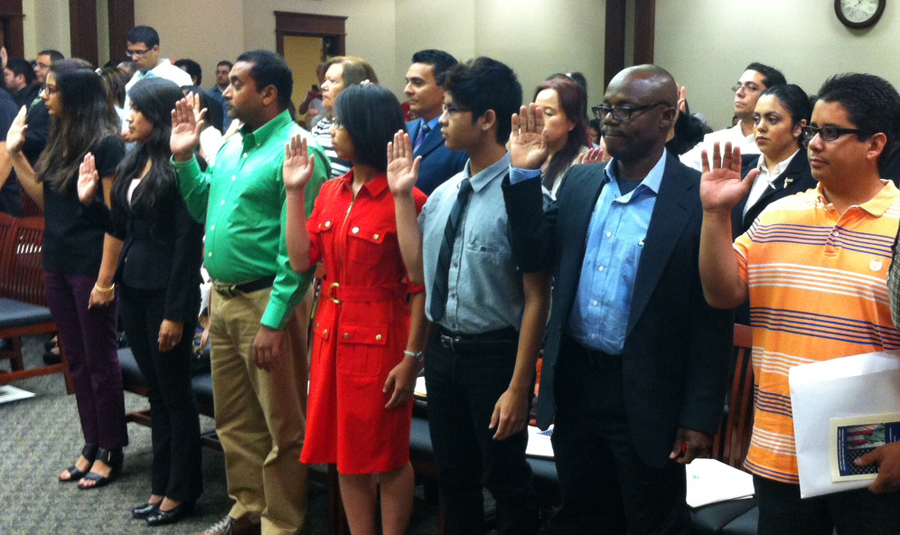
New Americans take the Oath of Allegiance in Little Rock Friday. Aristides Urdaneta is in the blue jacket with blue tie behind the woman in the red dress. Wife Jeannette is to his left.

New Americans take the Oath of Allegiance in Little Rock Friday. Aristides Urdaneta is in the blue jacket with blue tie behind the woman in the red dress. Wife Jeannette is to his left.

By Steve Brawner
© 2015 by Steve Brawner Communications, Inc.

Fifty people from 22 countries raised their right hands Friday in U.S. District Judge Beth Deere’s courtroom. Journeys that had taken decades were ending in an 11 a.m. ceremony. The participants had been examined by the Immigration and Naturalization Service, met English language requirements, and passed a citizenship test that many native-born Americans would fail. After taking the Oath of Allegiance, they were no longer from 22 countries. They were from one.

Afterwards, each came forward to receive a certificate and a small American flag, and to introduce themselves and their countries of origin. Their foreign accents ranged from thick to nonexistent. Eleven were from Mexico, including one who finished his introduction with “Woo, pig sooie.” Another said, “I’m from Egypt. No, I’m from USA. USA! USA!” Afterwards, U.S. Rep. French Hill said in a brief speech, “My fellow Americans … welcome to your country.”

Among the 50 were Aristides and Jeannette Urdaneta, immigrants from Venezuela. They came to the United States in 2003 on a work visa with their son, Kevin, now a teenager who also became an American citizen that day by virtue of his parents’ new citizenship. He’s an Eagle Scout and the state president of Health Occupation Students of America, and he wants to be a doctor someday. While in the United States, the Urdanetas had a daughter, Albanie, who will be 10 next month and is an American by birth. She’s about to join a dance company, she said.

The Urdanetas are the second and third generations in their family to escape oppression. Jeannette’s father had immigrated to Venezuela from Albania years earlier to escape its communist dictatorship. (That’s where the name “Albanie” comes from.) As socialist dictator Hugo Chavez grabbed more and more power in Venezuela, her father would predict with eerie accuracy the government’s next move based on his own experiences. “Things were getting worse by the month, by the day,” Aristides said.

In search of a better life, Aristides began looking for jobs where he could put his computer skills to work in America, Canada, Australia or Spain. The best opportunity came with CAT Squared, a Conway-based software company serving the food industry and founded by immigrants from South Africa. They spent six years under a work visa and then applied for permanent residency. Eventually, Jeannette became a Spanish teacher at Maumelle Charter High School.

By taking the Oath of Allegiance, the new American citizens declared that they “absolutely and entirely renounce and abjure all allegiance and fidelity” to their home countries.

That’s a powerful statement – to say that you’re no longer associated with the country of your birth. I asked them how difficult it was to take that step. Their Venezuelan heritage will always be a part of who they are, they said, but they’re not looking back. “We made a decision that this is our country, and we have to stand for the United States now,” Aristides said.

Yes, I asked them about illegal immigration – specifically, about their level of sympathy for those who didn’t do it the right way, like they did. They did not have an easy answer. They said it is unacceptable for people to do things illegally, but the situation is complex, and individual situations need to be considered.

From the front of the room, the 50 people taking the oath of office seemed to be a stoic group. Not many showed much emotion, although one new Ukranian-American shed quite a few tears, perhaps related to the turmoil her homeland is experiencing. I picked out Aristides because his face seemed the most joyful of anyone I saw. Both he and Jeannette said they got a little emotional. Kevin said he did, too. “I had a moment when the judge first said, ‘My fellow Americans,’ I was holding back the tears. … At that moment, I felt just all the history in my family, from oppression to freedom back to oppression back to freedom,” he said.

Albanie feels the same weight, and she has plans to do something about it. “When I grow up, what I would like to do is, I would like to get a job where I could get a lot of money and I could buy tickets for the rest of my family to move here and experience what freedom is like,” she said.

I hope she can, and I hope Kevin becomes a doctor. Welcome to your country, Urdanetas family. It’s your home now.

A marvelous day in a Marvell school

By Steve Brawner
© 2015 by Steve Brawner Communications, Inc.

My wife would NOT stop talking Monday night.

She’d just returned from Marvell, a Delta farming community where she was writing a story for an education magazine I publish. The elementary school has an all-day summer program for students in danger of falling behind, which, in a school where 97 percent receive free and reduced price lunches, is a lot of them.

She wanted to tell us about all she’d seen. Enthusiastic teachers and college interns were going to war alongside these kids to fight for their futures. A teacher gave a student a high-five after he correctly identified the preposition and object of the preposition in a sentence. Kids were reading because they wanted to. The youngest students were being tutored – by third graders, who seemed to know what they were doing.

The program clearly is improving student performance and test scores. Under the leadership of its stick-of-dynamite principal, Sylvia Moore, the school had gone from occupying a permanent place on the state’s school improvement list to scoring an “A” on the state’s report card.

My wife saw a lot of smiles and laughter during her marvelous day in Marvell. Her heart melted when a kindergarten student told her she loved her. She laughed as she recounted the young male students’ antics. If she’d been offered a job, I think we would have at least had a discussion about moving to Marvell.

Marvell is not the only school district worth talking about. Flippin has made addressing dyslexia a school priority. As a result, previously struggling students now are excelling, and discipline problems are way down. In Greenbrier, students are earning two-year associate’s degrees along with their high school diplomas, saving their families a bundle on college tuition costs. The chancellor at the University of Arkansas at Little Rock actually handed them their degrees during the high school’s graduation ceremonies this spring. In Warren, grade levels are being blurred so that students advance whenever they’ve learned the material, not because they’re waiting for a page on the calendar to turn (or because the page has already turned). At Maumelle High, students declare what amounts to a major so their schooling can be tailored to their strengths and interests.

The point is not that all schools are excelling. On objective measurements, American students are not as prepared as many of their foreign counterparts to compete in a global economy. On the 2012 Programme for International Student Assessment, American students ranked 27th among 34 developed countries in math and 17th in reading. That’s happening despite the fact that American taxpayers spent more per student than many other countries – actually, $621 billion in 2011-12, or $12,401 per student in 2013-14 dollars, according to the National Center for Education Statistics.

But there are helpful takeaways from what Marvell and other school districts are doing. One is that many students might do better with a shorter summer break. In Marvell, there’s a dramatic difference in learning readiness at the beginning of the fall semester between students who attended summer school and those who spent the summer watching TV. Students are tracked regarding their progress in literacy. Few things are more discouraging than seeing that a student has regressed when he or she returns in the fall.

The second takeaway is that schools can do some great things when given a chance to experiment. They should be given that chance, even though experiments sometimes fail.

The third is that more is happening in education than the ongoing debate about Common Core, or whatever everybody is arguing about this week. Some things actually are positive, or at least hopeful, and if we’d all click off Facebook, turn off cable news, and go visit one of these schools (without listening to a screaming radio talk show host along the way), we might at least get a balanced view of things.

Skepticism is the ally of a free society; cynicism is an enemy of it. When we sit safely behind our computer screens and coffee mugs and murmur with people who agree with us, we see only problems – and people to blame. It’s only when we emerge from those hiding places that we see that good things are actually happening. That’s when we have hope, and when we have hope, we might act.

At the very least, we might have something positive to talk about.

Ex-con points way to closing prison’s revolving door

By Steve Brawner
© 2015 by Steve Brawner Communications, Inc.

Before this past legislative session, legislators were asked to consider building a $100 million prison, but nobody really wanted to do that. The state already housed more than 18,000 inmates, including a backlog of 2,500 in county jails, and a new prison would add only 1,000 beds. Forty-three percent of inmates released from prison return within three years, anyway. As soon as the new prison was finished, another would have to be built.

Other solutions are needed that change behavior, Gov. Asa Hutchinson said, so that prison becomes less of a revolving door. So he proposed, and legislators passed, a legislative package meant to provide a short-term fix, including renting space in Texas, and a more long-term effort that includes creating transitional re-entry centers where prisoners reintegrate into society – rather than just receiving the traditional $100 and a bus ticket back to the life that sent them to prison in the first place.

Hutchinson and legislators also created a criminal justice reform task force that is studying other options. Let’s hope its members talk to Jason Duncan.

Duncan, 33, does not look like an ex-con. He’s 6-5, handsome, and stands with a leader’s confident posture.

At age 18, he was a different person. At that point, he told me he decided “to seek whatever was pleasurable in the moment” and began a life that, a decade later, “found me completely addicted to drugs, a raging alcoholic and starting to develop quite a spectacular rap sheet.”

He was sitting in a concrete jail cell in North Carolina, a fugitive from Arkansas justice, when he opened a Bible out of boredom to Deuteronomy 28, read about curses resulting from disobedience, and saw himself. He decided to become a Christian, got out of jail, and immediately returned to his old life, which led him, finally, to an Arkansas correctional facility.

Duncan’s life began to change when he enrolled in a program offered through Arkansas Community Corrections where inmates are transported to Little Rock’s Arkansas Baptist College to participate in a program managed by Under Grace Ministries. The inmates attend classes in recovery, spiritual discipleship, entrepreneurial thinking and resource management.

The inmates stood out a little. They wore brown uniforms, which was OK because, Duncan said, “most of the students thought we worked for UPS.” Many were white, including Duncan, and they were attending class on a campus serving mostly African-American students that originally was built to educate former slaves.

The program gave Duncan the direction he needed. After leaving state custody, he remained at ABC for two semesters and then transferred to the University of Arkansas at Little Rock, where he’s studying international business and marketing. He’s now the director of international student ministry at Fellowship Bible Church. He’s married and has a son from his previous life.

Last week, he spoke at a ceremony dedicating ABC’s Scott Ford Center for Entrepreneurship & Community Development, which will house an expanded version of the program that changed his life. So far, about 30 inmates have started the program. Next year, 100-120 will be involved.

I asked Duncan what services inmates need to return to society and stay out of prison. He said they need a spiritual foundation along with education and work training because many have never had a job and don’t really know what one is. They need help overcoming their addictions. Also, each one of them should transition to society in a halfway house, a “safe environment with accountability but also a mix of freedom.”

The recently passed legislative package will pay for 500 parolees to be involved in such transitional re-entry centers. The state each year releases 10,000 inmates back into society.

Duncan didn’t say it, but fewer people need to go to prison in the first place. There are two reasons 43 percent of inmates return to prison within three years. One is that they were messed up to begin with, and prison didn’t fix them. The other is that they had merely made mistakes to begin with, and then prison really messed them up.

Let’s hope policymakers wisely consider solutions from every angle – keeping people out of prison who shouldn’t be there, helping parolees avoid returning, and keeping those who should be in prison locked up. Let’s hope the state finds more partners like Under Grace Ministries and ABC. Halfway houses are a good start, but let’s not settle for halfway solutions.

Seek first to understand, even in politics

By Steve Brawner
© 2015 by Steve Brawner Communications, Inc.

The fifth of Dr. Stephen Covey’s “Seven Habits of Highly Effective People” is “Seek first to understand, then to be understood.” Could that apply to politics, even today?

Covey taught that being understood is such a fundamental need that it is impossible to influence another person until that need has been met. He compared it to air: Remove it from a room, and nothing else would matter to the occupants.

Unfortunately, understanding is in short supply – in Washington, D.C., of course, but also outside the Beltway. Americans are divided ideologically, culturally and even geographically. We live in red and blue states and in safe Republican and Democratic congressional districts. Even our neighborhoods and churches are largely politically segregated. As a result, we’re far more likely to talk about people on the other side than with them. Now we’re entering another campaign season where billions of dollars will be spent to disunite us. Didn’t we just have an election?

Seeking first to understand, then to be understood is important politically for three reasons: because none of us knows everything (except radio talk show hosts and TV pundits, of course); because most of us have something to offer; and because the stakes are too high not to try.

The issues that we argue about usually involve competing worthwhile values that are difficult to balance – what government should do to help the needy, for example. Few Americans, including conservatives, want the government to do absolutely nothing to help those who truly need it, and most of us, including liberals, agree that too much government dependence is bad both for society and for dependent individuals.

What’s the exact dollar figure that perfectly balances those two competing values? No one can know. Thank goodness we don’t have to hit that sweet spot perfectly. Just getting reasonably close and governing responsibly is good enough.

In a country with 300 million people, you don’t reach that point by digging ideological trenches and shooting at each other across no man’s land. That kind of thinking just perpetuates an unsustainable status quo.

So how about seeking first to understand? What if we humbly acknowledged that, because we don’t know everything, the greater good is accomplished by combining our ideas with others’? It’s good that liberals warn of the dangers of capitalism degenerating into a survival of the fittest mentality, and it’s good that conservatives voice their concerns about government’s inefficiencies and its capacity to restrict freedom.

By valuing both points of views, and others across the political spectrum, we can get to Covey’s sixth habit: Synergize. That’s the idea that individuals can come together from different places and create something better than what either would have created on their own. It’s much better than compromise, where no one walks away particularly happy. Compromise is better than continued fighting, and in politics, it’s often the best possible result. But synergy happens, too. It’s how we got the Constitution. These days, a framework might be created that better addresses human needs without increasing dependency and adding to the $18 trillion national debt.

Covey also taught that each of us inhabits two circles: a circle of concern where we have no control, and a circle of influence where we do. Focus on your circle of influence, he said.

I can’t create synergy in Washington, but I can seek first to understand, then to be understood in my own life. I’ve decided to learn to avoid fruitless political debates, online or in person – the kind where two people are concerned only with scoring points and not considering the other’s ideas. Nothing productive happens when two people are emotionally invested in a political argument and motivated by pride and fear of losing face. I’ve wasted my time on several of these lately. In the end, all I accomplished was become frustrated and lose 45 minutes that could have been spent more productively.

Instead, I’ve determined to treat these discussions as opportunities for partnership rather than competition – to seek first to understand. I expect I’ll learn something actually listening to others. Maybe we’ll create a dialogue that enriches us both. Maybe I’ll influence the other person, and if I don’t, I certainly wouldn’t have done so by trying to debate them into submission.

And if I’m caught in a conversation with someone who’s not seeking to understand? Hopefully, I’ll be wise enough to get out of it, go somewhere else, and get some air.

No child in Flippin left behind

Interventionist Juanell Potter works with student Thomas Gravely.

Interventionist Juanell Potter works with student Thomas Gravely.

By Steve Brawner
© 2015 by Steve Brawner Communications, Inc.

FLIPPIN – Superintendent Dale Query has spent more than four decades in education, and one thing that has remained constant is smart kids struggling in school and often becoming discipline problems.

He and his fellow educators in Flippin long have struggled to find the key to helping those students reach their potential. Now they think they’ve found it. Many of them have dyslexia.

The condition, which is surprisingly common at varying degrees, is a language-based learning challenge based on brain structure. The students often are smart – sometimes very smart – but they just can’t read well or put things on paper, so from their earliest days in school, they begin falling behind their peers. Teachers tell their parents they don’t apply themselves. Some students make frequent trips to the principal’s office.

A couple of years ago, a school employee brought her grandchild to the elementary office and said the child was dyslexic. Principal Tracie Luttrell, who in the past had dismissed the condition per her training, decided to attend a seminar, and something clicked. Inspired, she and others began researching the condition.

The north-central Arkansas district has made dyslexia a top priority. Many staff members attended a Saturday training on their own time as the program was starting. Six full-time interventionists work one-on-one with students. The district has 800 students, and 107 of them last year attended hourly summer school sessions twice a week. Many saw significant improvements.

The district relies on the Susan Barton method, which uses multiple senses – sight, sound, touch – to help students’ left and right brains make the proper connections to make reading easier. In a room dedicated to dyslexia, students drag tiles with letters down a magnetic board as they learn the sounds those letters make. Tiles for more advanced students have groups of letters so that those developing brains can make the connection that “o-l-d” always says “old” when it’s part of a longer word. Students also are drilled in English grammar rules until they know enough to put a newspaper editor to shame. Did you know there’s a reason why “truck” ends in “ck” but “milk” needs only a “k”? These students do.

Juanelle Potter, one of the interventionists working with students, has a special reason for working what she calls “by far the greatest job I’ve ever had.” Her husband, a math whiz, and two of her children have dyslexia. Homework was a nightly battle. Now, the daughter who would tell her, “I’m stupid” has been invited to the freshman honors banquet. Her fifth-grade son, Raymond, is no longer falling behind his peers. “I thought I wasn’t that smart,” he told me. He wants to be a mechanical engineer someday.

For some students, the program will be the difference between reading well and a lifetime of near illiteracy. But Luttrell said the benefits have gone far beyond that small population. For the first time in her educational career, she’s ready to move students out of special education, which will allow those teachers to focus on those remaining. Students are graduating out of speech therapy more quickly. Meanwhile, students with mild dyslexic characteristics who were making “C’s” – and therefore not drawing much attention – are doing better in school. Counselor Sherry Rainbolt says students she was counseling with dyslexia no longer struggle with anger or motivation issues.

“Once they’re told that there’s a reason, it’s instantaneous that they know, ‘Well, I’m not dumb. Nothing’s wrong with me, really.’ I mean, this is something that we can help them with, and they see hope,” she said.

Query uses a pretty strong descriptor: “cured for life.” Students who were being left behind in school are catching up to their peers and will never fall behind again. He sees it as the answer to a lot of problems. He says certain students no longer will need therapy, or medication, or, eventually, wind up in jail.

“When we spread those numbers out from Flippin, Arkansas, to the state of Arkansas to our nation, dyslexia intervention has the potential of reshaping our whole society,” he said.

Thanks to laws sponsored during the past two legislative sessions by Sen. Joyce Elliott, D-Little Rock, school districts across the state will screen students for dyslexia in grades K-2, and in other grades where appropriate. Then they’ll be required to intervene.

Will they look to Flippin’s example? They will if they’re smart.