Spend less to tax less

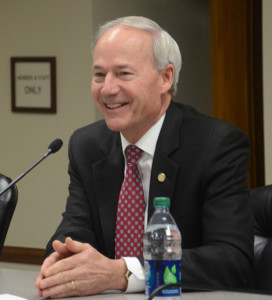
Lt. Governor Tim Griffin says tightening state government's finances is the necessary first step to cutting taxes.

Lt. Governor Tim Griffin says tightening state government’s finances is the necessary first step to cutting taxes.

By Steve Brawner
© 2016 by Steve Brawner Communications, Inc.

Lt. Governor Tim Griffin is pushing an idea: Cut spending first and then cut taxes. It’s so crazy it just might work, which is why he wants to try it in Arkansas and why, hopefully, someone will try it in Washington, D.C.

Griffin, who has announced he is running for re-election in 2018, points to the state’s ranking in the high 40s in many areas. Sitting across the table from me in a Little Rock coffee shop, he said the state can’t get to the top by tweaking. “Bold is the only option” he said.

A top priority would be the state’s income tax. It ranks in the middle of the country, according to the Tax Foundation, but the top rate, 6.9 percent, is tied for 14th highest and hits all filers with incomes of $35,099, which is not exactly Walton money.

Arkansas’ top rate is higher than all its surrounding states, including Texas, which has no income tax. Thus the state is at a competitive disadvantage, which is one reason Gov. Asa Hutchinson wants to cut income taxes next year, as was done in 2015. Hutchinson probably will propose relatively modest cuts. Griffin wants to go big.

The problem, Griffin says, is that elected officials who talk about tax cuts run into a brick wall erected by those who argue that the state won’t have enough revenues to meet critical needs. To get past that, the state must make reforms to meet those needs with fewer dollars.

The simplest way of looking at how the state spends money is its general revenue budget, which in fiscal year 2017 is $5.3 billion. Griffin says making government 10 percent more efficient, which is really doable, would free up $530 million – enough for a substantial income tax cut along with increased spending in other areas, such as highways.

Griffin is talking about not just cutting waste, fraud and abuse, but instead undertaking systemic reforms of state agencies, many of which he says were designed before the remote control was invented. He says if a boat is designed to require six rowers, it does no good to try to propel it with four. Instead, change the boat so it only needs four.

“Make smart government your focus. … If you just cut, you still have the same inefficient systems in place that require the inefficient resources,” he said.

Last year, Griffin undertook a review of the state’s massive Department of Human Services, which takes care of a lot of the state’s neediest residents and is a mess. Its new director, Cindy Gillespie, now is reorganizing it. Griffin wants to see the same effort undertaken across state government. He started by cutting one position from his three-person office.

Griffin says state government has a moral obligation to spend taxpayer dollars efficiently. He says Arkansas must be competitive with other states. And, it must prepare for the day when the debt-ridden federal government starts sending less money to Arkansas.

And that brings us to Washington, D.C., where Republicans adhere to two entrenched beliefs that are very different from what Griffin, a former Republican congressman, is describing. One, “starve the beast,” says government can be shrunk by depriving it of money through tax cuts. The other belief is that tax cuts generate so much economic growth that spending cuts aren’t really necessary. Donald Trump’s plan reflects that belief – tax cuts without spending cuts – which is why the Committee for a Responsible Federal Budget says it could add $11.5 trillion to the national debt.

Republicans in Washington over the past few decades have pledged allegiance to those two beliefs, enthusiastically cutting taxes without insisting on cutting government. Democrats shook hands on that bargain because they like to spend without taxing, too. The result has been the national debt ballooning from $1 trillion in 1981 to $19.4 trillion today. Unfortunately, money did not grow on trees, and the beast wasn’t starved because it could reach across the table into the future and steal food from the plates of our children and grandchildren.

All of this should make perfect sense to those of us who live on a budget. If you are struggling to make ends meet, you look for waste and inefficiency in your spending first, and certainly before you switch to a lower-paying job.

It makes sense in government, too, where being smart should be the focus, and where the state of Arkansas is a good place to start.

Related: If Trump or Clinton succeed? More debt.

When were the good old days?

By Steve Brawner
© 2016 by Steve Brawner Communications, Inc.

All the bad news and societal changes lately probably have a lot of people yearning for the good old days. When exactly were those?

If someone invented a time machine to transport you and me to other eras, imagine what we would see.

Let’s start our trip in the 1700s, as the nation was being founded on democratic ideals. Traveling to that time period, we might land in the middle of a slave auction where people were being sold as property. Picture the cries of sorrow we would witness as husbands and wives were separated and as children were yanked forever from their families. Around us, the buyers would not be troubled enough by the scene to stop what they were doing. Meanwhile, society continued to compromise its values to allow it to continue.

Maybe the time machine might then take us to 1838-39, when the Cherokees were forced by the government to march west from their native land across the Mississippi River, trudging through Arkansas along the way. Of the 15,000 who started the Trail of Tears, 4,000 died.

A couple of decades later came the Civil War, in which 620,000 men died, or about 2 percent of the population or the equivalent of 6 million today. At Gettysburg, 51,000 Union and Confederate soldiers were killed or wounded in one battle. The wholesale indifference to human life would be striking. We would watch troops line up across an open field from each other and then just start shooting, until someone gave the order to advance. According to the Civil War Trust, almost as many troops on both sides died while prisoners of their once and future countrymen as the number of Americans killed in the entire Vietnam War.

Our time machine might then take us to the Industrial Revolution, where in the latter 1800s and first part of the 1900s, children instead of going to school toiled unceasingly in terrible factories that employed them because they worked cheap and were easier than adults to control.

Along the way, the time machine might stop in Elaine, Arkansas, in 1919. An organizational meeting of a farmers’ union led to a race-based shootout and then days of bloodshed. Whites descended on Elaine, along with troops sent by the governor. According to the Encyclopedia of Arkansas, “Although the exact number is unknown, estimates of the number of African Americans killed by whites range into the hundreds; five white people lost their lives.”

From there, the time machine might take us to the 1950s – seen by many as an idyllic era. But for many Americans, it wasn’t exactly Mayberry. Society was set up on a separate but unequal foundation, and African-Americans, including World War II veterans, were forced to live second-class lifestyles. Suddenly transported to that environment, you and I would be shocked at the injustices and inequalities suffered by people who, in many cases, are still alive today.

Would you really want to go back to that? Would you really want to go back to any of those earlier eras?

The point is not that things have always been terrible. It’s that every era has had its troubles and persecutions – this one no more and in many ways far fewer. Children today spend their days in schools (yes, imperfect ones) instead of working for pennies in squalid factories with little hope of lifelong advancement. Likewise, the United States remains an imperfect union, but progress has been made in creating a more just society for people of all races. Even the problems that seem so bad today are not as bad as they were recently. Violent crime dropped 16.2 percent from 2005 to 2014, the FBI says. According to the Bureau of Labor Statistics, the economy created 287,000 jobs in June, which is really good. The unemployment rate in Arkansas is the lowest it’s ever been at 3.8 percent. True, that’s partly because many frustrated workers have left the workforce. But still.

Ecclesiastes 7:10 says, “Do not say, ‘Why were the former days better than these?’ For you do not inquire wisely concerning this.” Pining for the past is pointless and ignores the past’s problems.

Anyway, no one has invented a time machine yet, so we can’t go back even if we wanted to. We can only learn from history, live in the moment, and try to make the future better.

One of us for president?

Elections aheadBy Steve Brawner
© 2016 by Steve Brawner Communications, Inc.

What would happen if the president were an average person, not a member of the country’s political and wealthy elite? Matthew O’Connor would like to give Americans a chance to find out.

The Ohioan is trying to mount an independent presidential campaign and wrote me recently looking for someone in Arkansas to collect signatures. Prospective presidential candidates in this state must collect only 1,000, which is pretty doable, but the deadline is August 1.

What led a father of three with no real political experience, no support and no name recognition to run for president? His big issues are corruption, the national debt, and the failure of the country to produce the right kind of candidate. His website is www.darkhorse2016.com.

“I just felt like no one was doing it for the right reason,” he told me. “I felt that a lot of people felt like … either they deserved it, or it was their turn, or they could buy it, and I thought it was about time that somebody did it because they wanted to serve the country and serve the people.”

A lot of Americans are looking for the same thing right now, considering the two major party nominees, Hillary Clinton and Donald Trump, have historically high unfavorable ratings. It seems the current system is not producing humble, service-oriented candidates like the famed Cincinnatus, who in 458 B.C. left his small farm to lead Rome through a crisis and then returned to the farm.

O’Connor won’t get very far in 2016. While the bar for making the ballot in Arkansas and some other states is low, in many states it is impossibly high for all but the best-connected candidates.

Maybe it should be. Every walk of life includes a system for winnowing out the wannabes. In business, you move up the corporate ladder. In sports, you prove yourself in college and in the minor leagues. And in politics, candidates are elected to something less than president, make a name for themselves, and then run for the nation’s highest office. On rare occasions, someone with success in another walk of life – Trump, President Dwight Eisenhower, President Ulysses S. Grant – has gotten a shot at the title. There’s no “American Idol” for presidents, and thank goodness.

O’Connor is not a billionaire business mogul or a famous general. He says he’s been able to balance life’s important areas – as an information technology professional, a father of three and a happily married husband who the day after our interview was planning to celebrate his 20th wedding anniversary.

“I know that sounds like a strange thing to say, but there’s a lot of success in that,” he said. “A lot of people don’t manage those things.”

Could someone like that be president? Could America benefit from leadership by competent, moral persons plucked temporarily from Main Street? Would those people be better at balancing budgets and serving the people than the political and cultural elite? Or would Main Street Americans be like decent high school baseball players suddenly facing Major League pitching? A lot of us probably could read a speech off a teleprompter. Could we sit across the table from Vladimir Putin?

If you’re thinking you’d like to write in O’Connor as a protest vote on Election Day, you can’t. There is no provision in Arkansas law for write-in presidential candidates. He must collect 1,000 signatures, which is a steep hill to climb for someone without Arkansas roots or campaign donations.

If he doesn’t, there’s still enough time for Arkansans to qualify a favorite son or daughter for the ballot. They wouldn’t win, of course, but at least they would offer another choice.

Some suggestions?

– Sam Sicard, president of the First National Bank of Fort Smith. In an age of self-promoters, he cares about ideas and doing the right thing.
– Kevin Kelley, head coach of the Pulaski Academy Bruins, the high school football team that doesn’t punt. He’s a creative, data-driven thinker.
– Mark DeYmaz, pastor of Little Rock’s Mosaic Church, where people of all races and income classes worship under one roof. He brings people together.
– Mary Carol Pederson, founder of The CALL in Arkansas, which recruits families to foster and adopt children. She focuses on kids and the future.

Want to vote for one of those people, or Matthew O’Connor, rather than Clinton, Trump, or one of the third party candidates? The deadline for collecting signatures is August 1.

Related: It’s OK to vote for someone else.

It’s OK to vote for someone else

Hand with ballot and boxBy Steve Brawner
© 2016 by Steve Brawner Communications, Inc.

Voters complain each presidential election about their choices, but that’s especially true this year. According to Real Clear Politics’ compilation of polls, Hillary Clinton is viewed unfavorably by 55.5 percent of voters and favorably by only 39.7 percent, while Donald Trump’s numbers are worse: 61.1 percent to 33.4 percent unfavorable to favorable.

These are historic numbers, and they could get worse. When candidates’ negatives are so hopelessly high, they respond by trying to drive up their opponents’ unfavorables and, if necessary, win by becoming the lesser of two evils. Both campaigns will unleash a torrent of negative ads. Both have plenty to work with.

If you’re like many Arkansas voters, you may have said you’ll just write in somebody else’s name. Unfortunately, there is no provision in the law for you to do that in the presidential race.

However, there will be other candidates on the ballot: the Libertarians’ Gary Johnson, the Greens’ Jill Stein, the Constitution Party’s Darrell Castle, and possibly others. The bar for running for president in Arkansas as an independent is remarkably low: Just collect the signatures of 1,000 voters, which is much less than the 10,000 required to run for statewide offices. Candidates have until August 1 to submit those signatures.

This is the part where somebody always says, “Don’t waste your vote. If you don’t vote for one of the two major party candidates, you’re helping the other one” – the one they don’t want to win.

I respectfully disagree with that kind of thinking. An election is not just a process for picking winners and losers. It’s an opportunity for voters to express their beliefs about the country’s direction. Many voters strongly oppose both Clinton and Trump and do not want to affirm either candidacy on Election Day.

If your beliefs more closely align with one of those third parties, then vote your conscience and encourage others to do the same. That’s how the Republican Party came into existence. On March 20, 1854, a small group of idealists met in a Wisconsin schoolhouse to form a new party that would be based on their anti-slavery convictions, not raw political calculations about who might win the next election. Instead of holding their nose and voting for the lesser of two evils, they took the long view and stayed true to their beliefs. Six years later, Abraham Lincoln was elected president.

No matter how you vote, you won’t change the results in Arkansas. The United States does not have national elections where everybody’s vote goes into a big pot. It has individual, winner-take-all state elections that feed into the Electoral College. Arkansas has six votes, and we already know who will win them. In a recent Talk Business & Politics poll, Trump leads Clinton, 47-36 percent, and nothing will turn those numbers around. Clinton’s 36 percent is consistent with recent election results: President Obama won 37 percent in 2012; while in 2014, Sen. Mark Pryor won 39 percent in the U.S. Senate race while Mike Ross won 41 percent in the governor’s race. Somewhere in those numbers is the Democrats’ ceiling.

Regardless of what you as a voter do, Arkansas will be part of a large red splotch in the middle of the country on your television screen on Election Night. The state will be called for Trump immediately after the polls close, and then the attention will turn to the states that are actually up for grabs: Florida, Ohio, Pennsylvania, etc.

In other words, because Arkansas is blood red, your vote essentially has become meaningless as an election-deciding tool. However, as with those idealistic Republican reformers in 1854, it has great meaning as a form of political expression. This is when your voice really counts.

The best vote I ever cast was in 1992 for independent candidate Ross Perot. I believed he was not temperamentally suited to be president, but he campaigned on political reform and on balancing the budget and ran 30-minute infomercials explaining the national debt. On Election Day, he won 19 percent of the vote. Not coincidentally, President Clinton and the Republican Congress began working on balancing the budget. They couldn’t ignore Perot’s voters.

So do you really want to avoid wasting your vote? Vote your conscience.

Related: Independents, Greens better choice than death

If Trump or Clinton succeed? More debt

Uncle Sam hangs on for webBy Steve Brawner
© 2016 by Steve Brawner Communications, Inc.

Presidential candidates can’t possibly fulfill all their campaign proposals, and few would even want to try. But what would happen if Hillary Clinton and Donald Trump actually did what they said they want to do? Clinton would grow government and do nothing to reduce the growth of the national debt. Trump would explode the debt.

Those are the findings of the Committee for a Responsible Federal Budget, a nonpartisan group that advocates for deficit reduction. It scored the two candidates’ campaign proposals to find out how much they would increase the debt, determined maximum and minimum amounts based on various factors, and then came up with midrange amounts.

The CRFB found that Clinton’s proposals would increase spending by $1.4 trillion over 10 years, but she has proposed $1.2 trillion in tax increases over that time period. That’s $200 billion in new debt, plus another $50 billion in additional interest costs her policies would cause.

So Clinton’s not doing too badly, right? Not exactly. She has no plans for the $19 trillion in debt that already exists, nor does she propose anything that would reduce the additional annual deficits that already are baked into the system and are projected to add $10 trillion over 10 years if nothing is done.

Clinton gets a few points for this: While proposing to grow government, she also at least proposes to pay for most of that growth. Because of that, the CRFB says the national debt would not increase much as a share of gross domestic product if Clinton does what she says she wants to do. Without Clinton’s policies, the debt held by the public – the national debt minus what the government has borrowed from itself – will increase from its current 75 percent to 86 percent of GDP in 2026. With her policies, it would increase to 87 percent.

But I’m not reassured. Elected officials in Washington tend to keep their happy promises but not their take-your-medicine ones. If history is a guide, she along with Congress will more likely increase spending while letting her less popular tax increases slide.

Trump, meanwhile, proposes spending cuts of $650 billion, which is not much when you consider it covers an entire decade. Meanwhile, he’s proposing an estimated $10.5 trillion in tax cuts. Counting higher interest payments, Trump’s policies would increase the national debt by a midrange estimate of $11.5 trillion, the CRFB says. While tax cuts do have a stimulative effect, the economy would have to grow more than 10 percent a year for a decade for the budget to balance – more than twice the best it’s previously done over that time period. Moreover, like Clinton, he does little to address the current $19 trillion debt or the $10 trillion in new debt that’s already projected to occur. If Trump keeps his promises, then in a decade the debt held by the public could equal 127 percent of the gross domestic product – numbers not seen since World War II.

At this point, a lot of people might ask, so what? Since presidential candidates often don’t even try to enact their campaign proposals, then maybe we should just ignore them and vote with our guts.

The problem with that thinking is that it removes accountability. If voters don’t care what candidates tell us during the campaign, then they are free to say anything to get elected and do anything afterwards.

Moreover, a presidential campaign isn’t just a time to pick winners and losers. It’s also a time for voters to educate themselves about the issues. In 1992, third party presidential candidate Ross Perot broadcast 30-minute infomercials in which he explained the national debt. Because of him, it became a front-and-center issue, and after he won 19 percent of the vote, President Clinton and Congress moved to balance the budget. If the national debt is mostly ignored in this campaign, it probably will be mostly ignored after the election.

The CRFB says it will continue to track the candidates’ proposals as the campaign moves forward. Unfortunately, it has not scored any of the third party candidates, but hopefully that will change. Every candidate should be held to high standards – particularly Trump and Clinton. One of those two will succeed at becoming president. Let’s hope the winner doesn’t succeed at increasing the debt.

Related: Fiddling around, ignoring problems