Category Archives: U.S. Congress

Good times renew bad habits in Congress

By Steve Brawner

When a person is trying to solve an old problem, one of the most dangerous times is when they’ve had some success – especially when they really haven’t changed their mindset or habits. They’ve lost some weight on a fad diet, so they head for the buffet. They’ve cut down on their alcohol for a few weeks, so they drop into the bar because they’ve “earned it.” They’ve been pretty good about spending money lately, so they splurge.

Soon they’re eating, drinking and spending more than ever. Old habits die hard.

Congress is composed of people just like the rest of us, and those people also are vulnerable to the hazards of success. We’re starting to see that on display regarding the federal budget deficit.

The good news is that annual deficits temporarily are falling. The Congressional Budget Office (CBO) is estimating that Congress will “only” overspend by $492 billion this fiscal year – much better than 2009’s $1.4 trillion deficit and the trillion-dollar deficits that followed.

Why the positive direction? The economy is improving, so the money is coming in. Also, those huge deficits were so alarming that even Congress and President Obama were inspired to raise taxes a little on the wealthy, let the payroll tax cut expire, and allow spending cuts to occur through the sequester.

Here’s the bad news. While this year’s annual deficit is smaller than it’s been, it’s still not a surplus, which means we’re still adding to the national debt – now $17.5 trillion, or more than $50,000 for every American. The deficits soon will start rising again, eventually hitting about $1 trillion again in 2022. Each year, the national debt will increase as a result.

Unfortunately, Congress and President Obama failed to use that string of trillion-dollar deficits as an opportunity to really address the country’s ingrained habits. There was a lot of talk but little action. They didn’t craft bipartisan solutions for Social Security’s and Medicare’s long-term problems. They didn’t significantly reduce military spending or question if the United States should remain the world’s policeman. They didn’t reform the convoluted, anti-growth tax code. They didn’t structurally reform how we govern ourselves.

Now that the sense of urgency is gone and we’re only overspending by $492 billion, what will happen next? We’re starting to get an idea.

The U.S. House of Representatives voted May 9 to make permanent what had been a “temporary” research and development tax credit that has been around since 1981 and extended many times. All of the members of Arkansas’ House delegation voted yes except Rep. Rick Crawford, who was attending to the death of his mother.

Now the House Ways and Means Committee is planning to vote on permanently extending and in some cases expanding more tax breaks. Those potential expansions would increase the national debt by about $80 billion over 10 years, according to the Committee for a Responsible Federal Budget.

The Senate was to vote on its own bill, perhaps this week after press time, that would extend the research and development tax credit two years and also renew about 50 temporary tax breaks that Congress also routinely extends, including breaks for racehorse owners and makers of Puerto Rican rum.

What’s wrong with all these tax breaks, besides the fact that they tend to reward only certain groups of the well-connected? In both the House and the Senate, Congress isn’t even trying to offset them with spending cuts.

That’s regrettable but not surprising. The immediate crisis has passed, we’re no longer running trillion-dollar deficits, so it’s time to reward ourselves with a trip to the buffet or bar.

Old habits die hard. We’ll worry about the debt when it feels like a crisis again – which it will, eventually.

Would you vote for Joe?

By Steve Brawner

Would the following campaign ads be effective with you? I’m really asking.

In all of them, the congressional candidate – call him “Joe” – faces the camera before an unadorned white background. There’s no stirring music, no slow-motion photography, no phony interactions with average Americans, and no rehearsed kitchen table scenes with the family. No narrator describes his opponents ominously.

In a calm voice, Joe describes a serious, ongoing national challenge. Let’s say it’s the national debt. He says the country is $17.5 trillion in the hole – equal to well over $50,000 for every American. He says we’re willfully passing on this debt to our children, and it’s time to be bigger than this.

Then he says you’ll have a different choice this time. He won’t promise what he can’t deliver. If you elect him, he will go to Washington and make hard choices. He’ll also tell you what those choices are beforehand.

That’s all Joe can squeeze into 30 seconds.

In another ad, he tells you he’ll treat the nation’s finances like he would treat his own if they weren’t adding up. Years ago when he was broke, he had to reduce spending on everything. If he’s elected to Congress, everything will be on the table, including popular programs like Social Security, Medicare and the military. Those three, plus interest on the debt, make up three-fifths of the budget, so they can’t just be ignored. “We’re past the point of just cutting waste,” he says.

Has he lost you yet, or will you still give him a chance?

In another ad, Joe says the government is awash in so much red ink, and it’s made so many promises it can’t get out of, that the budget can’t be balanced without more revenues. The American people have made it clear they’ll only cut so far, and it’s not enough to balance the budget. He won’t vote to raise tax rates, but he will support cleaning up the tax code. He’ll go after fat-cat loopholes first, but he also favors changing other deductions with widespread support. Those would include the mortgage interest deduction, which he says encourages homebuyers to go into too much debt the way it’s structured now. When the budget is balanced and the national debt is being paid down, he’ll start voting to cut taxes.

In both ads, he says he’ll listen to your concerns and be open to compromise. But you can trust that he will never pander to you, and he won’t vote to put our children in ever deeper debt. “Americans will pay our own way from now on,” he says.

Joe runs one more ad pledging not to run a single negative commercial, and if outside interest groups do so in his favor, he’ll denounce them. You’ll elect him for the right reasons, or he’ll just have to lose. His Bible taught him not to bear false witness against his neighbor, and his mama taught him that if you can’t say something nice about someone, don’t say anything at all.

Joe has offered specific proposals for addressing a compelling national problem. You probably won’t agree with all of them, and some may even offend you.

But would you prefer a candidate who tells you nothing, offers “solutions” that don’t solve anything, and explains every problem by blaming the other party? The political professionals who produce most of today’s ads are certain you would.

Ross Perot campaigned for president sort of like what I’ve described using 30-minute ads, not just 30-second ones. In 1992, he used charts to lay out the country’s financial situation. Back then, the debt was $4 trillion – less than a fourth what it is now. He won 19 percent of the vote as a third party candidate.

But he was a billionaire. If Joe’s not rich, I’m not certain he could even raise the money to get on the air.

If he could, could you vote for Joe?

Pryor’s prior positions on Social Security, Medicare

By Steve Brawner

In one of Sen. Mark Pryor’s latest campaign ads, a Little Rock woman named Linda looks into the camera from her kitchen table and calls his opponent, Rep. Tom Cotton, “a real threat to your retirement” because he has voted to turn Medicare into a voucher system and has voted to raise the eligibility age for Social Security and Medicare to 70.

She’s right about at least the voucher part. Forcing seniors to buy private insurance with help from a government check is a bad idea.

But the part about raising the retirement age for Social Security? At least one other elected official has mentioned it as a potential solution – Sen. Mark Pryor.

In an interview in 2011 with the KTTS television station in southwest Arkansas, Pryor was asked what should be done about Social Security. He responded that the program is “very, very fixable. And again if people would get serious about this in Washington, we could fix Social Security next week if we wanted to.”

One possible fix? “Probably the biggest change would be is you would take my kids’ generation, teenagers today,” he said, “and life expectancy’s longer, etc., and probably say that they couldn’t get Social Security until they turn 68 or 69. If you just did that one change, you’d fix about 80 percent of it right there.”

You can see it on YouTube.

That was not the only time Pryor discussed making changes to popular entitlement programs. In 2010, he offered an amendment that would have established a limit on federal spending and created a presidential debt commission. His amendment would not have excluded Social Security and Medicare. “We need to put 100 percent of everything on the table,” the Arkansas Democrat-Gazette reported him saying.

Pryor was being honest about the problems the country faces, and honesty is the crucial first step to finding solutions.

And he wasn’t done. On Jan. 5, 2011, he told the Little Rock Rotary Club that he supported many of the recommendations of the National Commission on Fiscal Responsibility and Reform – known for its sometimes politically unpopular prescriptions.

“We have to take a hard look at entitlement programs, including the sacred cows of Medicare and Social Security, and admit that we cannot bring our spending into balance without changes in these programs,” he said, according to the Arkansas News Bureau. He also said, “The solution will be painful. There is no easy way out. Everything must be on the table.”

Three-and-a-half months later, Pryor told the Political Animals Club in Little Rock that he wanted his legacy to be addressing the national debt. That required making difficult decisions about programs such as Medicare and Social Security.

“My view on the debt is that it is beyond politics,” he said, according to the Democrat-Gazette. “This isn’t about the next general election; it’s about the next generation.”

That was three years ago. Pryor’s campaign isn’t talking much about painful solutions or the next generation now. Instead, he’s being positioned as the defender of the status quo.

That’s smart politics, but it’s not good for the national discourse. Campaigns are a conversation about the direction of the country, not just a time to pick winners and losers. They set the tone for how Congress governs afterwards. If campaigns lead voters to believe that Medicare and Social Security are perfectly fine, it makes it harder for members of Congress to make politically tough choices during the rare occasions when they actually govern after the election.

This isn’t to say that Pryor is a hypocrite. Campaigns rarely ennoble anyone. We voters have set the ground rules, and one of the rules is simple: Don’t give us the bad news.

But despite what his campaign ads are implying, even Pryor knows there really are problems with Social Security and Medicare. He said so repeatedly in 2010 and 2011. Those problems are fixable, but only if we acknowledge they exist.


A long shot campaigns for U.S. Senate

Armies of people are being paid to elect Sen. Mark Pryor or Rep. Tom Cotton to the U.S. Senate – campaign workers, political consultants, pollsters, state party staff, political action committee employees, etc.

Nathan LaFrance’s wife, on the other hand, designed his logo for his website.

LaFrance, 35, a Libertarian from Bella Vista, is also running for the Senate, along with Green Party candidate Mark Swaney of Huntsville. In a recent poll by Talk Business and Hendrix College, they each polled at 2 percent.

Pryor and Cotton spend most of their waking hours trying to win the election. Their taxpayer-supported offices enable them to campaign on a nearly full-time basis when Congress is not in session.

LaFrance doesn’t campaign until he comes home from his job at the Walmart home offices in Bentonville. He spends several hours each night doing campaign legwork and searching the internet for potential supporters and speaking opportunities. He says he’s spoken less than half a dozen times, but he did speak along with other candidates before a big crowd at Ashdown a couple of weeks ago.

His message is the same as his party’s. Libertarians would cut taxes along with spending on government programs, which sounds like Republicanism, but Libertarians would reduce government much more, including spending on the military. Their less-government philosophy extends to social issues. LaFrance, unlike Cotton or Pryor, supports gay marriage. He’s hoping that issue will win him support that ordinarily would go to Democrats.

The major parties, he said, “are two peas in a pod. They may have different special interest groups that they’re catering to, but they’re both in Washington catering to those special interest groups.”

With their millions of dollars in campaign contributions, Pryor and Cotton can flood the airwaves and the internet with ads. So can the groups that support them. Half the time I click on a YouTube video, I’m greeted first by Jerry and Wanda from Marion telling me that Obamacare cost them their insurance policy. In fact, I clicked on a video before writing that sentence just to test it, and there they were.

LaFrance, meanwhile, said he has raised between $2,000 and $3,000 from friends, family and his own personal contributions. His total war chest is about what Pryor and Cotton each can raise in a single phone call, but it’s enough to start thinking about buying yard signs and bumper stickers. The list of Libertarian supporters in Arkansas is small, and if there’s a national network of big rich donors, he’s not aware of it. LaFrance pointed out that Libertarians oppose big money in politics anyway.

For a third party candidate, victory realistically would look something like what Libertarian Robert Sarvis did in the recent Virginia governor’s race. On Election Day, he collected 6.5 percent of the vote, but he polled above 10 percent during the race and raised enough money to run television ads.

But LaFrance isn’t hoping for 6.5 percent. He says if he can increase his campaign war chest past $5,000 and can start polling at 5 percent, interest would increase in his campaign, maybe causing a snowball effect.

“I entered this race knowing that it would be a statistical long shot to win,” he said, “but I’ve entered it with the goal of winning, and that’s still my goal. … My goal is to win, and if I don’t achieve that goal, it’s going to be a disappointment.”

It’s a really long shot, but at least voters will have choices in the Senate race. There are four names on the ballot, not two.

“Medicare!” vs. “Obamacare!”

Medicare vs. Obamacare. That’s what this year’s Senate race between Sen. Mark Pryor and Rep. Tom Cotton is about.

Cotton’s campaign points to Pryor being the necessary vote to pass Obamacare, and Pryor’s points to Cotton’s Medicare votes that would raise the eligibility age for future beneficiaries and create a voucher-like system where seniors would buy insurance using government subsidies.

Last week, Pryor received the endorsement of the National Committee to Protect Social Security and Medicare. He stood before seniors who held hand-lettered signs, talked about how he voted to increase benefits, and said that House members who had voted to change Medicare were irresponsible.

Vouchers are a bad idea, but Medicare really does face serious, long-term challenges. It’s 14 percent of the federal budget, and Social Security is 24 percent. The costs of those two programs are part of the reason the Congressional Budget Office projects we’ll add another $541 billion this year to our $17.6 trillion national debt. The challenges will increase as the baby boomers age and as Americans live longer.

Call it a “cut” if you want, but somehow Medicare will have to spend less than it’s projected to spend – for its sake and for the rest of the budget’s. When I asked Sen. Pryor at his press conference what changes he would support, he said reform is needed and listed a few ideas such as allowing the program to negotiate drug prices and emphasizing preventive care. When I followed up by asserting those wouldn’t be enough, he didn’t disagree, saying, “The only way we’re going to get Medicare fixed is to do this in a bipartisan way.”

That’s true. But campaigns create the environment in which officials govern after the election. When candidates win by assuring voters that actual problems aren’t really problems, it weakens the ability of Congress to create those difficult bipartisan fixes later.

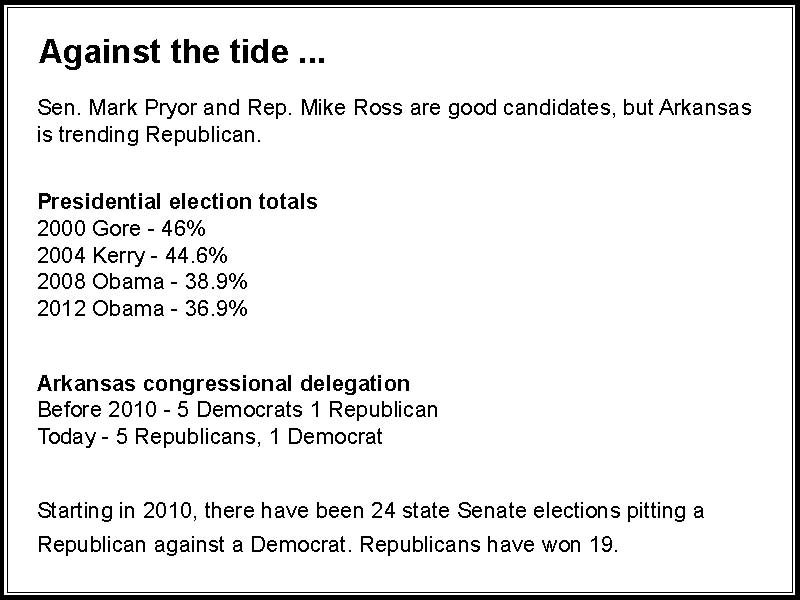
Republicans have used Obamacare – and President Obama himself – to gain a 5-1 majority in the Arkansas congressional delegation and majorities in the state Legislature. The message has been simple: Obamacare is bad.

But that message ignores the health care system’s serious problems. It hasn’t insured millions of people. Before Obamacare, it cold-heartedly denied insurance to those with pre-existing conditions and stopped covering them if they cost too much money. It’s 18 percent of our gross domestic product, far more than the rest of the industrialized world. A big reason Medicare has challenges is because it’s paying to treat seniors within this system.

Republicans, including Cotton, have focused far too much on what’s wrong with Obamacare and not enough on their own ideas. “Obamcare is bad” is not a health care policy.

Cotton’s Medicare votes are becoming a bigger political problem than Pryor’s support of Obamacare, as reflected by recent polls showing Pryor in the lead. By now, everyone who’s paying attention knows that Pryor voted for Obamacare, but they’re just now learning about Cotton and Medicare.

We’ve also reached the point where the news about Obamacare is not all bad. Yes, the employer mandates have been delayed, the website rollout was a disaster, and Obama never should have said that people who liked their plans could keep them. But the latest news, that eight million people have enrolled in insurance plans, gives Democrats the ammunition they’ve needed to return fire on the issue.

In an ideal democracy, the candidates would engage in an honest debate about Medicare’s long-term sustainability and about how to fix a health care system that was broken before Obamacare and still is. That debate, mirrored across the country, would continue in a statesmanlike fashion in Congress after the election, resulting in better policies.

Instead, the candidates will shout past each other – one saying “Medicare!” and the other “Obamacare!” – until November. It’s not an ideal democracy, but it’s the one we have.