
Category Archives: Politics

Here are my Arkansans of the year. Who are yours?

By Steve Brawner
© 2016 by Steve Brawner Communications, Inc.

Recently, Time magazine announced its “Person of the Year,” based on who its editors believe had the most impact, for good or bad, in 2016. It’s choice was President-elect Donald Trump.

Based on that criteria, who would be the Arkansans of the Year?

The list would have to include David Couch, the attorney who – basically by himself with the financial support of two donors – legalized marijuana for medicinal use in Arkansas. Couch proposed the amendment and qualified it for the ballot in a way that it survived a Supreme Court challenge when all the other voter-initiated proposals were declared invalid. He helped engineer the removal of a rival medical marijuana proposal. Then he ran just enough of a campaign to pass the measure with 53 percent of the vote.

As a result, Arkansans will have greater access to a natural remedy that clearly helps some patients. Sick people will have an option other than manufactured chemicals produced by industrialized, bottom-line-focused pharmaceutical companies. For some, marijuana will replace opiates, which, though legal, potentially are far more addictive and dangerous, even deadly. At least for now, no longer will otherwise law-abiding citizens be forced to sneak around state and local authorities to help themselves or their loved ones.

At the same time, the drug inevitably will find its way into the hands of people who are not sick, including curious young people using it for experimentation, not medicine. The state has taken a step in the direction of full legalization – the potential destination being Denver, where marijuana stores are more common than McDonald’s restaurants. The medical profession must now incorporate a treatment process it doesn’t fully understand. Employers must now negotiate a regulatory minefield using maps that keep changing.

In the upcoming legislative session, medical marijuana will command the attention of legislators who, in many cases, voted against it. Policymakers must now create a system legalizing a substance in Arkansas that’s still illegal in America, while keeping an eye on an incoming U.S. attorney general who has indicated strong opposition to the drug.

How’s that for impact?

Right up there with Couch is Cindy Gillespie, the state’s new director of the Department of Human Services. While so many others argue about past and future health care systems, she is in charge of administering much of the one we’ve got.

What has her job been like this year? In March, she took over an $8.4 billion agency that was a mess, and began cleaning it up. As of May, there was a backlog of 146,000 Medicaid applications, some dating back to 2013. Now there are less than 9,000, and probably none by the end of December. Her agency is in charge of the controversial private option, soon to be Arkansas Works, where the state buys private health insurance for more than 300,000 Arkansans – more than a tenth of us. Medicaid pays for nursing home patients and children’s health care. It also is responsible for finding temporary and at times permanent homes for the state’s foster children – yet another systemic crisis she is tasked with taming.

Two others would qualify for my list. Sen. Tom Cotton increased his national profile through his forceful denunciation of the Obama administration’s Iran deal and further positioned himself as a future presidential contender. If Hillary Clinton had won, he’d be running for president in 2020. (Bonus points for him for becoming a father for the second time this month.) Christie Erwin’s Project Zero organization this year connected 113 children with their adoptive families. What a huge impact she had on all of them.

Finally, it must be said that “impact” is impossible to measure. Seemingly earth-shattering people and events are soon forgotten. What happens in obscurity can set in motion world-changing chains of events. We must place little stock in journalists, or anyone, trying to explain The Meaning of It All. After all, a baby born in Bethlehem at most would have merited a few lines in the birth announcements at the time.

David Couch, Cindy Gillespie, Tom Cotton, and Christie Erwin – those are my Arkansans of the year. Who would be yours?
Drinking from a fire hose to set pot rules

By Steve Brawner
© 2016 by Steve Brawner Communications, Inc.

When you go to school to be a doctor or a pharmacist or a lawyer, you have to learn how to drink from a fire hose – do a lot of work and absorb a lot of information quickly while bearing important responsibilities.

Good thing that pretty much describes the Arkansas Medical Marijuana Commission, the appointees who will have a little more than a month to create rules for the growers and dispensers authorized by the Medical Marijuana Amendment, which voters passed in November.

The five members of the commission – which includes two doctors, a pharmacist and a lawyer – held their first get-to-know-each-other meeting Dec. 12. About all they otherwise accomplished was electing a chairperson, Dr. Ronda Henry-Tillman, a surgical oncologist, and agreeing to meet again on Dec. 20.

They agreed on that date remarkably fast, which is a good sign because the amendment legalizing medical marijuana doesn’t allow much time for fruitless debate. Rules must be in place 120 days from the Nov. 8 election, which would be March 9. But because a public comment and legislative review are required, the rules must actually be drafted by late January – in other words, a little more than a month from the commission’s next meeting.

Meanwhile, the Department of Health and the Department of Finance and Administration are drinking from their own fire hoses while crafting their own rules and regulations. And when legislators go into session early next year, they’ll be reviewing those rules and passing their own laws to alter the amendment, which they can do with a two-thirds vote. One pre-filed bill by Rep. Doug House, R-North Little Rock, would add 60 days to the timeline. But the Legislature doesn’t go into session until mid-January, and the commission and the affected agencies can’t assume House’s bill will pass.

There’s never been an issue like this in state history. As Gov. Asa Hutchinson’s spokesperson, J.R. Davis, often says, Arkansas is in the process of creating a miniature Food and Drug Administration. And let’s not forget that while marijuana is legal at least medically in 29 states and the District of Columbia, it’s still illegal in the United States of America. The only reason states are passing these laws is the Obama administration made it clear it would look the other way, but President Obama is leaving office next month. President-elect Donald Trump has said he favors medical marijuana, but his pick for attorney general, Sen. Jeff Sessions of Alabama, is a staunch opponent.

So that means that Hutchinson, at one time the head of the federal Drug Enforcement Administration, is leading a state government trying to quickly legalize a drug that’s still completely illegal under federal laws – laws that soon may be enforced again. He’s also trying to administer a program he campaigned and voted against. At least two of the Medical Marijuana Commission members also are known to have voted no.

Eighty-four of the state’s then-135 legislators publicly expressed their opposition prior to the election, though some of them won’t be returning to office. That’s almost two-thirds, and with a two-thirds vote the Legislature can change the amendment so much as to make it virtually meaningless – for example, by tacking on such high fees that few could afford the drug. But that probably won’t happen because there’s another number that will be hard to ignore: 68,505, which is how many more Arkansans voted for the Medical Marijuana Amendment than voted against it.

One other thing that’s kind of interesting about Arkansas’ passage of the amendment: If you look at the map, the states that have legalized marijuana for medical or recreational purposes mostly are on the coasts and along the country’s northern and southern borders. Arkansas is the first Bible Belt state to say yes unless you count Louisiana and Florida, which probably would be a stretch in both cases.

If a conservative state like Arkansas will vote to legalize medical marijuana, then perhaps any state will next. Well, perhaps any state except Utah, home to a large Mormon population, and maybe Alabama, home of Sen. Sessions. He’s soon to be attorney general of the United States, the nation’s top law enforcement official. Did I mention he’s really opposed to marijuana?

Steve Brawner is an independent journalist in Arkansas. Email him at brawnersteve@mac.com. Follow him on Twitter at @stevebrawner.

Please, Congress, if you cut taxes, cut spending too

Uncle Sam hangs on for webBy Steve Brawner
© 2016 by Steve Brawner Communications, Inc.

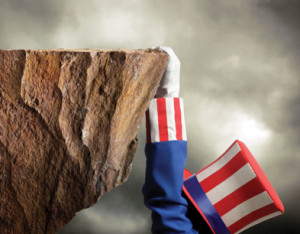
Here’s a simple request of our elected officials when they gather in Washington next year with Republicans in charge of everything: If you’re going to cut taxes, please cut spending, too.

I make that request for the future because I am not reassured by the past – not the past year, or the last 35, or the last 200.

Since 1790, the United States has been in a continual state of debt. There was a brief period in the mid-1830s when the debt was very small – it even briefly was paid off in 1835. But it reached $1 billion in 1863 during the Civil War and has never looked back. It has grown smaller at times as a percentage of gross domestic product, but the overall trajectory has been ever higher. In fact, the last time the United States owed less one year than the previous one was 1957, according to the government’s own Treasury Department website.

It took almost 200 years for the national debt to reach $1 trillion – in other words, 1,000 billions. It crossed that point somewhere around late 1981. By 1990, it was $3.2 trillion; by 2000, it was $5.7 trillion; by 2009, $11.9 trillion; and today, it’s $19.9 trillion. That’s more than $61,000 for every American.

So that’s almost 200 years to reach $1 trillion and then 35 years to reach $20 trillion. This is beginning to look like a death spiral.

That’s a discouraging couple of centuries. Then came this year. President-elect Donald Trump campaigned on large tax cuts while barely mentioning spending cuts. He said he wants to spend more on the military, spend $1 trillion on infrastructure, build a wall along the Mexican border, and leave the growing Social Security and Medicare programs alone.

When he comes into office next year, he will be working with a Republican Congress that will want to act quickly to enact some of its long-suppressed priorities while it controls both the executive and legislative branches. They will want to do big things fast while they still can. In 2001, when Republicans controlled both the White House and Congress, they passed a tax cut and then went on an extended spending spree along with their Democratic counterparts. In 2009, Democrats controlled both the White House and Congress, so they quickly passed their big thing, the Affordable Care Act, also known as Obamacare.

If Republicans want to cut taxes, that’s fine, but that big thing also must be accompanied by another big thing, which is cutting spending by at least an equal amount.

History suggests they won’t do that – that they will focus on the tax cuts and spend more on defense without really cutting spending elsewhere, because Americans like tax cuts and more spending, and elected officials’ jobs depend on being liked.

If tax cuts come first without spending cuts, elected officials will justify it by arguing that the tax cuts will spur so much economic growth that they will pay for the same old spending. And it’s true that tax cuts do spur growth, as does deficit spending. When you have more money, your standard of living improves. It makes no difference, for a time, if that money is borrowed from someone else. But someone eventually has to pay the bill.

So I have this simple request of Arkansas’ congressional delegation: Don’t let history repeat itself. Please, Sens. John Boozman and Tom Cotton, and Reps. Rick Crawford, French Hill, Steve Womack and Bruce Westerman – don’t make the assumption that tax cuts will spur so much growth that corresponding spending cuts can be put off for another time. Have the political will to do both at the same time, and if you don’t possess that will, at least do neither. If your tax cuts more than pay for themselves, then apply the new revenues to paying down the debt, which has not been done since the Eisenhower administration. And if they don’t, then you will have cut taxes and cut spending, which is what you’ve said you wanted to accomplish all along, without adding to the debt.

I make this request on behalf of myself, but also because I have two daughters and eventually expect to have grandchildren too. I’d like to give them an inheritance, not hand them a bill.

Arkansas should honor the most honorable

Statues, statue

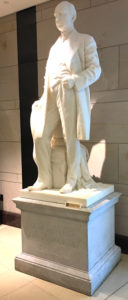
Sen. James Paul Clarke’s statue at the U.S. Capitol, near the entrance.

By Steve Brawner

Hillary Clinton’s running mate, Sen. Tim Kaine, said Aug. 20 that Virginia could “do better” in picking its two historical figures to honor with statues in the U.S. Capitol  than George Washington and Robert E. Lee.

Certainly, Arkansas could. Unlike Virginia, our state is honored in Congress’ National Statuary Hall Collection by two figures occupying very small spaces in anyone’s history books.

One is Uriah Rose, founder of the Rose Law Firm and a nationally prominent attorney during the latter half of the 1800s and early 1900s.

The other is James Paul Clarke, Arkansas’ 18th governor from 1895-96 who then served more than two terms in the U.S. Senate after the turn of the century. He was president pro tempore of the Senate, broke with his party to support the Panama Canal, and supported progressive legislation, including opposing literacy tests for immigrants.

White supremacy views, not a titanic figure

Clarke also, according to the Encyclopedia of Arkansas, supported white supremacy. Campaigning for governor in 1894, he said, “The people of the South looked to the Democratic Party to preserve the white standards of civilization.”

We are all products of our time, but Clarke clearly doesn’t represent the best of Arkansas, and he doesn’t represent all Arkansans. The state should grant its highest honors to the most honorable.

Aside from his views on race, he is not a titanic historical figure in Arkansas history, much less American history. Certainly, he does not compare to historical figures representing other states, such as Washington or Kansas’ Dwight Eisenhower. One of Oklahoma’s is Will Rogers, while Helen Keller is one of Alabama’s. On the other hand, many states also are represented by forgotten or forgettable figures and by those who also should be replaced, such as Mississippi’s Jefferson Davis, president of the Confederacy.

Perhaps Arkansas should follow the lead of some states that have replaced statues in recent years. California swapped one of its statues for President Reagan in 2009. Michigan honored President Ford with a statue in 2011. Arizona enshrined Sen. Barry Goldwater in 2015. In 2016, Ohio replaced one of its own white supremacists with Thomas Edison, paying the sculptor $80,000 for the job.

Replacing a statue would require an act of the Legislature. It also would require funding.

I’m doubting Clarke would have many defenders. The controversy would involve paying for the new statue and, of course, deciding who to pick.

Who instead?

According to the 1864 law establishing the collection, the statue must honor a deceased person. Some off-the-top-of-my-head suggestions would be:

– Hattie Caraway, the nation’s first female senator.

– Daisy Bates, civil rights leader and mentor to the Little Rock Nine as they integrated Central High School.

– Johnny Cash, famous country singer.

– Sam Walton, founder of Walmart.

The selection would not have to enjoy universal support. Not every Californian is a Reagan fan, and even Edison has his detractors because of his sometimes ruthless business practices. But the statue must honor someone historically important, clearly tied to the state, and recognizable. It should be someone of whom Arkansans could say, “We had the only one of these, and you didn’t.”

History changes as our lenses get longer. Those who seem important today can be forgotten tomorrow. Some should be forgotten. And some really weren’t that memorable to begin with.

Arkansas should find someone else to represent the state. Who would you pick?

© 2017 by Steve Brawner Communications, Inc.

Castro’s death moves Cuba farther into the market for Arkansas rice, ideas

By Steve Brawner
© 2016 by Steve Brawner Communications, Inc.

Fidel Castro is dead. How does that affect people in Arkansas? Maybe a lot, especially if they work in the rice industry or are elected to represent people who do.

Cuba’s 11 million people import 400,000 tons of rice each year, mostly from Vietnam, which means the rice arrives after a long boat ride from a country on the other side of the globe. Rep. Rick Crawford’s eastern Arkansas 1st District includes half of America’s rice acreage, so it’s understandable that his reaction to Castro’s death focused on the future, not the past.

“Fidel Castro’s death is an opportunity for America to end its ineffective policies so we can influence the future direction of that nation,” he tweeted, then added, “Through my own visits to Cuba I’ve seen people ready for change. With Fidel dead, America needs to help lead Cuba toward a better future.”

Crawford for some time has been an outspoken supporter of prying open Cuba’s markets, which have been largely closed since Oct. 19, 1960, because of the American trade embargo. He’s pushed legislation to allow Cubans to purchase agricultural products on credit rather than the currently required cash, of which Cubans don’t have much, so they could replace that Vietnamese rice with fresher, cheaper rice grown here.

Two other Arkansas officials who represent those same eastern Arkansas agricultural producers (and voters) took a similar forward-looking approach. Sen. John Boozman tweeted, “I hope the death of Fidel Castro marks a new beginning for an American-Cuban partnership and brings light to democracy in #Cuba.” Speaking to reporters, Gov. Asa Hutchinson called Castro’s death a “moment that I believe needs to be seized.”

President-elect Donald Trump said he would terminate the current opening with Cuba initiated by President Obama unless Cuba makes a better deal for its own people, for Cuban-Americans, and for the United States. That threat may have just been the country’s new dealmaker-in-chief doing what he does, which is start the negotiating process by taking a hard line and then moving away from it.

In response, the governor said Trump’s stance is “understandable,” but while change must be accompanied by enhanced freedom for Cubans, “I hope that we do not go back to the simple, straightforward, rigid embargo that we have tried for 50-plus years.”

Hutchinson and Boozman represent the state while Crawford represents his district, so their remarks were meant for those audiences. Sen. Tom Cotton has an additional audience – a national one. It includes many people who, like him, have argued that this thawing of relations between America and Cuba will only help the Castro regime. Cotton released a two-sentence comment focused on the past, except for one assertion of Castro’s future: “Fidel Castro created hell on earth for the Cuban people. He will now become intimately familiar with what he wrought.”

Count me with Crawford, Boozman and Hutchinson on this one. The American people are supposed to be practical-minded problem-solvers who, when something doesn’t work, try something else. We’re the country where Thomas Edison invented the light bulb through experimentation, failure and more experimentation. And yet when it comes to its Cuba policy, we’ve stubbornly tried the same thing for 56 years that clearly didn’t work. Only old age and death, not the American trade embargo, removed Castro from power. Now his brother, Raul, remains in charge. He’s 85, by the way.

Pry open the doors to Cuba, let in a little freedom, and see what happens. Arkansas rice will be more than just an item on the dinner table. It will be a taste of what a free market economy offers. As Cuba opens itself to visitors from Arkansas and elsewhere, it will not be able to choke off ideas that are contrary to its glorious revolution. Fifty-five years after the failed Bay of Pigs invasion, an army of businessmen, tourists and missionaries will descend on an island 90 miles from Florida, accomplishing what the embargo never could.

Somebody’s going to sell rice to the Cubans, and when they do they’ll also export their ideas and way of life. Currently, that exporter is Vietnam, another repressive communist regime. I think Arkansas offers a better deal.