Category Archives: Politics

He was playing chess; she was playing checkers

By Steve Brawner
© 2017 by Steve Brawner Communications, Inc.

Donald Trump won the Republican Party nomination because he was playing checkers while the other candidates were playing chess, and it was a checkers year. In November, the opposite happened: He checkmated Hillary Clinton while she was playing checkers.

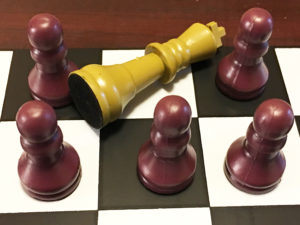
Remember the primaries? Those 16 other mostly conventional Republican candidates were all playing chess – trying to execute their grand strategies and position themselves for Trump’s inevitable fade, or to be the last person standing against him. While they were staring at the chessboard, he just kept bouncing from state to state on the checkerboard until he reached the back row and shouted, “King me!”

In the general election, however, it was Clinton who tried to play checkers, while Trump realized it had become a chess match.

Checkers is a simple game, which is why we don’t hear much about “checkers masters.” The strategy involves a balance of offense and defense: You try to reach the opponent’s back row without allowing them to reach yours. If you play too aggressively, you leave yourself open, so it’s best just to plod along, pick up pieces and look for the double jumps.

That’s what Clinton did. Once she had that small lead in the polls, she played it safe and ran a same-old, same-old campaign. She didn’t reach out to voters who ordinarily wouldn’t support Democrats; those were discarded into her “basket of deplorables” and forgotten about. She thought her back row was protected by that supposed “blue wall” of states like Michigan and Pennsylvania that of course would vote for the Democrat because they always had. When that old Trump video where he talked about grabbing women surfaced, she thought she’d made a double jump right onto his back row.

Trump, meanwhile, was playing chess. Chess is an offensive game where you win by taking the opponent’s king regardless of what it costs you, and often by surprising the opponent. With checkers, you always know who’s winning; with chess, the player with fewer pieces can suddenly strike and end the game. So while Clinton’s campaign (and most pundits) were counting the number of checkers left on the board, Trump’s campaign found some holes in that blue wall and exploited them.

Meanwhile, Trump did what Clinton refused to do or could not do – find new voters.

The modern Republican Party has been an awkward coalition of business elites and socially conservative regular Americans whose interests sometimes conflict, particularly lately when those business elites are getting really rich while many regular Americans are struggling.

Trump saw that there are a lot more regular Americans than there are business elites, and some who typically vote for Democrats could become his voters. He could speak to them in a way that Mitt Romney couldn’t in 2012 because Trump is blunt and earthy and understands popular culture, and because Clinton, the daughter of a middle class Chicago small businessman, had become one of those elites herself. He wasn’t going to lose the regular Americans he already had, and he didn’t need the elites’ money because he’s already rich, he was getting so much free air time, and he’s a wizard at using free social media.

He realized that he could appeal to regular Americans’ legitimate fears and concerns – and, for some, to their misplaced grievances and their unacknowledged prejudices – by using the most effective and darkest campaign slogan in recent American history. A lot’s implied in “Make America Great Again,” especially that last word, “again,” as in, “It used to be great, but it’s not now, and here are the groups of people responsible for that.”

In the end, Clinton had 3 million more votes across the country, but Trump won the states that mattered most. Her checkerboard had more pieces, and so did her chessboard, but the checkers game didn’t matter, and he had surrounded her king with a bunch of pawns.

He recognized what no other candidates saw this election except perhaps Sen. Bernie Sanders – that the game was different this time. In fact, both games were, and the trick was knowing when to play which. That’s why the Republicans who were playing chess had to king him in checkers. That’s why he captured Clinton’s king in the general election chess match while she was moving her checkers around the board. And that’s why he’s the nation’s 45th president, and they’re not.

Related: Trump played checkers and they played chess – in a checkers year
2016 wasn’t so bad

By Steve Brawner
© 2016 by Steve Brawner Communications, Inc.

More than a few people are expressing their hopes for a happy new year by saying good riddance to the old – the basis being that they aren’t happy with the presidential election, along with the fact that a lot of famous people died in 2016, especially lately.

The truth is that famous people die every year, and it’s not the year’s fault. Also, whatever you think about the election, the good news is that we had one.

Consider that on March 1, almost 632,000 Arkansans went to the polls to help select the two major party candidates. Then in November, about 1.13 million Arkansans voted in the general election for one of those two candidates or for one of six others. In January, the current president will peacefully hand the Oval Office’s keys to his successor and become a private citizen, while the new president takes the reins of power only temporarily.

This process is fairly common around the world these days but rare throughout history, when power has often been transferred through war or intrigue or birthright. George Washington came along and just gave power up. As flawed as it was, the 2016 presidential election was a blessing, not a curse, when you consider many of the possible alternatives. As Winston Churchill once said, “Indeed it has been said that democracy is the worst form of government except for all those other forms that have been tried from time to time.”

In fact, the 2016 campaign in some ways was remarkably open and democratic. The Republicans offered 17 candidates for president, each of whom had ample opportunities to make their case to the voters. Donald Trump won in part because he inspired first-time or infrequent voters to go to the polls. The Democrats offered the first female major party nominee, and her gender was not the defining issue. Third party candidates were treated, at least for a time, as candidates, not asterisks.

The campaign gave a shot of adrenaline to a political process that has grown predictable and stale. This time, the usual left-versus-right narrative simply didn’t apply. Both Trump and Bernie Sanders gave voice to legitimate concerns about global trade and the unevenness of the economic recovery. Moreover, they made their cases largely through oratory and direct communication rather than formulaic 30-second television advertising, which has been the norm. In November, the candidate who raised a lot less money and ran far fewer ads won by using tools that are at least theoretically available to others: a message that drew crowds and media attention, and social media.

Here’s where some of you say, “But Trump …”

I know, and I share many of your concerns. I voted for John Kasich in the Republican primary and the independent Evan McMullin in November – two candidates I believed offered positive, unifying visions. But, for one column, let’s look on the bright side, or at least all sides. It’s wrong to look at the world through rose-colored glasses, but it’s also a mistake to reach for the gray ones instead. In fact, it’s worse.

It wasn’t just in national politics where 2016 wasn’t so bad. In Arkansas, the Legislature met three times and along with Gov. Hutchinson produced tangible results in health care and highway funding. The unemployment rate in Arkansas is about 4 percent, which is far below the national average. Granted, that’s partly a result of the high number of former workers who have dropped out of the labor force, but clearly things are better than they were.

The Charles Dickens novel, “A Tale of Two Cities” begins with the words, “It was the best of times, it was the worst of times.” Based on the way so many people talk these days – and have been for the past decade or two – you’d think these are just the worst of times. Let’s be realists, not cynics. By many measurements, Americans live better than 99 percent of all people who have ever lived.

So may we each have a happy new year while keeping the right perspective on the old one. Maybe it wasn’t the best of times, but the times certainly weren’t the worst.

Bathrooms at the Capitol

CapitolBy Steve Brawner
© 2016 by Steve Brawner Communications, Inc.

When the Legislature meets in regular session starting in mid-January, Gov. Asa Hutchinson wants to cut taxes, increase funding for the state’s foster care system, and change the way colleges and universities are funded.

What he does not want is a bathroom bill.

Hutchinson does not want Arkansas to have the same experience as North Carolina. There, the city of Charlotte passed a broad gay rights ordinance which included a provision allowing individuals to use bathrooms based on their gender identity. The state Legislature then passed a bill repealing it and prohibiting all other cities from enacting their own local gay rights ordinances. Attracting the most attention was a provision whereby the state became the first to require individuals to use bathrooms corresponding to the gender listed on their birth certificate, a listing the legislation allowed those individuals to change.

That law made North Carolina ground zero for this latest culture war battle. Entertainers and, more importantly, big businesses expressed their disapproval. The NCAA pulled championship tournaments, the NBA cancelled an All-Star Game, and the company Paypal scuttled a plan to expand there. The Republican governor in November lost to his Democratic challenger – which didn’t happen in many places. A deal was made with the city of Charlotte where both the local ordinance and the state law would be repealed, but the Legislature voted Dec. 21 to keep the law in place.

While all of this was going on, the Obama administration released a heavy-handed “guidance” to every public school in the nation strongly encouraging them – underline “strongly” – to allow students to use restrooms and locker rooms conforming to their gender identity.

When that guidance was released, Hutchinson reacted by telling schools they should ignore it and make their own decisions. But he does not want Arkansas to become embroiled in a North Carolina-like controversy while he’s trying to court businesses from elsewhere.

He said in a press conference Dec. 20 that he has had “a lot of discussion” with legislators in hopes of keeping the focus on other areas. His view is that the issue is now being considered by the court system, that the Trump administration should be less intrusive than President Obama’s, that Arkansas doesn’t seem to have a big problem with bathroom controversies at the moment, and that, when it comes to schools, local administrators and school boards can handle this kind of thing without any edicts from above.

If anyone were to sponsor a bathroom bill, it would seem to be Rep. Bob Ballinger, R-Hindsville. The legislator sponsored the controversial Religious Freedom Restoration Act in 2015. Supporters said it was meant to protect business owners from having to violate their consciences by requiring them, for example, to participate in a gay wedding. Opponents said it allowed more discrimination.

Ballinger said recently that he does not intend to file a general bathroom bill and does not know of anyone who does, but he can’t speak for 134 other legislators. Instead, he’s looking at more specific bills – for example, one that targets acts of indecent exposure in bathrooms, and one that increases the penalties for taking photographs of victims in stalls.

“There’s some things like that, that I expect that we’ll probably address simply because we have a change in culture, and with a change in culture you’ve got to have laws that are consistent with it in order to protect the public,” he said.

That’s a better way to handle it, at least for now, than some far-reaching bill. Address harms on which most of us should agree. Anyone want to defend indecent exposure and unwanted picture-taking in the bathroom? Meanwhile, avoid a humongous controversy until one might be necessary.

The whole bathroom debate took an ugly turn in 2016 and played a bigger role in the elections than it’s being given credit for. Maybe 2017 will offer more clarity through the new presidential administration or a court decision. Maybe society will come to a reasonable consensus that respects everyone’s vulnerabilities without the federal government telling every establishment in the land what their bathrooms have to look like – and without any level of government adding “patrol bathrooms” to the list of police officers’ duties. Maybe it will become more commonplace for establishments to have only single-toilet, gender-neutral restrooms with locking doors. We’ll have to stand in line longer sometimes, but we’ll have more privacy.

Whatever happens, may we all just go to the bathroom in peace. Happy 2017.

The six voters who mattered

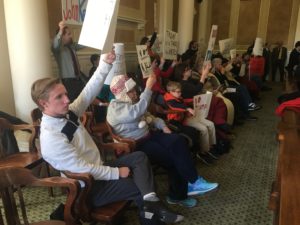
Arkansans hold signs imploring electors not to vote for Trump.

Arkansans hold signs imploring electors not to vote for Trump.

By Steve Brawner
© 2016 by Steve Brawner Communications, Inc.

The campaign that began a year and a half ago finally, mercifully ended Monday in the Capitol’s Old Supreme Courtroom, when the only six Arkansans who ultimately mattered in this presidential election one by one said firmly and clearly, “Donald J. Trump.”

Those six were Arkansas’ electors who, in the previous month, had been the subjects of a campaign themselves. Keith Gibson of Fort Smith said he received 70,000 emails, along with 100 handwritten letters and about a dozen phone calls. Most were from out of state and many were just copies sent to other electors with his name inserted, and those didn’t demand much of his attention. But many were personal, emotional and sincere as they pleaded with him not to vote for Trump. Mom was right; he paid closest attention to the handwritten ones.

The campaign to change the electors’ minds occurred because, while they were pledged to Trump, they could vote for whomever they wanted regardless of that little exercise involving 1.13 million Arkansas voters Nov. 8.

Did any of it make a difference? No, but Gibson did listen.

“What I can say is that I read the letters and considered the position of those who asked me not to do that, but I don’t think I ever came to a point where I said I will not do that, I will vote for someone else,” he said. “I never reached that point.”

In the courtroom were about 40 protestors sitting quietly, many of them holding handmade signs. “Our forefathers planned for this day,” read one sign, while another encouraged the electors to vote for Ohio Governor John Kasich, who managed only 3.72 percent of the vote, including mine, in Arkansas’ May primary.

Billy Marshall of Malvern held a sign saying, “I’m sorry I voted for Trump. Save America.” He said he had voted for Trump because, “Like everybody else did, I guess, make America great.” But events since the election had changed his mind, including the involvement of the Russians and Trump’s cabinet appointments.

“What I’ve seen, he lied through his teeth,” he said. “He’s not even keeping up with what he said he was going to do.”’

The electors made their selection while sitting in the old justices’ chairs, which sit regally several feet above the rest of the courtroom. They were separated from the sign carriers by a distance of 10 yards and by a wooden railing.

The gap between what they were doing and what the sign carriers wanted them to do was much wider, but Gibson and several of the electors tried to bridge it. Prior to the vote, they approached the protestors and spoke sympathetically with Suzanne Scherer of Fayetteville, who voted for Hillary Clinton and wanted them to do the same.

“I long for the day when we can have cordial dialogue again, where both sides can participate in a meaningful debate without hating each other,” Gibson told me he said to the protestors that day.

Despite their earlier conversation, after the votes were cast for Trump and his running mate Mike Pence, Scherer said loud enough to be heard, “You voted for a facist.” “President! He’s our president!” replied a man not carrying a sign from the other side of the room. At that point, Secretary of State Mark Martin announced that anyone else who spoke out would be escorted from the room. “You voted for a homophobe,” said a woman, and she was led out by Capitol police.

This is the second time in five elections that the winner of the popular vote lost the election. We’re told that’s a non-issue because the wishes of voters in small, rural states like Arkansas were protected against the potential power of those Left Coast Californians who happen to be on the wrong side of the not-one-person-one-vote system. And if something would have happened since Nov. 8 that unquestionably called Trump’s legitimacy into question – and goodness knows what that would have to be – the electors would have served as the nation’s reserve parachute.

So six Arkansans voted for Donald J. Trump based on the wishes of 684,872 voters who cast ballots for him Nov. 8. We could do better and we could do worse, but we’re not going to do anything different any time soon. So after this long, bitter campaign, let’s try some of that cordial dialogue and meaningful debate Gibson was talking about, without hating each other.

Related: Every county is purple.

Electing judges: Is it the people’s will, or politics?

golden balanceBy Steve Brawner
© 2016 by Steve Brawner Communications, Inc.

Should judges in Arkansas be democratically elected after collecting campaign donations from the same lawyers and corporate interests that bring cases before them? Or should an appointment process be created, reducing the influence of money but also the role of the voters?

Because we already use deeply flawed process number one, we probably will not open up the can of worms that would accompany flawed-in-other-ways process number two.

The past few years have demonstrated some of the challenges with electing judges. In one case, a circuit judge reduced a jury’s verdict in a nursing home case from $5 million to $1 million after receiving campaign money from the nursing home’s owner. That judge pled guilty to bribery, was sentenced to 10 years and has since appealed. Meanwhile, the past few Supreme Court races have sunk beneath the dignity of the office because of ad campaigns run by anonymously funded, independent political action committees, otherwise known as “dark money.” One losing candidate, Tim Cullen, was dragged through the mud because he had once been appointed by a judge to represent a convicted sex offender – a distasteful assignment to be sure, but in America, unlike in some other places, we try to guarantee the right to a fair trial.

In addition to the corrupting influence of money, the other problem with electing judges is that voters have limited information. Candidates aren’t supposed to tell us how they’ll vote on cases because they should remain neutral until they hear the facts in court. Also, judicial elections are nonpartisan, so voters can’t use party labels as a guide. Ironically, the other problem with judicial campaign donations is that candidates don’t collect enough to purchase a big ad campaign that would really introduce themselves. The whole process results in many voters picking a name on a list.

But for all their messiness, elections are the way we do things in America. It’s how we imperfectly keep small groups of individuals from amassing power and acting contrary to the people’s will from behind closed doors.

The difficulty of coming up with a better system was demonstrated Friday during a meeting of the Arkansas Bar Association’s House of Delegates, the attorney group’s policymaking body. A task force had submitted a plan for electing Supreme Court justices where an appointed commission would offer three names to the governor, who would then choose one. According to the proposal, 22 states use that kind of process. If it passed, the Bar would find a legislator sponsor who would try to get it referred to the voters in 2018 as a proposed constitutional amendment.

The vote was 34-20 in favor, which was short of the required three-fourths majority, so it died. During the debate, a couple of the delegates said their lawyer constituents overwhelmingly oppose ending elections. Another delegate relayed a message from the five returning Arkansas Supreme Court justices and the two recently elected ones revealing that they unanimously support keeping elections. By voting for the proposal, the attorneys would be at odds with the justices before whom they may someday appear.

There are lots of ways to select judges. In some states, including Missouri, a commission presents nominees, the governor appoints one, and then, after a probationary period, the judge stands before voters in an up-or-down retention election with no other candidates on the ballot. But in the spirit of this glass-half-empty column, retention elections have the same issues as the current system – money and politics.

Even without the Bar’s support, some legislator next year probably will propose a constitutional amendment for appointing rather than electing judges. Gov. Asa Hutchinson favors some kind of change. However, there’s not widespread support in the Legislature – not enough to make it one of two or three issues referred to the voters. As another solution, Democrats have introduced a bill that would require dark money groups to disclose their donors. However, there aren’t many Democrats left in the Legislature, and besides, an argument can be made that people have a right to donate anonymously to groups that align with their beliefs.

So in 2018, we’ll probably be electing judges and justices pretty much like we have in the past. It’s not perfect, but, as is often the case, we’ll choose the problems of the current system over different problems that would come with a new one.