Category Archives: Inspirational

He has an iPod. He wants a family.

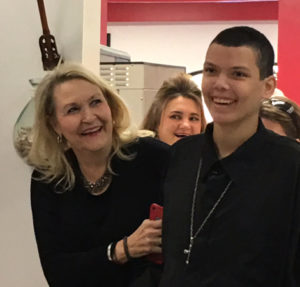
Anthony arrives at his birthday party with Project Zero's Christie Erwin. Behind them is Angela Newcomb with the Division of Children and Family Services.

Anthony arrives at his birthday party with Project Zero’s Christie Erwin. Behind them is Angela Newcomb with the Division of Children and Family Services.

By Steve Brawner
© 2016 by Steve Brawner Communications, Inc.

“Oh, my word,” Anthony said, his eyes lighting up as he saw that one of his gifts was an iPod Touch – one of many presents he received that day at his birthday party at a Little Rock restaurant.

What he really wants is a family.

The 15-year-old is one of more than 375 Arkansas children waiting to be adopted through the state’s Division of Children and Family Services (DCFS). He’s been in foster care since he was nine as a result of abuse and neglect, and he now lives in a group home.

DCFS employees try to find a home for every kid, but Anthony is special. Angela Newcomb, the area director over the county that works with him, has been working with the agency 17 years, but she’s no hardened state employee. Watching Anthony at the birthday party, and hearing him talk about his desire for a family, brought tears to her eyes.

“Anthony, he touches my heart because I know there’s got to be someone, someone that’s willing to take him in and love him like he needs to be loved and meet his needs,” she said. She can be reached at angela.newcomb@dhs.arkansas.gov

Anthony is loving and affectionate, but 15-year-olds are much harder to place than cuddly babies, and he was born premature and has some challenges to overcome. If no parent is found, he’ll age out of the system. There will be services available for him, but he will not have a family to offer love and support, which is why young people who age out often have a tough time in life.

Continue reading

In praise of being naive

By Steve Brawner
© 2016 by Steve Brawner Communications, Inc.

Somewhere there is a perfect spot on the spectrum between being naive and being cynical, and humans should try to find that perfect spot. But humans err, so err on the side of being naive.

I write that in the face of the most cynicism-inducing election of my lifetime. And I’m apparently not alone because a deep cynic would say that voting itself is an act of naivety, and yet Arkansans and people across the country are lining up at the polls to do it anyway.

Keep in mind that, regardless of what you think about this year’s choices, at least we had them: for the nation’s chief executive, for lawmakers and for local officials. For more than a year, two rich and powerful people who want to become even more powerful have been required to traverse the country as part of the world’s most challenging job interview. Arkansas voters this year also have a direct say in the governor’s powers; in how long county officials stay in office; in how much debt the state can incur for economic development; and whether marijuana should be used legally for medicinal purposes. True, my vote did not count for much. But it counted exactly the same as everyone else’s in Arkansas.

Giving an average citizen this kind of say is rare in world history but not so rare in today’s world, in large part because of the example set by the country where God let me be born. That’s pretty cool, which is why, even in the midst of all the cynicism of A.D. 2016, just about every polling machine was occupied at my early voting site in Benton, and why, afterwards, a family stood outside the polling place snapping a photo of their son who must have voted for the first time. They all looked pretty proud, but I guess they were just being naive.

Believing a New World would offer religious and economic freedom? You might call that naive. So was believing that freedom was worth fighting for. That self-government was possible. That former slaves and the children of slaves could participate in a society with former slaveowners and their children. That a railroad could be built across a country and a canal dug between the oceans. That wars could be won on foreign shores, and democracy was possible in far-off lands. That a man could land on the moon – in less than 10 years, no less.

It takes a certain naivety to do these things; it certainly doesn’t happen through cynicism. Cynicism is inherently an attitude of powerlessness and inaction, which is why cynics do not grow many successful businesses, plant churches, begin charities, or start movements that change things for the better. Cynicism is self-centered and fearful, and it assumes the worst of people to the point of gross inaccuracy. It’s incompatible with achievement and service because why try to achieve if seen and unseen forces doom you to failure? And why serve if you are only going to be taken advantage of? True, there are some very rich cynics today. But a lot of them only got that way by appealing to others’ cynicism.

Yes, naivety can lead to disaster, because it’s based on trust, and sometimes trust is misplaced. But better to trust too much than not enough. After disaster, a naive person can still “stoop and build ‘em up with worn-out tools,” as Rudyard Kipling wrote, because he trusts those tools.

I’ve heard it said and implied many times this year that, if either Hillary Clinton or Donald Trump wins this election, then the country will not survive.

But such deep, pervasive cynicism is far more dangerous than the outcome of one campaign. It leads to the kind of “We pretend to work and they pretend to pay us” attitude of the old Soviet Union. In the United States, structures are still in place that will limit the damage either Clinton or Trump will cause. But a cynical people quits trying, which can’t be overcome.

Anyway, I’m pretty sure there’s going to be another election in four years, and we can all give it another shot. Call me naive.

19 not-angry students

By Steve Brawner
© 2016 by Steve Brawner Communications, Inc.

All adults have been 18 once, but most of us have not been 18 in 2016. There’s a difference, which I kept in mind as I spoke to 19 freshmen taking part in a special leadership course at the University of Arkansas at Fort Smith last week. 

The students were there because the university’s chancellor, Dr. Paul Beran, believes they’re future leaders, and for some reason he thought I might have something to say to them. So I encouraged them not to get mad. Proverbs 22:24 says, “Make no friendship with an angry man,” so don’t be that angry man. 

Thankfully, that message turned out to be merely a warning, not a scolding, because I didn’t see a lot of anger in that room. I don’t spend much time around 18-year-olds, but I was struck by this bunch’s youthful optimism and positive outlooks. One student named Kelsey completely disagreed with one of my comments, but in the most respectful way possible. Maybe she was simply showing deference to her elder, but while her eyes were passionate, they were not unkind or condemning.

Gosh, I hope she stays that way.

I choose to believe that those young people looked cheerful and optimistic because they really are cheerful and optimistic. So the question becomes, why them and not so many of us? 

Part of it’s just being young, of course. It just feels better than being older, physically. 

But 18-year-old future leaders also lack two bad habits that many of the rest of us have developed – the media we consume, and the things on which we focus.

These young people watch the news some, but that’s about it. They have things to do, tests to study for, friends to hang out with, and future mates to seek. So they’re not going to spend three hours listening to a news anchor or talk radio host yell about the latest manufactured controversy. Plus, young people simply don’t get their news that way, thank goodness. They get their news in bite-sized chunks and move on.

The other thing I suspect about these students is that they spend more time in the “circle of influence” than they do in the “circle of concern.” Those are two illustrations by the late Dr. Stephen Covey, author of “The Seven Habits of Highly Effective People.” The circle of concern is a big circle involving all of the things we worry about. Contained within is the smaller circle of influence, which involves what we can actually affect. 

Our attention should be focused on the circle of influence, but as adults it can be very tempting to wallow in the circle of concern. The word “ruminant” refers to animals such as cows that chew their food, swallow it, and return it to their mouth to chew it again. Too many of us adults spend too much time ruminating about things we can’t control, like this year’s presidential race. We internalize it, spit it back up and then chew on it some more, this time mixed with bile. The students at UAFS seemed to be following the race, and many seemed to share in the widespread disappointment with this year’s choices. But maybe because they have other things to do – things they can influence, like the next test – they aren’t ruminating on it.

The late comedian George Burns used to sing, “I wish I was 18 again and going where I’ve never been. But old folks and old oaks standing tall just pretend. I wish I was 18 again.” 

Until someone invents a time machine, that wish won’t come true – which means it never will, because if it were possible to travel back in time, we would have already met someone from the future. Still, even old folks and old oaks can recapture some youthful optimism by turning off the TV and focusing less on what we can’t change, and more on what we can.

Looking on the bright side in 2016

Hand with ballot and boxBy Steve Brawner
© 2016 by Steve Brawner Communications, Inc.

This presidential election is producing two major party nominees with extremely high unfavorable ratings. You’re probably either a big fan of either Donald Trump or Hillary Clinton, or you dislike them both a lot. If you’re part of that large latter group, you might think this presidential election is a disaster.

What if it’s not? Is it possible to lament this year’s results and still see the good in this year’s process? Yes.

The American political system in recent decades has grown stale, with both parties offering cliched, uncreative arguments designed more to appeal to special interest groups than to solve problems. Important issues – such as how the global economy is affecting America’s lower middle class – haven’t really fit into the script. No wonder so many voters have dropped out or never dropped in.

Say what you will about Donald Trump and Bernie Sanders, but they don’t read off a script. And thanks to them, the campaign is largely about often-ignored issues such as income inequality, crony capitalism, campaign finance reform, and the fact that the global economy produces both winners and losers. Trump has shown that a candidate can speak like an actual person by refusing to bow to political correctness. Sanders has offered big government prescriptions without pretending that he’s not – which means that at least he’s honest about it – and he’s showing that strong convictions, sincerely expressed, can inspire a lot of voters and small donors.

Importantly, Trump and Sanders have shown that elections can be decided by actual voters, not big money or the party establishment, each of which dislikes them both. They’ve done this in part by attracting millions of new voters to the process: Trump, disaffected blue collar workers; and Sanders, young people. While Jeb Bush, the anointed one, and his allies spent $130 million to no effect, Trump won his party’s nomination through his use of the media and social media, both of which cost candidates very little. Sanders is competing well with Clinton through small donations given by average people.

Moreover, the next few months could inspire Americans to seriously consider their political alternatives. It’s possible – though unlikely – that conservatives will rally behind a third party or independent candidate. The small-government Libertarian Party likely again will nominate former New Mexico Governor Gary Johnson, a legitimate candidate. Americans who want 40 choices in the cereal aisle may finally be open to more than two at the ballot box.

Finally, this election – and the past two – have reflected American diversity like none before. After eight years of having our first African-American president, Americans may next give that job to a female – 96 years after women finally attained the right to vote. Two of the four leading Republican vote-getters, Sen. Ted Cruz and Sen. Marco Rubio, are the sons of Latino immigrants. Sanders is Jewish. Dr. Ben Carson advanced farther than any African-American has ever advanced in a Republican primary.

Let’s not discount that this election has produced much divisiveness and two major party nominees many of us don’t support. At times, it’s been extremely discouraging for voters like me. I voted for Ohio Gov. John Kasich.

But let’s also not ignore the rest of the truth. This campaign has upset a status quo that needs to be upset, inspired millions of people who previously didn’t vote, shown that voters aren’t complete hostages to big money and the party establishments, and celebrated America’s diversity by producing diverse candidates.

Same-old, same-old will not solve America’s problems. Maybe in 2020, a plain-speaking, budget-balancing problem-solver can apply lessons learned from Trump and Sanders.

Of course, in my opinion, we had that in Kasich. But he lost. So God bless America. This is the system we have, and the people are speaking – loudly. It’s imperfect but seldom disastrous. In world history, most people would trade theirs for ours.

Feel better?

Related: Trump played checkers and they played chess in a checkers year.

Trading an empty nest for a full house

By Steve Brawner
© 2016 by Steve Brawner Communications, Inc.

Maria and her three younger sisters needed a home, while John and Tricia Goyer had too many empty bedrooms. Thankfully, they solved each other’s problems.

The story starts 27 years ago, when Tricia, 44, had her first child as an unwed 17-year-old. She’d been born to a single mom, would not know her biological father for another 11 years, and didn’t have much of a relationship with her stepdad.

Then she married John. He adopted her first child, and they had two of their own, the youngest when Tricia was 22. She’s a successful author and novelist, while he’s a computer security analyst for a large international company. Set to be empty-nesters by the time she was 40, they were thinking about traveling, scooting around in a convertible, and then coming home to their six-bedroom house.

That’s when their story had a plot twist. They had a heart for girls in tough situations. She’d started a group for teen moms at the family’s Mosaic Church in Little Rock. Through the ministry, she’d watched five girls age out of foster care and then quickly become pregnant. She knew from experience they were looking for love in the wrong places because they hadn’t found it in the right ones. So the Goyers started adopting – first a baby privately, and then two more through the Department of Human Services.

Then came Maria, 16, and her three sisters, who come from an abusive and neglected background. Their mother was a meth user. They spent six years in the foster care system, sometimes apart. At times Maria thought she would never have a family.

She’s not alone. Arkansas’ foster care system oversees more than 4,900 children, 1,200 of whom are waiting for a foster family to give them a temporary roof over their head, much less a permanent one. They’re staying in group homes and wherever the Department of Human Services can find a place for them. Six hundred children have had their parents’ rights terminated and are waiting to be adopted. The older they are, the less likely that will happen.

On April 30, the need for caring families was spotlighted at the Walk for the Waiting at Little Rock’s War Memorial Stadium. The annual faith-based event is sponsored by The CALL and Project Zero, two groups that work with DHS to recruit families, and Immerse Arkansas, which supports some of the 250 teenagers who age out of the system every year without being adopted.

The Goyers were there, though they were late. It can be hard getting seven children to a football stadium by 9 a.m. on a Saturday, and these children have some extra challenges. Foster kids have been taken from troubled parents and shuttled from home to home and from school to school. The Goyers’ children have gone through failed adoptions where they thought they had a home, and then didn’t.

Even being in a loving family requires an adjustment. As Maria explained, “It took a while to get used to the fact that I actually finally had a family and that I was finally out of foster care.”

John offers the family’s comic relief, and Tricia and he work together to manage the home. They have rules, but the kids have been through a lot, so the focus is on love, not discipline.

“By the time they come to us, they’re hurt and they’re broken, and it just takes that daily reinforcement,” Tricia said. “Even when things don’t go well, we still love you. You’re not going anywhere. We’re not going to abandon you. And they need to hear that over and over and over again.”

It can be tough. John’s professional world is ordered and based on predictable computer algorithms. Then he comes home to seven kids. Tricia’s writing career has become a part-time endeavor. They could have been traveling the world and driving around in a convertible. Instead, they’ve traded an empty nest for a full house.

“There are days when we definitely question, like, why did we do this?” Tricia said. “But that lasts 30 minutes, and we get over ourselves, we get over our self-pity, and we’re like, OK, we’ll just keep loving these kids. And so now we’re so thankful. We wouldn’t change it for the world.”

Related: Adoptions turn blue balloons red