Category Archives: Elections

The craziest primary, hands down

By Steve Brawner
© 2016 by Steve Brawner Communications, Inc.

I cannot believe I’m writing this, but last week saw two of the four remaining Republican presidential candidates commenting about the size of Donald Trump’s “hands.” I’m 46 years old, which means I’m at the age when I start looking at the past through rose-colored glasses, but I’m pretty sure presidential elections have never sunk this low in my lifetime.

How did we get here? Donald Trump ran for president and appealed to a part of the electorate that wasn’t inspired by anyone else. The other candidates each thought he would eventually go away, so they ignored him and focused on each other. Then one day, they realized that, dang, Trump was winning this thing. So Florida Sen. Marco Rubio nicked him with a few zingers and, reveling in the attention, decided to go straight to the gutter by saying Trump has “small hands.” Trump joined him, or was already there waiting for him.

The other two remaining candidates, Texas Sen. Ted Cruz and Ohio Gov. John Kasich, refrained from discussing body parts. Of the two, Kasich has the more proven record as both a congressman and governor, and he has run a positive, unifying, Reagan-esque campaign, to the point that he alone often refused to join the competition in insulting Democrats.

In Arkansas, he won less than 4 percent of the vote March 1.

Trump, meanwhile, won almost 33 percent of 409,828 votes cast in the Republican primary. He beat Cruz, who had 30.5 percent, by more than 9,000 votes.

How did he do that? An analysis by the consulting firm Turtle Target and by the media outlet Talk Business & Politics found a high percentage of this year’s early voters had participated in only one or none of the last three primaries. Most of the early voters were above the age of 50, and two-thirds voted in the Republican primary.

Something about this election was different enough that it motivated those people to vote. Trump is the most different candidate.

Until Tuesday, it looked like Trump’s act might be wearing thin. After basing his candidacy on being a straight-shooter, he’s been flip-flopping lately, including on immigration, his signature issue. The establishment finally is hitting him hard. But he won Michigan, Mississippi and Hawaii, while Cruz won only Idaho.

Can Trump still lose? Sure. No one can say for certain what will happen next in this crazy primary season, including the pollsters. In a recent speech at the Clinton School of Public Service in Little Rock, pollster Andrew Smith said polling is much harder during the primaries, when voters are choosing between like-minded party candidates, then in the general election, when it’s the Republican versus the Democrat. In primaries, voters wait very late to decide. In New Hampshire this year, 47 percent of Republican primary voters made up their minds in the last three days before the election.

That’s one way you get such wild swings as what happened recently in Michigan, where Kasich went from having 15 percent support in a CBS News/YouGov poll taken March 2-4 to 33 percent support in another poll by American Research Group taken March 4-5. That second poll occurred entirely after that Fox News debate in Detroit when Trump said his “hands” were big enough while bickering the entire night with Rubio and Cruz. Kasich stayed above the fray and was generally considered the night’s winner.

Other polls had Kasich still behind Trump, and on Tuesday, he came in third place in that state, just behind Cruz.

Next are Wyoming and the District of Columbia March 12. Then comes the big day, March 15: Florida, Ohio, Illinois, North Carolina and Missouri. If Rubio and Kasich lose their home states of Florida and Ohio March 15, they’re out. They’ll have lost the only poll that matters, the one in the voting booth, among the people that know them best.

Trump is increasingly looking like the nominee, though I’m not predicting that or anything else this year. Not only is he winning among the Republicans, but on the Democratic side, the Clinton machine can’t put away a 74-year-old socialist who’s not even a Democrat.

Crazy, huh?

Hutchinson’s ham and egg election

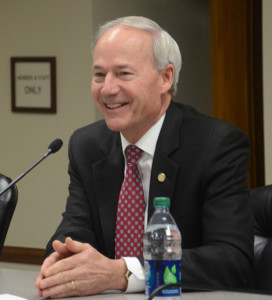
Gov. Asa Hutchinson

Gov. Asa Hutchinson

By Steve Brawner
© 2016 by Steve Brawner Communications, Inc.

You know that old saying about the difference between ham and eggs? The chicken is involved but the pig is committed. Gov. Asa Hutchinson was both during this year’s primary elections.

With the presidential race, he was merely involved. He endorsed Sen. Marco Rubio for president eight days before the vote. He made a couple of appearances and a TV commercial. Donald Trump won Arkansas. Rubio was third, which he was going to be anyway.

Hutchinson, however, was committed in the state legislative races, where his political action committee, ASA PAC, donated money to eight Republican candidates who had Republican opponents.

This happened because the eight he supported also support, or at least would consider supporting, Hutchinson’s Arkansas Works. That’s the continuation of the private option, the state program that uses federal Medicaid dollars through Obamacare to purchase private insurance for adults with incomes up to 138 percent of the federal poverty level.

Created in 2013 by Republican legislators and Gov. Mike Beebe’s administration, it now covers 200,000 Arkansans. It brings a billion dollars in federal money to the state’s economy annually and has saved hospitals from providing millions of dollars in uncompensated care. But some Republicans are opposed because of its association with Obamacare, because it’s another government entitlement, and because they say neither the state nor the country can afford it.

Because it involves spending money, it requires a three-fourths vote for passage every year, which means nine senators can kill it. It barely reached three-fourths in 2013 and in 2014.

In 2015, Hutchinson persuaded legislators to accept a truce: Fund the private option through 2016, when it would end, and he and a task force would look into creating something else. That alternative is Arkansas Works, which is like the private option except that it requires a bit more personal responsibility on the part of beneficiaries. He says it’s a real change. Opponents say it’s cosmetic.

Hutchinson says Arkansas needs it. His budget depends on it. He doesn’t want to take insurance from 200,000 people. He needs $50 million in extra money for highways so the state will be eligible for $200 million in matching federal dollars. Take away the private option, or Arkansas Works, and that money’s hard to find without a tax increase, which isn’t happening.

On April 6, legislators will meet in special session to vote on Arkansas Works, or something. It can pass with a simple majority, which isn’t that high a bar. Then they’ll meet in the fiscal session, which occurs every even-numbered year, to vote on funding. And because a three-fourths majority will be needed, that session could be a doozy.

Arkansas Works was a central issue in those eight Republican primaries, which left Hutchinson a choice: Do nothing so as not to offend the potential winners; get involved like the chicken; or be committed like the pig. He was committed. He openly supported candidates. He held a press conference defending them. His political action committee gave each of them $5,400.

His job would have become much harder had those candidates lost. While the winning candidates would not take office before the special session, the current legislators would see Arkansas Works as a losing bet. Then Hutchinson next year would be dealing with as many as eight new legislators he’d worked to defeat.

Instead, six of the eight won, including all three in the Senate, where Hutchinson has no votes to spare. On the House side, three of his five candidates won, and one who lost was challenging an incumbent, Rep. Josh Miller, R-Heber Springs. Miller was already in the House, so Hutchinson’s situation didn’t change there.

The next day, Hutchinson addressed the Political Animals Club at the Governor’s Mansion. His mood was not quite jubilant, but it was definitely somewhat north of relieved.

“I think everybody in this room knows that if those three state senators had lost their race, it would not be a pleasant day for me in this room,” he said. “I would have to be explaining. It would have been considered a referendum on me and my leadership.”

Yes, it would have been, in a way that the presidential race was not. He was merely involved with Rubio for eight days, but he’s staking a big chunk of his first term as governor on Arkansas Works. That’s commitment.

Related: Coming health care debate a “cage fight,” says leading legislator.

For president, governors no longer need apply

Elections aheadBy Steve Brawner
© 2016 by Steve Brawner Communications, Inc.

One thing about Asa Hutchinson – he’ll never be president. His name starts with the wrong three letters. Not “A-s-a,” but “G-o-v.”

It wasn’t long ago that being governor was the best route to becoming president. From 1976 to 2008, governors – Jimmy Carter, Ronald Reagan, Bill Clinton, and George W. Bush – won seven of eight elections and held the nation’s highest office 28 of 32 years. Being senator was a ticket only to being vice president – Walter Mondale, Dan Quayle, Al Gore.

That appears to have begun changing in 2008, when President Obama was elected president after a Senate career that was too brief to include any noteworthy accomplishments or leave many battle scars. His vice president, Joe Biden, also is a former senator, though a veteran one.

This election cycle has come down to two senators among the Democrats, former Sen. Hillary Clinton and Bernie Sanders. Two of the three leading Republicans, Ted Cruz and Marco Rubio, are also senators, while Donald Trump has never held elective office.

The governors are getting killed. Of the nine who started on the Republican side, only one, Ohio Gov. John Kasich, remains, and he’s a long shot. The two Democratic governors, Martin O’Malley and Lincoln Chaffee (also a senator), ran short, forgettable campaigns. An early February poll by Talk Business & Politics and Hendrix College found the three governors then remaining in the race were polling only 6 percent in Arkansas. Two, totaling 2 percent, have since dropped out.

For now, being governor is a dead-end job, while being senator is a potential ticket to the White House. What changed? The country’s political climate.

During the recent past, Americans have looked for a competent elected official from outside Washington to be president, and governors fit the description well. They have executive experience in jobs that look almost presidential – particular Reagan, who as California’s governor led a state that, if it were a country, today would have the world’s eighth largest economy.

This election cycle, being competent isn’t in vogue, and being governor is not outsider enough. In their day-to-day jobs, governors must make government function, and that’s a messy process. They must make tough, compromising decisions – such as whether to accept federal money for expanded Medicaid services, as Hutchinson and Kasich have done. They are totally accountable for what happens in their states while dealing with a federal system over which they have no control. They must work with members of the other party. They must be realistic, practical and pragmatic. They must balance budgets.

In other words, they develop records that are easy to attack in a presidential race.

Senators don’t have to deal with any of that stuff any more. They know nothing is going to get done in Washington anyway, so they don’t have to try. They don’t have to balance budgets because deficits can always be passed to tomorrow’s voters. They can take polarizing positions and throw red meat to their party’s bases. While Hutchinson and Kasich accepted Medicaid money to deal with problems in health care they didn’t cause, Cruz and Rubio can vote repeatedly to repeal Obamacare without offering a real replacement. And while Hutchinson and Kasich are serving as their state’s one governor, senators are one of 100. They can make speeches, avoid compromises, and stay away from tough votes. There’s always somebody convenient to blame.

This is how two of the three leading contenders for president on the Republican side are first-term senators with few constructive accomplishments in Washington, while the third, Trump, hasn’t done anything in politics. He can campaign as the rich businessman who can fix everything because he hasn’t had to run a government, where easy fixes are rare. The Democrats are choosing between Clinton, who’s trying to run on competence, and a socialist senator, Sanders, who’s running not on what can be done, but on what he thinks should be done.

Governors have to focus on both – what should be done, and what can be done. Those who succeed in both respects might make good presidents. They just can’t get elected right now.

The people have spoken (in four states)

Hand with ballot and boxBy Steve Brawner
© 2016 by Steve Brawner Communications, Inc.

The Arkansas ballot in the Republican presidential primary this year lists 13 candidates, but only five are still in the race as of this writing, and we’re told we must choose between the top three because those are the only ones who can win.

Is this really the best way?

For much of the past year, Arkansas voters have watched the campaign unfold. We’ve watched debates on TV and discussed the candidates with family and friends. Former Gov. Mike Huckabee announced his candidacy in Hope. A Ben Carson event on the Capitol steps drew thousands. Carly Fiorina visited Springdale. Donald Trump and Sen. Ted Cruz made campaign stops.

Between then and now, voters in four states – as always, Iowa, New Hampshire, South Carolina and Nevada – have narrowed our choices before Arkansans have had a chance to vote.

This happens every year. For months, voters in Iowa and New Hampshire meet candidates face to face and in intimate town halls – except for maybe Trump, who mostly speaks to big crowds. Real people share their concerns and offer their perspectives. It’s really a remarkable thing, if you think about it: The person capable of launching nuclear missiles asking for the support of the common man.

Unfortunately, these few states get to choose who the rest of us vote for. They don’t necessarily pick the winners as decide who has lost. They winnow the field. And the question is, why do they get to do it every election?

To make Arkansas more relevant, legislators last year moved the primaries earlier, to March 1, to coincide with other states in the South. Informally, it’s know as the “SEC primary.” After Iowa, New Hampshire, South Carolina and Nevada, we’re next.

The move has had its desired effect in that Arkansas has at least been visited by some of the candidates. Sen. Marco Rubio dropped by February 21, and Cruz is coming for his second visit and Trump his third this week. On the other hand, for candidates in other races, it makes for a long campaign.

Solutions? Here are four.

First, a national primary. Let everybody vote on the same day. That would be fair, and it would remove the horse race aspects of the campaign. It would no longer be a huge story that Rubio slipped up in a debate and finished fifth in New Hampshire and was in trouble, and then finished second in South Carolina and became the establishment pick. The downsides? The horse race still would occur – it just would occur in terms of an enormous money chase as candidates try to run a national campaign. Meanwhile candidates would lose the face to face contact with average citizens that occurs in those early states.

Second, regional primaries. Let the South vote on the same day, which is sort of happening this year, the West Coast on another day, etc. That solution probably would have the same effect as the national primary.

Third, take turns. Let three or four new states vote first next time, and then rotate. Over time, many different states’ interests would come to the forefront. The downside? It could take 12 or 13 electoral cycles before Arkansas gets its turn. That’s potentially half a century.

Fourth, leave it like it is. Iowa and New Hampshire know how to run a presidential campaign. So let them. They’re good folks.

Even though the people have spoken (in four states) and candidates have suspended their campaigns, Arkansans still can vote for the one they support. Every vote will be counted. So if you want to vote for Huckabee, or Sen. Rand Paul, or someone else, do it.

By the way, I’ve focused only on Republicans for a reason: Despite all the early campaign fireworks, in this election cycle Hillary Clinton has been the Democratic nominee a long time – long before even Iowans and New Hampshirites and Nevadans and South Carolinians had their say, actually.

She was sort of anointed, which wasn’t best for anyone, including, probably, her.

For hire: one president, inexperience necessary

Elections aheadBy Steve Brawner
© 2016 by Steve Brawner Communications, Inc.
The most noteworthy finding from Arkansas’ first presidential poll wasn’t who was at the top of the standings, but who was at the bottom.

In a poll conducted Feb. 4 by Talk Business & Politics and Hendrix College, Sen. Ted Cruz was leading the Republican field with 27 percent, while Donald Trump and Sen. Marco Rubio each had 23 percent.

No surprises there. Cruz was a big winner not long ago in a straw poll among Republican Party insiders. Rubio, as of Feb. 4, was the rising establishment choice. The day before, he’d been endorsed by two of Arkansas’ congressmen, Reps. Rick Crawford and Steve Womack, and by Lt. Governor Tim Griffin. And Trump is, well, Trump, the darling of a sizable percentage of the electorate who want somebody, anybody, other than a politician. (And the only one who could fill up much of Barton Coliseum, as he did Feb. 3.) Ben Carson, also not a politician, was fourth at 11 percent, while Carly Fiorina – again, not a politician – had 4 percent.

At the bottom of the standings were Ohio Gov. John Kasich, who also had 4 percent support, former Florida Gov. Jeb Bush at 1 percent and New Jersey Gov. Chris Christie at 1 percent.

That’s 6 percent total for the three governors who have actually led state governments in large diverse states, tried to balance budgets, worked with legislators from both parties, responded to disasters, made court appointments, spoken on behalf of all their citizens – in other words, sort of what presidents do.

Meanwhile, 88 percent are supporting the candidates whose political resumes are, well, a little thinner. Like President Obama before them, Cruz (age 45) and Rubio (age 44) are young, first-term senators. Trump, Carson and Fiorina have almost no political experience between them, though they have achieved much elsewhere.

Elections are about hiring a person to do a job. But if that were their only purpose, the three governors would have been doing better than 6 percent between them.

Elections also are about giving voters the chance to express their values, and this year, “proven political leadership” is not one of them. They’re angry, and, as is usually the case in a democracy, angry about different things. A lot of voters aren’t looking for someone who can make the trains run on time. They want someone who says they’ll tear up the tracks and replace them with something else.

That’s how you get a Trump or a Cruz or, on the Democratic side, Sen. Bernie Sanders. As with Trump, know-it-alls like me have said all along that he can’t win, and he probably still can’t. The race now moves South, where the advantage goes to Clinton. The Talk Business poll has the state’s former first lady leading 57-25 here – again, before the New Hampshire primary. Meanwhile, the Democratic Party has stacked the deck against Sanders. Despite his big win in New Hampshire, Clinton leads in the delegate count, 394-44, thanks to all the party’s superdelegates who have pledged their loyalty to her.

But Sanders, who raised $5.2 million in the 18 hours after his New Hampshire victory speech, isn’t going away – especially not this year, with this electorate.

Arkansans don’t vote until March 1, and a lot can change between now and then. Since the poll was conducted Feb. 4, Rubio’s balloon was deflated by a poor debate performance and then a disappointing fifth place finish in New Hampshire. Kasich finished second in that state but will have a tough time following that up. Christie and Fiorina have since dropped out of the race. Clinton – she’s damaged.

One other thing that might affect the vote count: Mike Huckabee may have suspended his campaign, but he’s still on the ballot, as are Christie and Fiorina and Rand Paul and all the other candidates who once formed that l-o-o-ng line on the debate stage. So Arkansans still will choose from 13 candidates, one of them a favorite son.

Still, it’s hard to see how the race’s overall dynamic will change in Arkansas. Among the Republicans, it’s Cruz and Trump and Rubio, probably in that order, with the governors trailing well behind.

The Democrats – superdelegates and others – will support the state’s former first lady, of course.

Related: Kasich, the anti-Trump