Out of the shadows

DACABy Steve Brawner

On Jan. 21, Ana Aguayo stood on the steps of the State Capitol and admitted – proclaimed, you might say – before thousands of people including police officers that she was committing a crime.

Ana, 28, is an undocumented immigrant, so her crime is not crossing the border to return to a homeland that hasn’t been home for a very long time. At the age of 8, she was bought by her parents from Guadalajara to Springdale, where she was raised knowing nothing of her status. Her teachers taught her English and helped her integrate into the community, and by the age of 16 she was pretty much an American girl.

That’s when she found out she wasn’t. When her peers started getting driver’s licenses and jobs, she learned she wasn’t like them, that she was an unacknowledged guest and not part of the family. And it changed her childhood.

“I grew up living in fear and in the shadows and at a time where the media identified myself as a criminal, when I didn’t understand what had happened, that my parents crossed the border unbeknownst to me,” she said in an interview. Continue reading

When medical marijuana almost died in the House

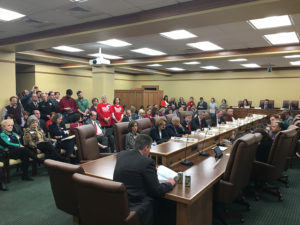
Rep. Doug House makes his case for HB 1058.

By Steve Brawner
© 2017 by Steve Brawner Communications, Inc.

There was a moment this past week when the Arkansas Medical Marijuana Amendment, approved by 53 percent of the voters in November, looked like it might effectively die in the Arkansas House of Representatives.

On Tuesday, Rep. Doug House, R-North Little Rock, presented that chamber the first two of a number of bills meant to fix problems with the amendment, which the Legislature can do with a two-thirds vote.

One of the bills, House Bill 1058, modified a section of the amendment requiring physicians to certify that marijuana’s benefits would outweigh the harm to a particular patient, after which the Department of Health would give the patient a card letting them purchase the drug. That kind of language puts physicians in jeopardy of being sued because there’s no accepted national standard for the use of marijuana, which remains illegal in the United States. So under House’s bill, the physician would merely certify that a patient has one of the conditions that qualify for use of the drug under the amendment.

House told his fellow legislators that few doctors will be willing to qualify their patients for the drug unless this part of the amendment is changed.

Which is exactly what some representatives wanted to happen. A couple questioned House about whether or not federal law trumps state law (it does) and what would happen if the bill did not pass. A couple argued that people had voted for this particular amendment with this exact wording. House said they had voted for legalizing medical marijuana, and the Legislature ought to make this minor change to accommodate that.

Remember, the bill needed a two-thirds vote to pass. Watching from the press’s perch in the House gallery, I thought it might fail. If it did, voters might have voted for legalized medical marijuana, but patients would have a much harder time obtaining it.

It passed with three votes to spare, 70-23, and will be considered in the Senate next week.

I voted against the amendment in November but found myself rooting for the bill to pass. Arkansans voted for it, after all, so let’s move forward. At the same time, I don’t blame the legislators who voted against it, even though it could be argued they were trying to thwart the election’s results by not fixing the flaw.

All lawmakers must balance their constituents’ wishes with their own convictions; otherwise, they’d be merely pollsters. They should listen but also lead, keeping their eyes and ears on their districts without simply sticking their fingers in the wind. The Founding Fathers were right to create a model described by Benjamin Franklin not as a direct democracy but as “A republic, if you can keep it.”

For Rep. House, that tension is especially complicated because he opposed the amendment and even donated money to help defeat it. But he also believes the voters have made their will known, and so the Legislature must now ensure the drug is available to the people who might benefit from it – and only to them. Moreover, two months before the election, Speaker Jeremy Gillam, R-Judsonia, asked him to manage the Legislature’s response if the amendment passed. A retired National Guard colonel, House dutifully accepted the assignment and then, after the election, began looking for problems to solve, finding 135 of them. So he’s trying to solve them.

House argues in this case, legislators must enact the people’s will because the people won’t accept anything else. Marijuana is now legal in some form in 26 states and the District of Columbia. In 2012, Arkansas voters surprised the political establishment by almost passing another medical marijuana measure. When that happened, the establishment should have acted to address that rising demand, he said. When it didn’t act, the voters acted instead.

“If we sabotage the amendment where people are not able to get the product legally, I fully expect a petition to be generated among the people to enact a constitutional amendment which totally decriminalizes marijuana,” including for recreational purposes, he said in an interview.

In other words, he’s trying to ensure an amendment passed by the people works in the real world, lest those voters produce another that really violates his convictions. It’s not a perfect republic, but it’s one we can keep.

He was playing chess; she was playing checkers

By Steve Brawner
© 2017 by Steve Brawner Communications, Inc.

Donald Trump won the Republican Party nomination because he was playing checkers while the other candidates were playing chess, and it was a checkers year. In November, the opposite happened: He checkmated Hillary Clinton while she was playing checkers.

Remember the primaries? Those 16 other mostly conventional Republican candidates were all playing chess – trying to execute their grand strategies and position themselves for Trump’s inevitable fade, or to be the last person standing against him. While they were staring at the chessboard, he just kept bouncing from state to state on the checkerboard until he reached the back row and shouted, “King me!”

In the general election, however, it was Clinton who tried to play checkers, while Trump realized it had become a chess match.

Checkers is a simple game, which is why we don’t hear much about “checkers masters.” The strategy involves a balance of offense and defense: You try to reach the opponent’s back row without allowing them to reach yours. If you play too aggressively, you leave yourself open, so it’s best just to plod along, pick up pieces and look for the double jumps.

That’s what Clinton did. Once she had that small lead in the polls, she played it safe and ran a same-old, same-old campaign. She didn’t reach out to voters who ordinarily wouldn’t support Democrats; those were discarded into her “basket of deplorables” and forgotten about. She thought her back row was protected by that supposed “blue wall” of states like Michigan and Pennsylvania that of course would vote for the Democrat because they always had. When that old Trump video where he talked about grabbing women surfaced, she thought she’d made a double jump right onto his back row.

Trump, meanwhile, was playing chess. Chess is an offensive game where you win by taking the opponent’s king regardless of what it costs you, and often by surprising the opponent. With checkers, you always know who’s winning; with chess, the player with fewer pieces can suddenly strike and end the game. So while Clinton’s campaign (and most pundits) were counting the number of checkers left on the board, Trump’s campaign found some holes in that blue wall and exploited them.

Meanwhile, Trump did what Clinton refused to do or could not do – find new voters.

The modern Republican Party has been an awkward coalition of business elites and socially conservative regular Americans whose interests sometimes conflict, particularly lately when those business elites are getting really rich while many regular Americans are struggling.

Trump saw that there are a lot more regular Americans than there are business elites, and some who typically vote for Democrats could become his voters. He could speak to them in a way that Mitt Romney couldn’t in 2012 because Trump is blunt and earthy and understands popular culture, and because Clinton, the daughter of a middle class Chicago small businessman, had become one of those elites herself. He wasn’t going to lose the regular Americans he already had, and he didn’t need the elites’ money because he’s already rich, he was getting so much free air time, and he’s a wizard at using free social media.

He realized that he could appeal to regular Americans’ legitimate fears and concerns – and, for some, to their misplaced grievances and their unacknowledged prejudices – by using the most effective and darkest campaign slogan in recent American history. A lot’s implied in “Make America Great Again,” especially that last word, “again,” as in, “It used to be great, but it’s not now, and here are the groups of people responsible for that.”

In the end, Clinton had 3 million more votes across the country, but Trump won the states that mattered most. Her checkerboard had more pieces, and so did her chessboard, but the checkers game didn’t matter, and he had surrounded her king with a bunch of pawns.

He recognized what no other candidates saw this election except perhaps Sen. Bernie Sanders – that the game was different this time. In fact, both games were, and the trick was knowing when to play which. That’s why the Republicans who were playing chess had to king him in checkers. That’s why he captured Clinton’s king in the general election chess match while she was moving her checkers around the board. And that’s why he’s the nation’s 45th president, and they’re not.

Related: Trump played checkers and they played chess – in a checkers year

Voters might support highway taxes, but they want to choose

By Steve Brawner
© 2017 by Steve Brawner Communications, Inc.

This may be true: Arkansans believe the state’s highways need work, and many are willing to pay to improve them, but not at the pump. And this definitely is true: They want to make that choice, not have it made for them.

That’s based on a recent poll of 800 Arkansans by the Arkansas Good Roads Foundation. Ninety percent said the state’s highways “are in need of repair,” but 62 percent said they opposed increasing fuel taxes, which are the primary source of road funding. Support increased when told those taxes haven’t been raised in 15 years, but even then only 48 percent supported increasing them just 1-3 cents per gallon. The numbers dropped dramatically for higher amounts so that only 5 percent supported an increase of 5-8 cents. We can’t fix the roads on 1-3 cents.

There’s just something about paying higher fuel taxes that a lot of people can’t abide. Fuel is seen as a necessity and the taxes are visible, which ought to be a selling point, but I guess we like to pretend we’re not paying them.

Fuel taxes actually are among the easiest and fairest ways to raise money for highways. Collection costs are low, and the taxes are paid by road users. The person receiving the government service actually pays for the service, so if you don’t want to pay higher taxes, you can drive less or drive more efficiently. The other plus is that some of the taxes are paid by travelers and truckers passing through our smack-dab-in-the-middle-of-the-country state, rather than by Arkansans.

Fuel taxes have their own problems however, in that they are destined to be a declining revenue source each time cars become more fuel efficient, which is often. (Because of that, and because of inflation, drivers basically receive a fuel tax cut every year.) Moreover, they aren’t completely fair, either. The laborer who gets to work in a duct-taped 1987 Oldsmobile that gets 12 miles per gallon pays more than someone who can afford a newer, more fuel-efficient vehicle. If you can pay the $33,220 starting price to buy a Chevy Volt electric car, then you can enjoy the government-funded highways almost for free.

But while poll respondents don’t want to pay higher fuel taxes, a surprising majority, 62 percent, were willing to continue an existing tax that was set to expire in a few years. That would be the 10-year half-cent sales tax passed by voters in 2012 that is funding the Connecting Arkansas Program. That tax specifically exempts fuel and food, meaning it’s not a user fee at all. The grandmother on a fixed income who never drives far is paying for highways every time she shops at the corner store. When asked the same question about extending the half-cent sales tax a second time at the end of the survey, support rose to 69 percent, suggesting some might be open to having their minds changed.

I guess it’s easier to keep paying the tax you’re already paying, and not let it expire, then it is to pay a new one.

Keep in mind that this was a poll, and polls, you may recall from recent history, don’t always get things exactly right. The order of the questions matters, too. If you tell a pollster that the roads are bad, you’re probably primed to later say you’d pay more to fix them. But based on the survey, Arkansans certainly might be willing to increase taxes for highways.

But they want to be in charge of making that choice. Eighty-one percent would be more likely to support a legislator who referred a highway tax increase to them for a vote, while 12 percent would be less likely. Meanwhile, 45 percent would be less likely to support a legislator who voted for a straight up tax increase, while only 38 percent would be more supportive.

That’s not news to legislators, who aren’t exactly lining up to introduce bills to raise taxes for highways. They knew how their constituents felt about it long before this survey.

The poll’s results might persuade some of them to refer the matter to voters, but that doesn’t mean it will happen. Yes, 81 percent might tell a pollster they would be more supportive of a legislator who referred a tax increase to them. But legislators know the 12 percent who say they wouldn’t be – they really mean it.

Could Monday be Arkansas’ last King-Lee holiday?

By Steve Brawner
© 2017 by Steve Brawner Communications, Inc.

On Monday, Arkansans will join Mississippians and Alabamians in honoring Dr. Martin Luther King Jr. and General Robert E. Lee on the same day.

It might be the last time for Arkansas.

The three states are the only ones that combine the holidays – and that includes Lee’s home state of Virginia, which separated them in 2000.

The dual holiday here stems from the fact that Arkansas was already celebrating Lee’s birthday each Jan. 19 when the King holiday was created in 1983 and set for the third Monday of each January. Because the holidays were right on top of each other, legislators combined them in 1985. Then-Gov. Bill Clinton signed the legislation.

Some state legislators tried to separate the holidays in 2015, but they failed. Vocal opponents filled committee rooms and argued their case – which, I’m telling you, can be a surprisingly effective tactic, particularly if legislators have mixed emotions or are unsure which way the wind is blowing on an issue.

Gov. Asa Hutchinson began that legislative session without a strong opinion on the holiday and eventually supported separating the days, but he didn’t really fight for it. Since then, he has made it an emphasis. In July 2015, he wrote the state president of the NAACP that he would “do what is in my power” to give King his own day. Last January, he said lawmakers should separate the holidays and said he would attend events honoring King that day without mentioning anything about honoring Lee. In December, he presented a list of 19 priorities for the upcoming legislative session, most of them relatively noncontroversial, but the holiday was one of them. In a press availability Jan. 4, he said Lee was “on the wrong side of history,” a noteworthy comment in a state where some people still revere Lee. He said he wants to move Lee’s day to October but not make it a holiday for state employees.

Hutchinson is not the type of governor who relishes a big fight over a hot-button social issue. Those kinds of controversies are bad for business, which is why he’s been trying to persuade legislators not to introduce a transgender bathroom bill like the one in North Carolina.

But in this case, Arkansas’ current situation is already bad for business and bad for the state’s image. For a Southern state to pair the country’s greatest civil rights leader with a Confederate Civil War general just looks bad, and it doesn’t help persuade out-of-state and out-of-country business executives that Arkansas is a forward-looking place. Meanwhile the dual holiday makes a statement to the state’s own citizens that we really aren’t all-in on civil rights.

When the bill comes up in committee, it probably will attract the same opponents it attracted last time – those who will argue that Lee was a man of honor and an important figure in Arkansas and American history, and that the day commemorates Southern heritage, not slavery.

It will be interesting to see which legislators oppose the separation, and the reasons they give. It was only a few months ago that a few of them were threatening action against the University of Arkansas because some female basketball players knelt rather than stand during the national anthem. Yet the entire state honors alongside Dr. King a general who fought to give us a different anthem entirely. Had Lee succeeded in his efforts, you and I would be Confederates, not Americans, standing only for “Dixie.” For us, “The Star-Spangled Banner” would be just a historical reference to a country we used to be a part of, the equivalent of “God Save the Queen” now. The American flag would be just another country’s flag.

The fact that the still-powerful governor has prioritized giving King his own day makes it much more likely it will happen. But nothing is certain. Dr. Martin Luther King had a dream, but he couldn’t predict the future, and neither can I.

Related: Arkansas flag’s one star a reminder or a celebration?