Not if you don’t cut spending

By Steve Brawner

The economy grew 3 percent in the third quarter, which was pretty good – almost as good as the second quarter, when it grew 3.1 percent. The past four quarters, in fact, have been better than the previous four. Meanwhile, the federal budget deficit was bigger in 2017 than it was in 2016.

Hmm. That’s weird, because we’re being told that economic growth by itself reduces deficits.

Here’s the background. President Trump and congressional Republicans have been pushing for tax cuts. To get there, they needed to pass a budget that would allow the cuts to pass with a simple majority. Otherwise, the Democrats would filibuster.

The House of Representatives voted for a budget that included a framework for both tax cuts and offsetting spending cuts. On paper, the yearly deficits would end by 2027, though the overall debt, now $20.4 trillion and much bigger by 2027, would remain.

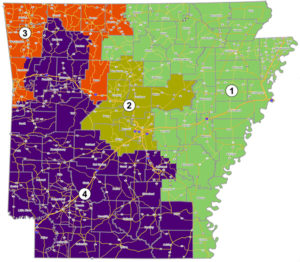
Then the Senate passed its own budget that includes a framework for tax cuts, which are popular, without spending cuts, which are not. In fact, it calls for a total of only $1 billion in cuts out of a potential $47 trillion in spending. That’s a cut of .00002 percent. If you weighed 250 pounds and were trying to lose weight, that would be .005 percent of a pound. That’s some kind of painless diet. Arkansas Sens. Tom Cotton and John Boozman voted for it. The House of Representatives, including all four members of the state’s delegation, quickly voted to shelve their own plan in favor of the Senate’s. Continue reading

We can’t afford Alzheimer’s

Alzheimer's

Harry Johns is national president and CEO of the Alzheimer’s Association.

By Steve Brawner

The first sign that Walt Klusmeier’s had Alzheimer’s was when he asked his wife, Lisa, how to send an email on his phone. He was 49 years old.

Then he needed help with expense reports on his laptop. When that happened, Lisa assumed was the result of stress caused by his responsibilities as a father of three children and as a pharmaceutical sales rep.

“I just thought he had this huge territory, had a lot of responsibility,” she said. “Our kids were growing. We were a busy family.”

But it was more than stress. He would withdraw at home. While he learned to compensate for his failing cognition, his work was subpar, which his employer interpreted as a lack of commitment. Eventually he lost his job, which meant the family lost not only his income but his insurance, and he didn’t qualify for government benefits because of his age. The money ran out. After he was diagnosed with younger-onset Alzheimer’s, he became eligible for Social Security Disability payments and two years later for Medicare. He lived at home until his last month of life and died at age 58. Continue reading

Little Rock’s base hit

By Steve Brawner

Let’s start with two assumptions. One is that we live in an attention-based economy where having a message isn’t enough if no one notices it. The other is that what’s good for Little Rock is generally good for Arkansas.

Which brings us to the capital city’s “rejection” of Amazon.

You may be familiar with the story. The Seattle-based tech giant announced it is opening a second headquarters and invited communities to apply. (Which of course would include offering generous tax breaks and government subsidies). The company promised to hire 50,000 workers, many of them highly paid, and invest $5 billion. The winner will be transformed, as Seattle has been, which is why 238 cities have submitted applications.

Little Rock Mayor Mark Stodola, facing a tough re-election campaign against two credible opponents so far, initially said his city would apply. But Little Rock didn’t meet some of Amazon’s specifications, and it was obvious the city couldn’t compete against places like Boston and Austin, Texas, that are bigger and cooler. Continue reading

Why is this man so comfortable?

Asa Hutchinson

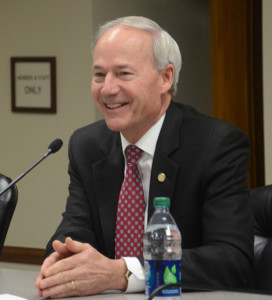
Gov. Asa Hutchinson visits with reporters Oct. 17.

By Steve Brawner

This is the part of the calendar when elected officials often are more worried about campaigning than governing. That’s not the case with Gov. Asa Hutchinson – not yet, anyway.

Hutchinson’s apparent peace of mind – with the campaigning part of his job, anyway – was reflected during an Oct. 17 sit-down with reporters. With the Republican primary half a year away, he might have used the occasion to toss red meat to the base. Instead, he talked policy. He stated his opposition to using general revenues for highways. He also offered assurances that his Arkansas Works health program would not be harmed by President Trump’s ending some subsidies for insurance companies.

That’s boring government stuff, not campaign stuff.

Why is Hutchinson so comfortable with the state of his campaign? Several reasons. Continue reading

Health care: Can Arkansas Children’s Hospital, Gracie Kimbrell show the way?

Kimbrell, Children's

Stewart O’Malley tests her balance at Arkansas Children’s Nutrition Center’s new Laboratory for Active Kids and Families.

By Steve Brawner

If we’re ever going to fix health care in this country, then places like Arkansas Children’s Hospital and people like Gracie Kimbrell will have to be part of the solution.

At the Arkansas Children’s Nutrition Center, researchers have built only the nation’s second laboratory studying the science of children and exercise. At the Laboratory for Active Kids and Families’ debut Oct. 10, kids ran on a treadmill, tested their strength, and exercised on a stationary bicycle wearing a mask to measure their lung capacity. Stewart O’Malley, 8, shifted her weight on a balancing platform connected to a screen to guide a digital ball through a maze.

By now, we know what makes a healthy human: real food, physical activity, and adequate sleep. Still, there’s always more to learn. Researchers will study children and pregnant mothers. They will be looking for the underlying factors for why some kids are fitter and more active – social, cultural, biological and others. Greg Kearns, Arkansas Children’s chief research officer, said researchers will study the link between exercise and cellular structure, understanding that the cellular doesn’t necessarily follow the lifestyle and that each person is unique. The entire program – not just the lab – is funded through a $7.3 million U.S. Department of Agriculture appropriation.

Meanwhile, in Bryant, kindergarten student Emma Kincaid is able to grasp objects with her left hand for the first time. Born without fingers on that hand, she was fitted with a prosthetic hand built by Gracie Kimbrell and other high school engineering students. As reported by The Saline Courier, Gracie and the other students researched how to make the hand online and then printed it over two days using the school’s 3D printer. It cost about $20, it’s purple, and Emma likes it. A new hand can be printed as she grows, and if a piece breaks, a replacement is easy to produce. Gracie is already working on a better model.  Continue reading