Surprise! Money did not grow on trees

tax, taxes, debt, deficits, spending, trillion, State of the Union, deficit hawks, balanced budget amendment, Jonathan Bydlak, immigration, $98.8 trillion, $970 billionBy Steve Brawner, © 2019 by Steve Brawner Communications, Inc.

There’s nothing more annoying than someone saying, “I told you so,” and it gives me no pleasure to do so. Well, maybe a little, but I’d much rather be wrong.

This bittersweet moment is inspired by March’s wholly foreseeable news that the federal government’s February budget deficit was the biggest ever for that month – $234 billion.

For the year, the Trump administration projects the deficit will be $1.09 trillion, a number last seen in 2012. (The Congressional Budget Office earlier projected $897 billion.) One trillion is about $3,300 for each of us, and it all will be added to the $22 trillion national debt. Your share of that amount is a little more than $67,000 – and growing by the minute.

In fact, the Trump administration projects $1 trillion deficits for each of the next four years, but even that may be a rosy scenario. Now that we’ve reached this plateau, there’s no plan to bring us down.

Last year’s deficit was $779 billion, which was bad enough. So how’d we get from there to here? Continue reading →
Tax credits for private school scholarship bill fails

Note: Senate Bill 620 never ran in committee. Instead, Johnson tried to run another scholarship bill, Senate Bill 539, that failed in the House Education Committee April 4. 

By Steve Brawner, © 2019 by Steve Brawner Communications, Inc.

This is the part of the legislative session when you might expect Gov. Asa Hutchinson to set it on cruise control. Instead, he made a right turn last week and stepped on the gas.

I write that first sentence because he’s accomplished three of his four priorities: a tax cut, increased highway funding, and higher teacher pay. All that’s left is shrinking the number of state agencies from 42 to 15. That government transformation is slowly working its way through the Legislature – as one would expect with a 2,000-page bill.

Still to come is the Revenue Stabilization Act process, where lawmakers will determine exactly how tax dollars will be spent. There might be a big fight over the Arkansas Works health program, but probably not. Then everyone can go home.

Hutchinson has accomplished a lot and still has a lot to do, which is one reason his strong support of Senate Bill 620 by Sen. Blake Johnson, R-Corning, and Rep. Ken Bragg, R-Sheridan, is interesting. Continue reading →

Legislature nears the finish line, and then …

LegislatureBy Steve Brawner, © 2019 by Steve Brawner Communications, Inc.

The legislative session at the Arkansas Capitol heads for the finish line. What’s left? Mostly spending your tax dollars and finalizing the constitutional amendments you’ll consider in 2020.

In the next few weeks, lawmakers will divvy up state funding through the Revenue Stabilization Act. First passed in 1945, it prioritizes spending. Higher priority areas are guaranteed to be funded while lower priorities get money if it’s available.

The RSA is a big reason the state doesn’t run budget deficits, though it does incur debt in other ways, such as retirement programs and bond issues. It would be nice if the federal government had a similar mechanism, but alas.

Since 2013, one state agency has dominated the process: the Division of Medical Services, which administers Arkansas Works. That’s the state program that purchases private health insurance for lower-income Arkansans. Continue reading →

Democrats in the sandbox with the big kids

LegislatureBy Steve Brawner, © 2019 by Steve Brawner Communications, Inc.

What’s it like to be a Democrat in the Arkansas Legislature, when the other side outnumbers you three to one? Basically, you can play in the sandbox, and sometimes the big kids will let you help build the castle – especially when they need one of your shovels. But you’re still not one of the big kids.

In other words, your participation is real but limited. Here are a few recent examples, working our way back in time.

– On Thursday, March 14, Senate Majority Leader Jim Hendren, R-Sulphur Springs, announced he was filing Senate Bill 571, which would cut taxes for lower- and middle-income Arkansans while raising cigarette and e-cigarette taxes. He did this in a crowded conference room with both Democrats and Republicans standing behind him. In fact, the way it worked out in the people-shuffling, the Democrats were standing closest to him. Hendren is the kind of lawmaker who reaches across the aisle anyway, but he’ll particularly need Democrats’ support to pass this bill. Continue reading →

Nicotine is cool again. Now what?

Jim Hendren, tobacco tax

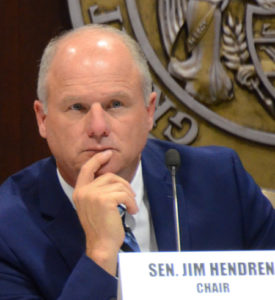
Sen. Jim Hendren is sponsor of Senate Bill 571.

By Steve Brawner, © 2019 by Steve Brawner Communications, Inc.

Remember how we all woke up and realized the country faces an opioid crisis? Another health crisis is brewing: the skyrocketing use of e-cigarettes by young people. For the next few weeks, the question will be, what should Arkansas do about it?

First, the crisis.

For decades, society has successfully reduced tobacco use. The Centers for Disease Control and Prevention said last year that 14 percent of American adults smoked cigarettes, down from 42.4 percent in 1965. According to the Campaign for Tobacco-Free Kids, only 7.6 percent of high school students nationwide smoke. In Arkansas, it’s 13.7 percent.

Then these vaping products – which contain nicotine and other harmful chemicals – were introduced. They’re new and sleek and have fruity flavors, and a lot of kids are using them. More than 3.6 million middle and high school students used e-cigarettes in the past 30 days last year, according to the CDC and the Food and Drug Administration. About 1.5 million more American young people used e-cigarettes in 2018 than in 2017. Continue reading →