The Constitution makes it clear that while the president is the commander-in-chief, the Congress declares wars, and for a very good reason: Otherwise, one person – you know, like a king – can involve the nation in conflict.
Unfortunately, that’s what’s been happening since World War II. The United States has fought long-lasting wars across the planet – in Vietnam, Korea, Panama, Iraq, Kosovo, Afghanistan, Iraq again, Libya, and elsewhere – all without a declaration of war.
Sometimes Congress has authorized the president to use force, a measure that commits troops but not the nation to battle, and we have seen the results: Half-hearted national efforts with the costs passed down to future generations.
Last week, Arkansas’ House delegation took a small step toward restoring constitutional balance by voting against a resolution supporting President Obama’s policies in Libya. The Senate is expected to take up a resolution in the Senate Foreign Relations Committee by Sen. Kerry that would authorize force for one year but prohibit the use of ground troops in most circumstances.
More about the issue in my Arkansas News Bureau column here.
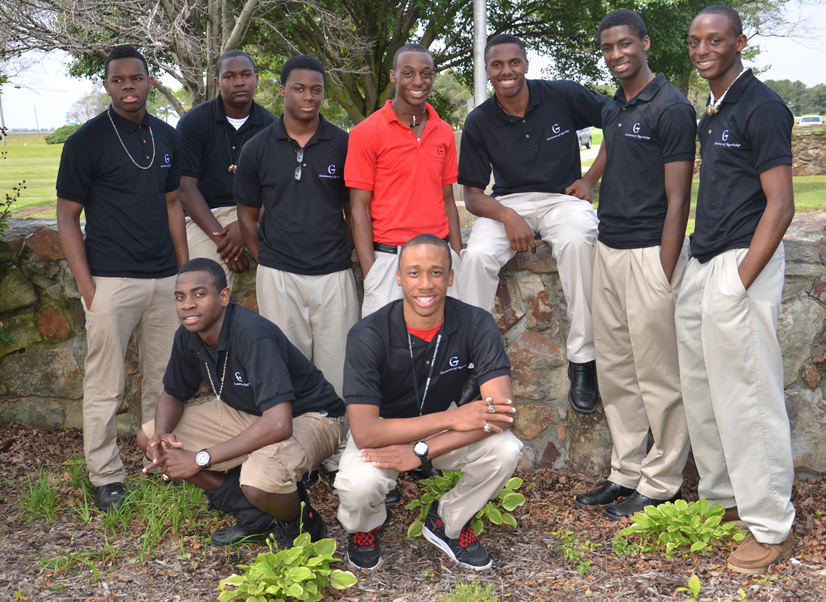
The Gentlemen of Knowledge: Front, sophomore DeSean Gordan and junior Robert Cooney. Back, sophomore Rakeem Stewart, freshman Kavian Ingram, freshman Timothy Talley, junior Tay Baber, junior Terrian Tyler, freshman Khalil Williams, and junior Ty Baber.
WILSON – How did Rivercrest High raise test scores among African-American students by 17 points in one year? It tried something so crazy that it almost had to work: It asked the students what the problem was and how to address it.
Second-year teacher Lindsey Kelley and assistant principal Tom Bennett decided it wasn’t OK that only 31 percent of African-American juniors were scoring proficient on the state’s benchmark exams, compared to 65 percent of white kids. So, working with a training consortium known as the Arkansas Leadership Academy, they created a plan that would give the students a real say in their own educations. African-American students were called grade by grade into the library and asked what the school district could do differently during a session led by one of their peers. Afterwards, all African-American students in the junior class were interviewed in groups of two or three about their individual learning styles, with the information given to teachers.
Then something happened that wasn’t part of the plan: A group of students coalesced to form the Gentlemen of Knowledge in order to hold themselves and their classmates accountable.
Test scores rose from 31 percent to 48 percent in one year. Told the news, two of the Gentlemen, twins Tay and Ty Baber, had this to say: Next year it should be 58 percent.
My Arkansas News Bureau column takes a break from politics to talk about the best comeback made by a Ryan this year. Not Arkansas quarterback Ryan Mallett. Not Ryan O’Neal. (That’s a famous actor for those of you under 30.)
I’m talking about my neighbor, until recently, who also is named Ryan. Ryan moved next door to my house a few years ago, and of course we got to know each other. He was a dad with a wife, two sons, a job, college classes to attend – and with a past.
Ryan had been in jails in Mississippi and Arkansas for drug convictions, but he had turned his life around and was seeking a pardon from the governor.
He did get that pardon – and is about to get his college degree, in geology, which he’ll use to work in the natural gas industry.
I thought it was a story worth sharing about a guy who has made the most of his second chance. Here is the column.
One of the most important decisions of the 20th century was also one of the loneliest.
On the evening of June 5, 1944, Gen. Dwight Eisenhower, supreme commander of the Allied Expeditionary Force, had a choice to make. Thousands of his troops were poised to begin the assault on Normandy, France, the next day. If it worked, it would lead to the end of World War II in Europe.
But the weather wasn’t cooperating. Winds and rain would disrupt the airborne operations and naval and air bombardments that were critical to the success of the mission. The weather officer expected somewhat of a clearing, but this still was no time for an invasion. Eisenhower knew that without effective bombardments, many of the invading forces would be slaughtered by the Nazi machine gun nests when they hit the beaches.
Ike would have preferred to wait, but the invasion had already been postponed once because of the weather, and the tides would not be favorable again until June 19. That was a long time to keep the finger on the trigger. The men would go crazy spending that much time locked up in camp, and delay increased the likelihood that the Germans would learn of the planned invasion.
One by one, the generals gave their opinions. In a variety of accents, some said go and some said wait. And then it came to Eisenhower. He paced, struggling with the decision. After a moment, he said, “OK, let’s go.” His subordinates cheered and then left for their posts, living Eisenhower alone.
It was a firm decision, but not one made with certainty. The next day, he penned a press release to be made public if the invasion failed. “My decision to attack at this time and place was based upon the best information available. The troops, the air and the Navy did all that bravery and devotion to duty could do. If any blame or fault attaches to the attempt it is mine alone.”
We now know that Eisenhower was correct – correct to decide to invade, and correct that some of the invading forces would be slaughtered.
World War II produced its share of legends – blood-and-guts generals like George S. Patton and the regal and glory-seeking Douglas MacArthur, and all deserve their place in history. But when it came time for that fateful decision on June 5, I’m glad it was Ike, the humble common man, who was making it.
Now the United States faces a different kind of enemy – its own fiscal irresponsibility. Unlike World War II, which started with the bombing of Pearl Harbor, the national debt is an enemy that attacks our freedom and prosperity from within, slowly and undramatically. It can be ignored for decades, as it already has been.
But instead of confronting this enemy, America is at war with itself. If Republicans and Democrats were Allied armies, then the United States and Great Britain would have killed each other instead of the Nazis.
This time, thank goodness the country doesn’t need soldiers willing to charge through machine gun fire across a foreign beach. What’s needed are statesmen willing to make tough choices – to reduce spending on popular programs, and to raise taxes for the purpose of balancing the budget so that our children and grandchildren don’t have to do it for us.
It needs leaders willing to listen to diverse points of view, to make their decisions based on the best information available instead of relying on rigid orthodoxy, and who accept that it’s OK to be uncertain. We need elected officials who accept that any decision they make will be painful but that delay is unacceptable. We need people in Congress and the White House who are willing to accept responsibility for their decisions and to blame no one else when things go wrong.
My column this week is about Gov. Huckabee’s recent speech to the Clinton School of Public Service in Little Rock, where he elaborated on his decision not to run for president.
Huckabee said his decision was based on spiritual reasons, and I don’t question that, but practical considerations were involved, including President Obama’s huge advantages as an incumbent as well as the toxicity of the current political environment.
No need to go into great detail; if you want more, scroll down on this site a few inches to see the former Arkansas governor and current Floridian quoted at length.