
Hate my Congress, keep my congressman

By Steve Brawner

In April, just 11 percent of Americans said they approved of Congress’ performance, and 80 percent said they disapproved, according to an Allstate/National Journal Heartland Monitor Poll. A Gallup poll in May found only 22 percent of Americans say most members of Congress deserve re-election, while 72 percent say they do not. And yet guess how many midterm primary elections congressional incumbents have lost this cycle?

One.

As PBS Newshour pointed out, incumbents had won 139 of 139 contested races prior to this week. They won 45 of 45 last week. On Tuesday, Rep. Ralph Hall, R-Tex., became the first incumbent defeated. One of Congress’ last two World War II veterans, he is 91 years old and is in his 17th term.

We’ve all heard the Ben Franklin quote that nothing is certain except death and taxes. Almost as certain is being re-elected to Congress. In 2012, 90 percent of House incumbents running for re-election were victorious, according to the Center for Responsive Politics. Going back to 1964, it’s never been lower than 85 percent, and five times it’s been 98 percent. Re-elections for Senate incumbents have not been quite as automatic through the years, but 91 percent were re-elected in 2012.

How can Americans hate Congress but so rarely vote to change it? One reason: The way the system is designed, voters don’t have a chance to vote against the institution. They only vote for or against their own congressman, who seems all right and may have helped them with a problem. Partly because of the way House districts have been drawn, there’s a good chance their congressman agrees with them on a number of issues. Using modern data-mining techniques, he or she knows what those issues are and how to communicate them. Because we live in such a polarized environment, voters often blame the other side instead of their own members.

There isn’t space to list all of the other advantages incumbents have, but money is an obvious one. According to the Center for Responsive Politics, the average incumbent House member raised $1.6 million in campaign contributions in 2012, compared to $268,000 raised by challengers. U.S. Senate incumbents raised an average of almost $12 million, compared to challengers’ $1.4 million. Those numbers skew against challengers because they include all candidates who filed campaign reports, including minor candidates who raised little money.

The system’s imperfections aren’t insurmountable, of course. Thanks to the internet, almost all voters have access to enough information to make informed, creative choices at the ballot box. That would require us to base our decisions on research rather than impressions gleaned from 30-second TV ads and superficial media coverage – which, unfortunately, we don’t often do.

While incumbent congressmen rarely lose elections, there is turnover thanks to retirements and other causes. Some members don’t run again because they know they would lose or face a tough fight. The Cook Political Report revealed in December 2012 that, from 2008 to 2012, nearly 40 percent of the Senate had turned over. USA Today quoted Cook in January 2013 saying that 39 percent of House members, including nearly half the Republicans, started this current term with less than three years of experience.

That kind of turnover is reflected in Arkansas. After November, at least two of Arkansas’ six congressional seats, the House 2nd and 4th Districts, will be occupied by a new representative. If Rep. Tom Cotton defeats Sen. Mark Pryor, half the delegation would turn over this year. In fact, Arkansas’ entire delegation would be different than it was before the election of 2010. The only elected official remaining from that time would be Sen. John Boozman, but he was serving in the House four years ago.

So the good news is that turnover does occur in Congress, giving the institution new blood and fresh ideas. The bad news? It doesn’t usually happen because of the voters, who are unhappy with Congress but, for many reasons, don’t seem able to do much about it.

Pryor vs. Ross

By Steve Brawner

He’s a Democrat running for a high-profile statewide office. He’s developed a reputation through the years as a centrist willing to work with both sides of the aisle. He excels at retail, face-to-face politics. He faces a Republican attorney who doesn’t.

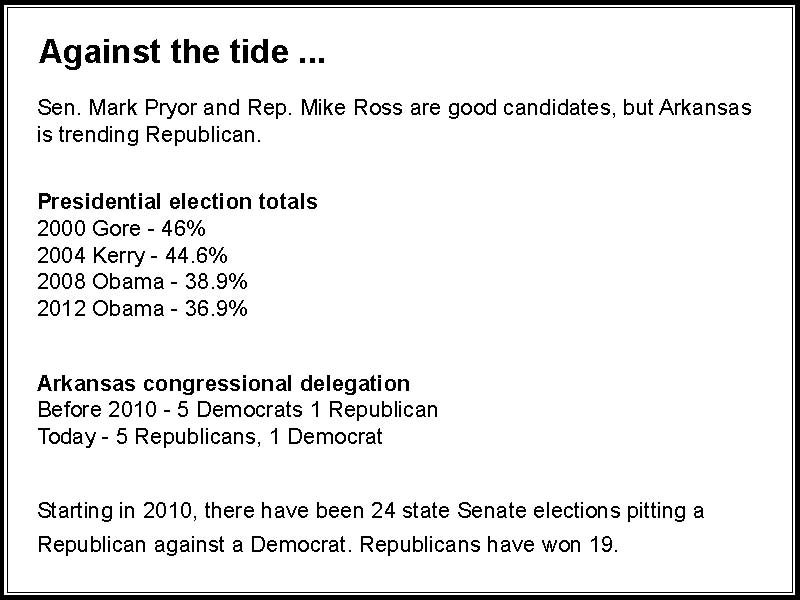
I could be describing Sen. Mark Pryor or Mike Ross. They’re similar elected officials facing similar opponents, and yet in the Senate race Pryor is usually polling several points ahead of his opponent, Rep. Tom Cotton, while Ross is polling behind Asa Hutchinson in the campaign for governor.

Why the difference between Pryor and Ross so far? One theory: They’re competing with each other a little bit, and Pryor is winning. Perhaps the most intriguing matchup this year is not Pryor vs. Cotton, or Ross vs. Hutchinson. It’s Pryor vs. Ross.

Let’s start with more conventional explanations for those polls, and then I’ll explain that theory. Pryor is a statewide figure who has represented all of Arkansas in the Senate for 12 years. He still enjoys good will because of his father, former Sen. David Pryor. Ross represented only one-fourth of the state as a member of the U.S. House of Representatives, and he’s been out of office for nearly a year-and-a-half.

As for their opponents, Hutchinson, the longtime Arkansas political figure, is a more polished candidate than Cotton. Hutchinson knows how to soften his stances and appeal to folks in the middle, while Cotton seems to know only one speed – full ahead. We like our politicians on a first-name basis here: Mike, Mark, Blanche, etc. We all know who “Asa” is, but Cotton, whom we just met a couple of years ago, is not yet “Tom.”

Other explanations? Because the Senate seat is so important nationally, the race has attracted millions of dollars in campaign ads that have taken the shine off Cotton. Hutchinson and Ross really haven’t laid a glove on each other yet. Meanwhile, Hutchinson was involved in a primary contest against an active opponent, Curtis Coleman, so his campaign has been somewhat in the public eye. Ross faced an inactive primary opponent and has been mostly laying the groundwork for the general election.

Let’s get back to the theory that Pryor and Ross are competing against each other.

Resources are limited. There is only so much campaign money, and there are only so many volunteers with only so much time and energy. There is only so much space for yard signs and bumper stickers.

That’s the case with any campaign season, but this year’s races are occurring in the context of a Republican surge in Arkansas that may have peaked but hasn’t ended. When there’s a trend, there’s more room for one outlier than two.

Of course, hanging over all of this is the fact that President Obama is still in office, he’s still a Democrat, and, right or wrong, he’s still deeply disliked by many Arkansans.

Arkansans like to think of themselves as independent. We have a history of splitting our tickets. Until 2010, this was one of the more Democratic states in the country, and Democrats still hold a lot of power at the local and state levels.

Given all that, some diehard Obama-dislikers will be prepared to vote for a member of Obama’s party in either the U.S. Senate or the governor’s race. But they won’t vote for a member of his party in both of this year’s major races. Doing so would be too much of an endorsement of him and what they believe he represents. Pryor and Ross are competing for those voters.

Republicans still have the momentum in Arkansas. Pryor and Ross – both very good politicians – are trying to swim against that tide. It’s foreseeable that one can do it. It’s harder, though certainly not impossible, to see both winning. They’ve both got a lot to compete against, including, in some ways, each other.

Anyway, that’s one theory.

Graphic for blg 5

Is this the way to select judges?

By Steve Brawner

In a democracy, how we select officeholders is more important than whom we elect in a single election. That being the case, it’s time to reconsider how we select judges and Supreme Court justices. It’s not been a good election cycle.

For example, last year, nursing home operator Michael Morton donated thousands of dollars through seven different political action committees to the campaign of Circuit Judge Mike Maggio, who at the same time reduced a jury verdict against one of Morton’s nursing homes from $5.2 million to $1 million. Morton has said the timing of the gifts and verdict were a coincidence, but the Arkansas Supreme Court has reassigned Maggio’s entire caseload.

Also, as reported in Sunday’s Democrat-Gazette, Morton donated $46,000 to the campaign of Supreme Court Justice Rhonda Wood, who doesn’t have an opponent. She later returned half of that. He also donated $20,000 to Judge Karen Baker, who also is running unopposed for Supreme Court. Both of these represented sizable percentages of the two candidates’ campaign hauls.

The only competitive Supreme Court race pitted Court of Appeals Judge Robin Wynne versus attorney Tim Cullen. (Tuesday is my deadline, so I don’t know who won.) In that race, a campaign ad funded by the out-of-state Law Enforcement Alliance of America made an issue of Cullen once serving as a court-appointed lawyer for a sexual predator who was appealing his sentence. In the legal brief, Cullen used the phrase “victimless crime” because the predator had been caught through a police sting operation. In typical negative campaign ad fashion, the LEAA pulled that quote out of context and painted Cullen as an ally of sexual predators and dismissive of child pornography.

The ad was not just an attack on Cullen. It was an attack on one of the most fundamental values of the American judicial system – the right to a fair trial and a vigorous defense. Wynne distanced himself from the ad, which wasn’t his, but he did not denounce it – a fact I remembered in the polling booth.

Misleading negative ads and big campaign donations are nothing new, of course, and one might argue that they are the price we pay for having a vibrant democracy and free speech. Some might say judges should go on the hot seat just like everyone else.

But the judiciary is unique among the three branches of government. While the executive and legislative branches should listen intently to popular will, the judiciary should be relatively independent of campaign-related passions. Also, the executive and legislative branches operate through collaboration, so there’s a limit to how much influence can be bought with a donation to a single candidate. Judges, however, make decisions that stand on their own. A group of four justices can change the way we live with a single decision.

Arkansas always has had an uneasy relationship with judicial elections. Judicial ethics have forbidden candidates from discussing how they would rule on cases, resulting in bland campaigns offering limited information to voters. Now that campaign dollars are flowing more freely, candidates are being placed in increasingly compromising situations. After all, unless they are independently wealthy, they must accept contributions in order to run a campaign.

Should judges be selected through an appointment process – perhaps by the governor with confirmation from the state Senate, as it’s done in Washington? Or would that simply import some of Washington’s troubles here? Maybe we should just trust the current process. Of course, the current process is also how we elect constitutional officers, and two of the seven have resigned in disgrace.

We’ll be fine regardless of whether Wynne or Cullen won on Tuesday. They’re both qualified. But in a democracy, how we select is often more important than whom we elect. It’s time for a judicious review of the process.

Good times renew bad habits in Congress

By Steve Brawner

When a person is trying to solve an old problem, one of the most dangerous times is when they’ve had some success – especially when they really haven’t changed their mindset or habits. They’ve lost some weight on a fad diet, so they head for the buffet. They’ve cut down on their alcohol for a few weeks, so they drop into the bar because they’ve “earned it.” They’ve been pretty good about spending money lately, so they splurge.

Soon they’re eating, drinking and spending more than ever. Old habits die hard.

Congress is composed of people just like the rest of us, and those people also are vulnerable to the hazards of success. We’re starting to see that on display regarding the federal budget deficit.

The good news is that annual deficits temporarily are falling. The Congressional Budget Office (CBO) is estimating that Congress will “only” overspend by $492 billion this fiscal year – much better than 2009’s $1.4 trillion deficit and the trillion-dollar deficits that followed.

Why the positive direction? The economy is improving, so the money is coming in. Also, those huge deficits were so alarming that even Congress and President Obama were inspired to raise taxes a little on the wealthy, let the payroll tax cut expire, and allow spending cuts to occur through the sequester.

Here’s the bad news. While this year’s annual deficit is smaller than it’s been, it’s still not a surplus, which means we’re still adding to the national debt – now $17.5 trillion, or more than $50,000 for every American. The deficits soon will start rising again, eventually hitting about $1 trillion again in 2022. Each year, the national debt will increase as a result.

Unfortunately, Congress and President Obama failed to use that string of trillion-dollar deficits as an opportunity to really address the country’s ingrained habits. There was a lot of talk but little action. They didn’t craft bipartisan solutions for Social Security’s and Medicare’s long-term problems. They didn’t significantly reduce military spending or question if the United States should remain the world’s policeman. They didn’t reform the convoluted, anti-growth tax code. They didn’t structurally reform how we govern ourselves.

Now that the sense of urgency is gone and we’re only overspending by $492 billion, what will happen next? We’re starting to get an idea.

The U.S. House of Representatives voted May 9 to make permanent what had been a “temporary” research and development tax credit that has been around since 1981 and extended many times. All of the members of Arkansas’ House delegation voted yes except Rep. Rick Crawford, who was attending to the death of his mother.

Now the House Ways and Means Committee is planning to vote on permanently extending and in some cases expanding more tax breaks. Those potential expansions would increase the national debt by about $80 billion over 10 years, according to the Committee for a Responsible Federal Budget.

The Senate was to vote on its own bill, perhaps this week after press time, that would extend the research and development tax credit two years and also renew about 50 temporary tax breaks that Congress also routinely extends, including breaks for racehorse owners and makers of Puerto Rican rum.

What’s wrong with all these tax breaks, besides the fact that they tend to reward only certain groups of the well-connected? In both the House and the Senate, Congress isn’t even trying to offset them with spending cuts.

That’s regrettable but not surprising. The immediate crisis has passed, we’re no longer running trillion-dollar deficits, so it’s time to reward ourselves with a trip to the buffet or bar.

Old habits die hard. We’ll worry about the debt when it feels like a crisis again – which it will, eventually.

UA, colleges go online to avoid Kodak’s fate

By Steve Brawner

More than 350,000 Arkansans have taken some college classes but do not have a degree. That’s a business opportunity for Arkansas colleges and universities. Meanwhile, 95 out-of-state, online higher education providers offer programs to Arkansas students that have been approved by the Department of Higher Education, and that number is growing. For Arkansas colleges and universities, that’s a market threat.

How do service providers respond to opportunities and threats in a free market economy? Adapt or die.

Dr. Donald Bobbitt, president of the University of Arkansas System, told the House and Senate Education Committees Monday how his system is adapting. The eVersity program will offer degrees starting this fall that are designed to reach older Arkansans who need employment skills but not the on-campus college experience. It’s meant to fill jobs that are available right now. The approach will be systemwide and funded entirely through student tuitions.

The courses are being designed to be cheaper and more convenient than traditional on-campus classes so a mom with three kids can go back to school without leaving home. Semesters will last six weeks, and there will be eight of them a year so that older students can take one course at a time and still finish in five years. Billing will be done monthly rather than in lump sums. Credit hours will be offered to students with relevant work experience. Bobbitt said a student will be able to earn a degree from home in five years at a cost of $18,000 – maybe significantly less.

Bobbitt acknowledged that his profession hasn’t changed all that much in 1,000 years, but changes are coming now. Online college-level chemistry course experiments can be done at home with the professor checking the results on YouTube. Courses are being designed to take advantage of free online material instead of textbooks.

Offering online courses is nothing new, of course. Arkansas State’s online MBA program was ranked 14th in the country by U.S. News and World Report, while Harding University students can earn an online MBA. Arkansas Tech’s eTech program offers several associate’s, bachelor’s and master’s degrees.

eVersity’s primary market is older, nontraditional students – not students who go to college straight from high school. But those students face challenges of their own. Student debt nationally is about $1 trillion, and far too many college graduates don’t have much to show for that debt but a job at Starbuck’s. If Arkansas colleges don’t provide sufficient value, more students will do what consumers always do – purchase what they need (job skills) at a cheaper price elsewhere.

And they do have choices. As Bobbitt explained, 95 out-of-state providers deliver more than 1,200 degree programs and credentials in Arkansas. Students can earn degrees from for-profit colleges like the University of Phoenix, public universities like the University of Missouri, and private schools like Liberty University. Those schools are educating students that might have chosen Arkansas institutions, which means those institutions have to step up their games, which is good for everybody. Plus, offering online courses gives Arkansas schools a chance to reach a potential worldwide marketplace.

Interviewed in a Capitol hallway after his presentation to legislators, Bobbitt said that faculty acceptance of the new online model has varied from professor to professor, but as a rule, “They understand that we don’t want to be Kodak.” That’s a reference to the film manufacturer and developer that failed to respond to digital photography and ended up declaring for bankruptcy.

Bobbitt had used another metaphor speaking to legislators earlier. He said the UA System is trying to operate like a fast-moving yacht, not the Titanic.

It must, as must other Arkansas colleges and universities. There are many ways for Arkansas students to get across the ocean these days, and many of them don’t require leaving home.