It’s not about whether terrorists should rot

By Steve Brawner
© 2015 by Steve Brawner Communications, Inc.

“In my opinion the only problem with Guantanamo Bay is there are too many empty beds and cells there right now. We should be sending more terrorists there for further interrogation to keep this country safe. As far as I’m concerned every last one of them can rot in hell, but as long as they don’t do that then they can rot in Guantanamo Bay.”

That’s what U.S. Sen. Tom Cotton said Feb. 5 during a hearing of the Senate Armed Forces Committee. He got a lot of attention because of that.

Let’s start by pointing out that Cotton, a decorated war veteran who volunteered for duty, has a perspective that those like me who stayed safely at home cannot have.

That said, the issue is not if confirmed terrorists should rot, but where detainees should be held. And it should not be in the government’s little corner of Castro’s island.

According to the New York Times, 780 detainees have been sent to the Guantanamo Bay prison since it opened in 2002. Of those, 122 are still there, 649 have been transferred, and nine have died on the island.

Most of those remaining probably are terrorists, but how do we know? Because the government has told us they are? That’s not the way America is supposed to work.

In America, we’re supposed to be skeptical of the government, but that’s hard to put into practice at Guantanamo Bay because it lacks some of the checks on the government’s power that exist elsewhere – juries, journalists, churches, human rights activists, etc. There has been little that anyone outside of the government could do when the detainees have been sent there – or when they have been sent elsewhere. If President Obama says it’s worth the risk to send them back home, well, should we trust that’s so?

The nation’s founding document, the Declaration of Independence, states, “We hold these truths to be self-evident, that all men are created equal, that they are endowed by their Creator with certain unalienable rights, that among these are life, liberty and the pursuit of happiness.”

Did you catch that? Our rights aren’t granted by the government, and we don’t have rights because we are Americans. We have rights because we were created. All men are created.

We have to respect that. American citizens can’t just blindly trust the government when it says that every detainee is a terrorist, and it can do with them as it wishes for decades without any oversight by anyone else. If we accept that, then we could be next.

We’ve seen the best of America since the attacks of Sept. 11, including acts of heroism and sacrifice such as those performed by Cotton.

But those attacks also have brought out the less-than-best of America. Osama bin Laden not only succeeded in killing 3,000 people, but he also convinced us to change our way of life and sometimes to ignore our founding principles, all based on fear.

Guantanamo Bay has hurt the country’s standing in the world, which is why the president called it “a propaganda tool for our enemies and a distraction for our allies.” And by “president,” I mean President George W. Bush, who wrote that comment in his autobiography. He wanted to close the prison and send many of the detainees back to their own countries. “Cold-blooded killers,” on the other hand, should be tried in U.S. courts, he said while in office.

Yes, in U.S. courts, or at least in some kind of legitimate process allowing Americans to keep an eye on the government. First, because it needs to be determined one-by-one that the accused actually are cold-blooded killers. And second, because the nation’s principles include not only the pursuit of happiness but also the pursuit of justice. All men are created equal and endowed with certain unalienable rights, and all men should face the consequences of their actions.
Governor, enjoy this while it lasts

Asa for web

By Steve Brawner
© 2015 by Steve Brawner Communications, Inc.

We are witnessing the smoothest legislative session in recent memory, thanks to its placement on history’s timeline and the political skills of the state’s leadership, particularly Gov. Asa Hutchinson. He should enjoy this while it lasts.

I say it’s the smoothest because of what it could have been. Going into the session, the debate over the private option threatened to dominate the session. The program, which uses federal Medicaid dollars to purchase private insurance for 200,000 lower-income Arkansans, barely passed in 2013 and barely was reauthorized in 2014. A number of freshman legislators had campaigned promising to end it, but supporters weren’t about to let it die, either. In presenting to the House one of the bills that will keep it afloat for two years, Rep. Kelley Linck, R-Flippin, said it has been perhaps the state’s most debated issue since secession. That was laying it on a little thick, but not that much.

Two things happened, the most important being that for the first time since shortly after the Civil War, Republicans control the Legislature and the governor’s office, and they do not want to give their party’s leader a hard time. One of the private option’s most influential opponents, Senate Majority Leader Jim Hendren, R-Sulphur Springs, is Hutchinson’s nephew and wanted to find a way forward. It’s not Mike Ross’ fault, but if a Democratic governor had been elected with a Republican Legislature, the debate over the private option would be deadlocked at this point.

The other thing that happened was that Hutchinson smartly took the issue off the table by proposing to fund it for two years while a task force studies overall health care reform, including changing the private option into something else. The proposal, sponsored by Hendren, gave opponents a reason to vote yes in hopes of ending the program at the end of 2016. Legislative Democrats knew there is a time to fight and a time to make peace, and this was not the time to fight. It not only passed, but it passed easily.

The rest of Hutchinson’s agenda is sailing through the Legislature. He’s already signed into law the middle class tax cut that was the centerpiece of his campaign. His budget has been meeting little resistance. His bill to require all high schools to offer computer science will have no problem passing.

He should not get used to this. Some of the legislators who campaigned against the private option but then voted for Hutchinson’s proposal could face primary opponents in the next election because they didn’t vote “no” enough. The task force will recommend significant changes and will no doubt want to change the private option’s name, but it won’t simply recommend ending it. That means the debate we’ve had the past three sessions will resurface in 2017, if it doesn’t do so earlier. The 2017 legislative session will not be the first in 150 years that Republicans control both the Legislature and the governor’s office. By then, it will be the norm. Factions will develop, and dissidents will be emboldened.

In other words, Republicans soon will start looking a lot like Democrats always looked when they were the undisputed majority party.

Earlier in his career, Hutchinson was a Republican candidate when being a Republican candidate wasn’t cool. Now, he’s a Republican governor when being a Republican governor may not again be this easy.

That’s not to discredit his accomplishments, because he ran a great campaign, transitioned well, and has performed effectively during his first month in office. His leadership has been thoughtful, measured and fair. A lesser governor with fewer political skills would not be this successful, regardless of what historical winds were at his or her back.

He’ll need those skills in the future when those winds start to swirl. They always do.

Welcome to Greenbrier High U

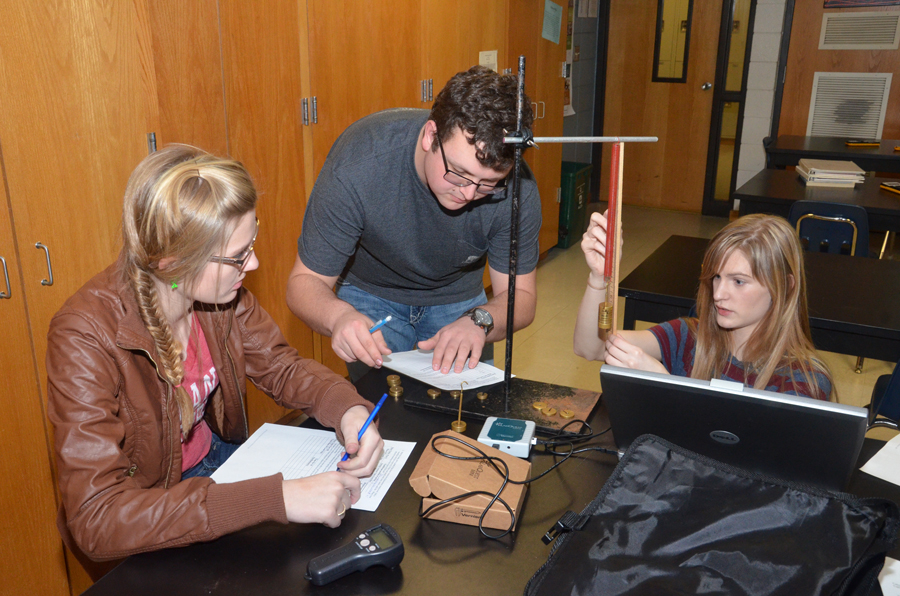
Greenbrier students Caroline Harrod, Will Ratliff and Kourtni Bowen study simple harmonic motion using a spring/mass system and Vernier motion sensors in an AP physics class.

Greenbrier students Caroline Harrod, Will Ratliff and Kourtni Bowen study simple harmonic motion using a spring/mass system and Vernier motion sensors in an AP Physics I class.

By Steve Brawner
© 2015 by Steve Brawner Communications, Inc.

Faulkner County is the home of three degree-granting educational institutions – the University of Central Arkansas, Hendrix College, and Central Baptist College. Soon there will be a fourth – Greenbrier High School.

Twenty minutes north of Conway, the district is waiting final accreditation – and there’s no reason to believe it won’t be granted – from the Higher Learning Commission in Chicago. If that happens before the end of the school year, 8-10 students will graduate high school with a two-year associate’s degree from the University of Arkansas at Little Rock.

Students already can earn college credit by taking concurrent and Advanced Placement courses – in other words, college English that counts as a high school English class. The cost for them and their families? Fifty dollars per class to give them “a little bit of skin in the game,” said Scott Spainour, the district’s superintendent, unless they can’t afford it, in which case it’s free. Lakeside High School in Garland County is partnering with National Park Community College to offer a similar opportunity.

Spainhour hopes the idea spreads beyond these two school districts. Arkansas ranks 49th in the country, above only West Virginia, in its percentage of adults above age 25 with a bachelor’s degree. According to the U.S. Census Bureau, 18.9 percent of Arkansans have reached that level of attainment.

Of course, having a four-year college degree isn’t necessary to be successful in life or to have a good-paying job – a fact that can be covered in another column. But, on average, you’re better off with more education than you are with less. The Federal Reserve Bank of San Francisco reported last year that average college graduates earn $830,800 more over their lifetimes than high school graduates. According to the Bureau of Labor Statistics, the unemployment rate in 2013 was 7.5 percent for Americans with a high school diploma but 5.4 percent for those with an associate’s degree and 4 percent for those with a bachelor’s degree.

College, obviously, is expensive, even with all the scholarships available. Last year, Greenbrier graduates saved almost $700,000 in college tuition costs because they had already taken those courses in high school.

But cost alone is not the only barrier to college completion. Many students graduate high school unprepared academically, and only one in 10 students requiring remediation will graduate with a four-year degree, according to “Four-Year Myth,” a 2014 report by Complete College America. Meanwhile, a college education is a major disruption occurring in an unfamiliar environment during a transitory stage in life. According to Complete College America, only one advisor is available for every 400 students on a typical college campus. It’s no wonder the National Student Clearinghouse Research Center reported in 2014 that, during the last 20 years, 31 million college students have started school but not earned a degree.

Students in Greenbrier and Lakeside, in contrast, will earn their hours in a familiar, supportive home environment before they go to college. “Four-Year Myth” reported that 62 percent of associate’s degree seekers who earn 30 credits during their first year graduate, compared with 10 percent with less than 12 credits. Greenbrier and Lakeside students easily can reach that level, and none of them have to be remediated. With up to two years of rigorous instruction already under their belts, they’re more likely to complete a four-year degree rather than drop out. And even if they enter the workforce straight from high school, they will be more job-ready because of the classes they have taken.

Arkansas has taken a number of steps to increase students’ educational attainment, including state-sponsored gambling through the lottery.

But making college more affordable isn’t enough. It’s not a good strategy to send 18-year-olds to a sprawling, impersonal campus and expect most of them to be successful. Arkansas has 297 public high schools, including Greenbrier and Lakeside, where classroom teachers know their students’ names and care about their well-being. There’s no reason many students can’t graduate with their basics at age 18, ready for more. Community colleges and four-year schools then can serve as economic and academic engines, not remedial facilities.

If this spreads – and it will – students could go “off to college” each morning from their homes, where parents can guide them, without going into debt. Sure seems like a better way to me.

Voters should select, not elect, judges

By Steve Brawner
© 2015 by Steve Brawner Communications, Inc.

The recent admission of bribery by former circuit judge Michael Maggio is an example of why Arkansas should consider changing the way it fills judicial offices – still relying on average citizens, but not by using elections.

Maggio pleaded guilty Jan. 9 to a felony bribery charge and now probably is on his way to prison. He had reduced a jury verdict against a nursing home operator from $5.2 million to $1 million two days after receiving large campaign donations from the operator.

Clear-cut justice-for-sale cases like this are relatively rare, so let’s not overreact. The corrupt official was caught, so you might say the system worked.

The problem, however, isn’t so much the obvious cases of bribery that can be prosecuted. The problem is when judges are merely influenced. Who donates to judicial campaigns? Often, those who have an interest in the outcomes of judicial decisions in general, such as attorneys and nursing home operators.

Elections of judges and justices has always been the least democratic of all ballot races. Candidates aren’t supposed to discuss how they would rule on specific cases because a judge should remain impartial until hearing the evidence. Meanwhile, they aren’t allowed to run under party labels, which at least would give voters a sense of where they stand. Many voters are just guessing.

In the future, the problem may go from voters having no information to them having a lot of bad information. More and more, the waves of campaign dollars swamping the executive and legislative branches is engulfing judicial races. In some other states, ads by outside groups in judicial races are as nasty as the ads for other offices. It hasn’t really come to Arkansas yet, but when it does, it will change not only judicial campaigns but also the administration of justice.

Solutions? One would be for the governor to appoint justices and judges the way the president does at the federal level, subject to legislative confirmation. That kind of power bestowed on the governor might make some people uncomfortable, but remember that he or she would be held accountable by the voters. A personal example: In 2000, enthusiastic about no candidate, I decided while driving to the polls to vote for soon-to-be President Bush solely because I preferred the justices he would appoint over Vice President Gore’s likely selections.

There is another model. In American democracy, where do registered voters best collect adequate information in a deliberative fashion before making an important decision? Juries.

So let’s have “voter duty” where 100 (or some other number of) Arkansas voters are randomly selected, summoned to a location, and given two days to interview judicial candidates and study their records. The names of the voters would be withheld so the candidates couldn’t influence them beforehand. At the end of two days, the voters would select the officeholders and go home.

We trust jury members to make life-or-death decisions in capital murder cases. Why not trust registered voters to appoint judges, which they do now anyway through the ballot box? Wouldn’t 100 informed and focused average Arkansans do a better job than 1 million scrolling through a list of names on the ballot that they recognize only through campaign attack ads? Best of all, judicial candidates could avoid having to raise money from shady donors who want something in return.

So let’s have a selection process instead of an election process for judicial offices. Elections are a means to an end, not the end itself. The ultimate goal is a just, democratic society ruled by the people. To keep justice from being for sale, 100 people might accomplish that goal better than 1 million of them.

Here’s some hopeful news on the national debt

By Steve Brawner
© 2015 by Steve Brawner Communications, Inc.

If you’re a person who reads this newspaper section or clicks on this column online, you’re probably aware of the national debt and maybe a little concerned, but you’re not crazy about reading 700 words about it.

I get it. The numbers are mind-boggling and the terms confusing. Could there be any more boring words than “federal budget” and “fiscal responsibility”? We’ve been hearing about this bear in the woods for decades, but he never seems to attack.

But a couple of important things happened this past week – one hopeful, one less so – that are worth noting, so let’s cover them. Bear with me. We’re already at 110 words.

Let’s start with the less hopeful news. The Congressional Budget Office (CBO) released its 10-year projections Monday, which told us what we already knew, which is that the debt is growing unsustainably. Already $18 trillion ($57,000 for every American), the debt is expected to grow to $27.3 trillion by 2025.

Each year, the government runs a deficit that adds more to the debt –about $1 trillion every year during the recession, less so in recent years. In 2014, the government added “only” $483 billon to the debt, and the next three years will be about the same. But then the deficit starts rising. By 2025, the government again will spend more than $1 trillion over what it collects that year.

The CBO reports are typically a good information source, but they are based on some rosy scenarios – for example, that Congress won’t extend tax loopholes that it always extends. Forecasters assume there won’t be a terrorist attack, a natural disaster, or a significant economic downturn between now and 2025. On the other hand, unexpected good things can happen as well, such as the United States’ increasing energy independence.

The CBO projections stop at 2025. The picture does not improve moving forward as the baby boomers age and as spending increases for Social Security and Medicare.

And Medicare is where we get to the hopeful news. The federal Department of Health and Human Services announced this week that it will rely less on the “fee for service” model that has helped create runaway health care costs. Under that model, doctors and hospitals are paid for whatever services they render. They bill, and taxpayers pay, few questions asked, creating an incentive for unnecessary tests and procedures.

In the future, alternative models more often will pay medical providers based on quality of care. This is very hard to do, but it has been tested. Little Rock’s CHI-St. Vincent has been involved in a Medicare pilot program where the hospital and doctors were paid a set amount for joint replacement procedures, and it was up to them to control costs to make a profit. I know we don’t like to think of health care in terms of profits, but the alternative is a government bureaucracy. The result of the pilot program was that patient hospital readmissions after those procedures were reduced by two-thirds. When I asked the hospital’s reform-minded CEO, Peter Banko, why the changes had not been made earlier, he said, honestly defining the problem, “There was no financial incentive to.”

“Until you change how we’re being paid, you’re not going to see changes in the system,” he also said.

At the state level, Arkansas has been involved in a similar effort, the Arkansas Health Care Payment Improvement Initiative, which involves Medicaid, insurance companies and others. As part of the initiative, medical providers have financial incentives to keep costs at certain levels for particular “episodes of care.” One result, according to the Arkansas Center for Health Improvement, is that unnecessary antibiotic prescriptions for certain respiratory infections have decreased 17 percent. Doctors now have a financial incentive not to prescribe medicines that serve no purpose other than making patients feel like something is being done.

These are not perfect solutions. They’re very top-down in a health system that has been becoming increasingly top-down for decades.

But they are hopeful. It is impossible to balance the budget without controlling health care costs. If that could happen, it would be one of those unexpected good things that might mess up CBO’s numbers, in a good way.