Arkansas Works and the private option: What’s all the fuss about?

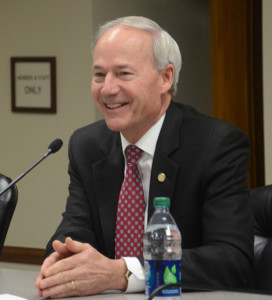
Gov. Asa Hutchinson

Gov. Asa Hutchinson

By Steve Brawner
© 2016 by Steve Brawner Communications, Inc.

This next month, legislators will debate whether or not the private option should continue as Gov. Asa Hutchinson’s version, Arkansas Works.

What’s all the fuss about? I’ll try to answer your questions.

What exactly is the private option?

Let’s start with the background. The Affordable Care Act, which created Obamacare, expanded the number of Americans eligible for Medicaid, the program that pays for medical care for poor people. Americans with incomes up to 138 percent of the federal poverty level became eligible. Meanwhile, the act cut the federal government’s reimbursements to hospitals that serve a high number of uninsured patients, who often don’t pay for their own care. The assumption was those people would be on Medicaid.

But then the Supreme Court ruled that states could choose whether or not to participate in the Medicaid part. Most Republican-leaning states said no, but their hospitals’ reimbursements are still to be cut. Arkansas in 2013 said “Yes, but.” Instead of putting people on Medicaid, a government program, it used those dollars to purchase private insurance. Republican legislators and Gov. Mike Beebe’s administration created it, and the federal government approved it.

What have been the results?

As of the end of January, 267,590 Arkansans had qualified. A Gallup poll last year found Arkansas’ adult uninsured rate had dropped from 22.5 percent in 2013 to 9.1 percent in 2015 – the country’s biggest improvement. Hospitals are treating fewer patients who don’t pay.

Other states that turned down the Medicaid money have faced consequences. Rural hospitals have closed. Oklahoma this week proposed cutting what Medicaid pays doctors and hospitals by 25 percent. That’s huge because Medicaid already doesn’t pay much, which is why many doctors won’t treat Medicaid patients. Louisiana, which first said no to Medicaid expansion under a Republican governor, recently elected a Democrat who promised to take the money.

What do opponents say?

The private option as it currently exists would cost $1.63 billion in 2017. Currently, the federal government pays for almost all of it, but next year the state starts picking up 5 percent, which increases to 10 percent by 2020 – assuming Congress doesn’t change the rules and make the state pay more. So the state will have to find that money.

Some legislators have a major philosophical problem with the private option. They say it’s a health care entitlement with roots in Obamacare that increases government dependency and adds to the national debt. Those federal dollars aren’t a gift; they come from American taxpayers, current and future.

So what’s Arkansas Works?

Last year, Hutchinson convinced legislators to approve the private option through the end of 2016 while the state figured out what to do next. In the meantime, he’s proposed Arkansas Works, which changes the program in a few ways. Beneficiaries with incomes from 100 to 138 percent of the federal poverty level would pay up to 2 percent of their income for insurance premiums – about $19 a month. Private option recipients would be referred to work and work training opportunities, though they wouldn’t be required to take advantage of them. Hutchinson would like to do more in that area, but the Obama administration won’t let him.

Is it really that different from the private option?

No.

Why does the Republican governor support government-funded health care?

He says he opposed and still opposes Obamacare, but he inherited this situation. If Arkansas does nothing, the private option would go away at the end of this year, and then all those people would lose their health insurance, and hospitals would have to go back to providing all that uncompensated care. Also, losing those federal dollars would blow a $100 million hole in the state budget.

What does the next month look like?

Legislators are meeting starting April 6 in a special session to vote on Arkansas Works. Then starting April 13, legislators meet in the fiscal session that occurs every even-numbered year. Because Arkansas Works will cost money, it requires a three-fourths vote in both the House and Senate. In other words, 26 representatives or nine senators could kill it.

What’s the vote count look like?

Hutchinson doesn’t have a three-fourths majority yet in either the House or the Senate. But he’s trying.

What will the outcome be?

I don’t know.

Related: The private option ink blot.

Cuba: trade embargo, or free trade?

Rick Crawford

Rick Crawford

By Steve Brawner
© 2016 by Steve Brawner Communications, Inc.

U.S. Rep. Rick Crawford’s 1st District in eastern Arkansas is home to half the nation’s rice acres. Cuba imports 400,000 tons of rice a year, mostly from Vietnam. So yeah, he’s for opening up trade to Cuba.

Speaking by Skype last week to a pro-trade-with-Cuba gathering at the Winthrop Rockefeller Institute on Petit Jean Mountain, Crawford said the trade embargo, in place since Oct. 19, 1960, has punished American producers instead of the Castro regime. Shipping rice from Vietnam take 36 days, versus the 36 hours it would take to ship Arkansas’ better, fresher rice, but the market is closed. Crawford, a member of a pro-Cuba trade congressional working group, has sponsored legislation that, among other provisions, would let Cuba buy rice on credit rather than requiring it to pay cash, which it doesn’t have. He’s traveling April 5-9.

Crawford isn’t the only Arkansas policymaker favoring a new approach to the communist country 90 miles off Florida’s shore. Sen. John Boozman also supports a change. He says the 55-year embargo hasn’t removed the Castro brothers from power, so it’s time to try something else – trading goods and ideas. The United States does business with worse regimes, he says, including Saudi Arabia and China. Last year, Gov. Asa Hutchinson – who helped enforce the embargo as undersecretary of the Department of Homeland Security, led a delegation of about 50 Arkansas business and government leaders to Cuba. He favors more trade without completely lifting the embargo.

Naturally, these policymakers have allies in the business community, including Arkansas Farm Bureau and Riceland Foods, both of whom see Cuba as a huge market.

Two Arkansas policymakers disagree. U.S. Senator Tom Cotton criticized President Obama as he traveled to Cuba last week, pointing out that the Castro regime arrested a human rights activist shortly before the trip. Rep. Bruce Westerman, who represents the 4th District, says opening up trade with Cuba rewards a regime that is still in power and still guilty of human rights abuses.

The state’s two other congressmen are still on the fence, sort of. Rep. French Hill, who represents the 2nd District, told KARN radio the other day that Arkansas will benefit from opening up the Cuban rice market, but he needs to see a path toward democracy and a market economy, and he’s concerned that there doesn’t appear to be a plan to make reparations to those who lost their businesses to the Castro regime. Rep. Steve Womack, from the state’s 3rd District, is still weighing the benefits and pitfalls of opening up trade, his office said.

The trade embargo began more than 55 years ago under President Eisenhower. In that time, all that’s been accomplished is that an ailing Fidel Castro was replaced by his brother, Raul. During that time, the United States has had 11 presidents. Meanwhile, the Soviet Union has gone from world superpower to historical artifact (for the moment); China has gone from closed communist country to manufacturing powerhouse; Europe’s economic borders have largely been erased; and the two Germanies have become one.

So the world has changed a lot – all except Cuba, where the Castros are still in charge.

And yet even Cuba’s past doesn’t necessarily limit its future. At the Winthrop Rockefeller Institute, Ruben Ramos Arrieta, Cuba’s minister counselor at its Economic and Trade Office in Washington, said the country has been undergoing a “transformation” since 2008. He said 80 percent of its agricultural land is state-owned, but 70 percent of that is now being used by private farmers and cooperatives. Whether or not that’s accurate, it’s notable that he described the private sector positively and that he spoke of “transformation” rather than “revolution.” Michael Bustamante, a Yale University professor with family in Cuba, said Cubans have an entrepreneurial spirit that helps them maintain an “a-legal economy” that is often ignored by the government authorities. Who knows what they could accomplish given freedom and a free market?

It’s said in sports that Father Time is undefeated. The same is true in politics. Raul Castro has said he’s leaving office in 2018, and even if he doesn’t, he’s 84 years old. Fidel Castro is 89. In the near future, somebody else is going to be Cuba’s leader.

The question for policymakers is, would that person be more influenced by a trade embargo, or by free trade?

Related: Make Cuba thirsty.

A hero, during and after the war

Cletis, uniformBy Steve Brawner
© 2016 by Steve Brawner Communications, Inc.

An American hero was laid to rest earlier this month.

Cletis Overton, 95, of Malvern, who died Feb. 29, enlisted in the Army in 1940 to serve as an aircraft mechanic and was sent to the Philippines. On Dec. 8, 1941, he awoke to the sounds of an air raid alert, bombs and gunfire. The Empire of Japan’s attack on the Philippines had begun.

When the enemy overtook his position on the Bataan peninsula, Cletis and his fellow soldiers were force-marched 60 miles to a prison camp. During what became known as the Bataan Death March, he saw three Americans stumble and fall, only to be quickly executed. Between 600 and 700 Americans and many more Filipinos died.

In a series of prison camps, Cletis and his fellow prisoners were forced into labor, given little food, and provided almost no medical care as they battled malaria, dysentery and other diseases.

Finally, as American forces drew near the Japanese positions, Cletis and his fellow prisoners were herded from Mindanao Island into the sweltering hold of a Japanese cargo ship. They received only a cupful of rice and a few swallows of water each morning and afternoon. Toilet facilities for 750 men, many with dysentery, consisted of two five-gallon empty oil barrels lowered into the hull. Then they were transferred to another ship, the Shinyo Maru, where conditions were just as bad.

As the Shinyo Maru departed the island, presumably for Japan, it was struck by a torpedo fired unwittingly by an American submarine. A wave of water almost waist deep rolled toward Cletis. Around him, men struggled and yelled. He fought his way toward a ladder through kicking legs, flailing arms, and scratching fingernails. Then he was rolled underwater by a rushing wave. For a moment, death seemed so certain that he considered taking a gulp of water to hasten it. Then he considered reasons to live – his parents, his girlfriend, and his belief that he had not yet done anything for God.

Somehow, he found an opening, made it to the ocean surface, and swam back to Mindanao Island while avoiding enemy soldiers who were shooting the survivors in the water. He was found by friendly Filipino forces. Six hundred sixty-eight men died in the sinking. Eighty-three survived. One died on the island, and one stayed to help the Filipinos.

The men were harbored by the Filipinos until they were met by the submarine USS Narwhal for the first leg of their trip home. Aboard the USS Monterrey, they whooped and hollered as the Golden Gate Bridge came into view. Soon he was home in Arkansas. As his mother, Virgie, saw him, she prayed in thanksgiving, they embraced, and then she cooked him fried chicken, his favorite meal.

It’s called the Greatest Generation not just because of what happened during the war, but afterwards. Cletis married his girlfriend, Maxine, became a dad and a grandfather, and when Maxine died, married his second wife, Adrienne. When he was in the water after the torpedo struck the Shinyo Maru, he promised God that he would share his Christian testimony whenever he talked about his experiences. He kept that promise. He harbored no bitterness toward his captors. He would say the guards had become what they had been taught to become, and that they were prisoners, too. In 2000, I helped him write a book about his life. One day, he told me undramatically, “If there is an attack on the United States or its possessions, and they needed 80-year-old men, I’d go.”

According to the National World War II Museum in New Orleans, 16 million Americans fought in World War II, they’re dying at the rate of 430 a day, and there are only 698,000 of them left – about 7,604 in Arkansas.

They all have stories to tell. Some will share them, and some will not. How can you know if your loved one will? Ask. Do it carefully and respectfully. But ask, because tomorrow there will be 430 fewer of them.

Related: Following in the footsteps of the Greatest Generation.

Disorder in the court

Uncle Sam hangs on for webBy Steve Brawner
© 2016 by Steve Brawner Communications, Inc.

Apparently we’ll spend the rest of the year with a 4-4 split on the Supreme Court, with the current vacancy left unfilled after the death of Justice Antonin Scalia. So here’s a scenario. Hillary Clinton beats Donald Trump in the election. Democrats take back the Senate. And then Clinton fills the vacancy by nominating President Obama.

Of all the facets of that scenario, the only one that’s completely unlikely is the last, and it’s not unthinkable. Obama is an attorney who appointed Clinton as secretary of state, so she kind of owes him. When asked earlier this year, she called his being a Supreme Court justice “a great idea.” Democrats would love it if she stuck her thumb in Republicans’ eyes that way. And Obama wouldn’t be the first to move from the White House to the Court. President William Howard Taft has already done it.

The rest is more likely but hardly certain. The latest average of polls by Real Clear Politics has Clinton beating Trump by nine points, and that’s before a potentially nasty fight at the Republican National Convention. In Senate races this year, 24 incumbent Republicans are up for re-election while Democrats are defending only 10 seats, so Democrats have an advantage on those numbers alone.

If Clinton wins and the Democrats retake the Senate, Republican senators might have to make some difficult decisions. They’ve been saying the voters should help pick the next justice through their choices in the election, but what would happen if Republicans are voted completely out of power? Would they give Obama’s nominee, Merrick Garland, or another nominee a second look while they still control the Senate between November and January, rather than take their chances with a Clinton nominee?

Arkansas’ two senators are taking different approaches. Sen. John Boozman says the next president should nominate the next justice, period. In a statement, he said, “Our country is very split and we are in the midst of a highly contested presidential election. My colleagues and I are committed to giving the American people a voice in the direction the court will take for generations to come.” His spokesman, Patrick Creamer, said Boozman’s position would not change even if Democrats win everything in November.

Sen. Tom Cotton, however, left himself some wiggle room. In his statement, he said, “In a few short months, we will have a new president and new senators who can consider the next justice with the full faith of the people. … The nomination should not be considered by the Senate at this time.” His spokesperson, Caroline Rabbitt, pointed to the “at this time” part and did not rule out Cotton considering Obama’s nominee after the November election.

At the very least, the Supreme Court sometimes will look like Congress in these coming months: divided and paralyzed. A 4-4 decision means the lower court’s ruling in that particular case will stand. Let’s hope those positions get filled if they come open.

This kind of standoff was bound to happen, I guess. The country, like the Supreme Court, is so divided that nation-changing court decisions will come down to one Supreme Court justice. In some ways, choosing that justice is more important than choosing the next president.

One other issue at play is the Founding Fathers’ really bad idea to give Supreme Court justices a lifetime appointment – to insulate them from politics, ha ha. Because of that lifetime appointment, presidents tend to pick someone as young as they can get away with. To Obama’s credit, Garland is 63, unlike the early-50-something-year-olds who have been nominated lately, or Justice Clarence Thomas, who was in his early 40s. Still, Garland could rule from the bench for at least two decades.

One good thing about this controversy is that it has reminded voters of the importance of this presidential duty. The next president could nominate at least four justices. In addition to Scalia’s replacement, Justice Ruth Bader Ginsburg is 83, Justice Anthony Kennedy is 79, and Justice Stephen Breyer is 77.

What happens if, after November, one party still controls the White House and the other the Senate? Will the two branches ever be able to agree on a pick before more vacancies occur?

Let’s hope so. Somebody has to do this job, and no one lives forever.

Kasich: What should have been

Hand with ballot and boxBy Steve Brawner
© 2016 by Steve Brawner Communications, Inc.

“For all sad words of tongue or pen, the saddest are these, ‘It might have been!’” wrote the poet John Greenleaf Whittier.

I’m thinking that line is appropriate regarding the presidential campaign of Ohio Gov. John Kasich. Perhaps some Republican party types are thinking that as well. If not, they may be after November.

After winning his home state of Ohio, Kasich is now the last candidate standing between the nomination and Donald Trump or Sen. Ted Cruz – candidates many Republicans, particularly those in the establishment, can’t accept (Trump) or don’t like personally (Cruz).

Despite that victory, Kasich is now mathematically eliminated from winning the nomination. At best, he can win enough delegates to deny Trump a majority, leading to a contested convention when Republicans gather in Cleveland in July. And then, the theory is, maybe he can emerge as a consensus candidate. It’s possible, but it’s a long shot.

Yeah, I voted for Kasich – I and 15,304 other Arkansans, or 3.72 percent of Republican primary voters.

I did that because I believed he’s the most experienced, qualified candidate with the best record. He was chairman of the House Budget Committee in the 1990s, the last time Congress came close to balancing the budget, and then he became governor of Ohio and led the state in turning that state’s deficit into a surplus. No other candidate, Republican or Democrat, can say anything like that.

I also voted for him because of his common decency, a quality that has been unfortunately uncommon in this ugly election year. More than any other candidate, he has avoided disparaging others and has offered a positive, unifying vision for the country.

If Republicans really want to win the election and deny Hillary Clinton the presidency, Kasich should be their first choice. An average of polls by the website Real Clear Politics shows, in hypothetical match-ups, Clinton beating Trump by more than six points, while Cruz is leading Clinton by .8 of a point, a statistical tie. Sen. Marco Rubio, who dropped out of the race after losing his home state of Florida, was leading her by four points. Kasich, however, is beating her by more than seven points.

Those are national averages, but the United States does not actually have national elections. Instead, it has 51 state ones counting the District of Columbia, and of those, only a few are competitive, including Ohio, which has 18 of the 270 Electoral College votes needed to win. No Republican has ever been elected president without winning Ohio. Kasich is beating Clinton there by an average of almost 18 points.

Also really important is Pennsylvania, with 20 electoral votes. It’s voted Democratic in each of the last six elections, but some have been close. According to a recent Mercyhurst University poll, Kasich was trouncing Clinton 49-36 there. Meanwhile, she was beating Cruz 45-42 and Trump 43-35.

A Republican who wins both Ohio and Pennsylvania would be your next president.

Unfortunately, leading Arkansas Republicans did not bet on this horse. Thirty legislators endorsed Rubio. Gov. Asa Hutchinson did, too, during that brief period after Jeb Bush dropped out and Rubio became the darling of the establishment.

Hutchinson chose the candidate who seemed to have the best chance of beating Trump, despite Hutchinson’s having a lot in common with Kasich, including serving together in the U.S. House of Representatives and both accepting Medicaid expansion dollars under Obamacare as governors. Rather than refuse the money, Arkansas created the private option, which Hutchinson wants to continue as a program he is calling Arkansas Works.

Another 18 legislators and Secretary of State Mark Martin publicly endorsed Cruz Feb. 24.

If Hutchinson or anybody else instead had come out swinging for Kasich, it wouldn’t have made much difference. Voters don’t base their decisions on endorsements by elected officials – or newspaper columnists, thank goodness. Still, no Republican legislators or state officials endorsed the candidate who balances budgets, reaches across the aisle, and has the best chance of winning the general election. That’s notable, I guess.

Kasich and some of his supporters are still holding out hope that something crazy will happen at the convention. Maybe something will, but more than likely, they and some other Republicans will be left wondering what might have been. Actually, what should have been.

Related: For president, governors no longer need apply.