Category Archives: U.S. Congress

Cuba: trade embargo, or free trade?

Rick Crawford

Rick Crawford

By Steve Brawner
© 2016 by Steve Brawner Communications, Inc.

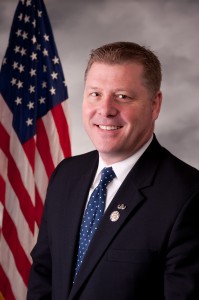
U.S. Rep. Rick Crawford’s 1st District in eastern Arkansas is home to half the nation’s rice acres. Cuba imports 400,000 tons of rice a year, mostly from Vietnam. So yeah, he’s for opening up trade to Cuba.

Speaking by Skype last week to a pro-trade-with-Cuba gathering at the Winthrop Rockefeller Institute on Petit Jean Mountain, Crawford said the trade embargo, in place since Oct. 19, 1960, has punished American producers instead of the Castro regime. Shipping rice from Vietnam take 36 days, versus the 36 hours it would take to ship Arkansas’ better, fresher rice, but the market is closed. Crawford, a member of a pro-Cuba trade congressional working group, has sponsored legislation that, among other provisions, would let Cuba buy rice on credit rather than requiring it to pay cash, which it doesn’t have. He’s traveling April 5-9.

Crawford isn’t the only Arkansas policymaker favoring a new approach to the communist country 90 miles off Florida’s shore. Sen. John Boozman also supports a change. He says the 55-year embargo hasn’t removed the Castro brothers from power, so it’s time to try something else – trading goods and ideas. The United States does business with worse regimes, he says, including Saudi Arabia and China. Last year, Gov. Asa Hutchinson – who helped enforce the embargo as undersecretary of the Department of Homeland Security, led a delegation of about 50 Arkansas business and government leaders to Cuba. He favors more trade without completely lifting the embargo.

Naturally, these policymakers have allies in the business community, including Arkansas Farm Bureau and Riceland Foods, both of whom see Cuba as a huge market.

Two Arkansas policymakers disagree. U.S. Senator Tom Cotton criticized President Obama as he traveled to Cuba last week, pointing out that the Castro regime arrested a human rights activist shortly before the trip. Rep. Bruce Westerman, who represents the 4th District, says opening up trade with Cuba rewards a regime that is still in power and still guilty of human rights abuses.

The state’s two other congressmen are still on the fence, sort of. Rep. French Hill, who represents the 2nd District, told KARN radio the other day that Arkansas will benefit from opening up the Cuban rice market, but he needs to see a path toward democracy and a market economy, and he’s concerned that there doesn’t appear to be a plan to make reparations to those who lost their businesses to the Castro regime. Rep. Steve Womack, from the state’s 3rd District, is still weighing the benefits and pitfalls of opening up trade, his office said.

The trade embargo began more than 55 years ago under President Eisenhower. In that time, all that’s been accomplished is that an ailing Fidel Castro was replaced by his brother, Raul. During that time, the United States has had 11 presidents. Meanwhile, the Soviet Union has gone from world superpower to historical artifact (for the moment); China has gone from closed communist country to manufacturing powerhouse; Europe’s economic borders have largely been erased; and the two Germanies have become one.

So the world has changed a lot – all except Cuba, where the Castros are still in charge.

And yet even Cuba’s past doesn’t necessarily limit its future. At the Winthrop Rockefeller Institute, Ruben Ramos Arrieta, Cuba’s minister counselor at its Economic and Trade Office in Washington, said the country has been undergoing a “transformation” since 2008. He said 80 percent of its agricultural land is state-owned, but 70 percent of that is now being used by private farmers and cooperatives. Whether or not that’s accurate, it’s notable that he described the private sector positively and that he spoke of “transformation” rather than “revolution.” Michael Bustamante, a Yale University professor with family in Cuba, said Cubans have an entrepreneurial spirit that helps them maintain an “a-legal economy” that is often ignored by the government authorities. Who knows what they could accomplish given freedom and a free market?

It’s said in sports that Father Time is undefeated. The same is true in politics. Raul Castro has said he’s leaving office in 2018, and even if he doesn’t, he’s 84 years old. Fidel Castro is 89. In the near future, somebody else is going to be Cuba’s leader.

The question for policymakers is, would that person be more influenced by a trade embargo, or by free trade?

Related: Make Cuba thirsty.

GOP shows Obama its cards, helps Hillary Clinton

By Steve Brawner
© 2016 by Steve Brawner Communications, Inc.

Generals don’t tell the enemy where they are going to attack. Boxers don’t tell their opponents where they are going to punch. But Republicans told President Obama and the Democrats exactly what they were going to do about the U.S. Supreme Court vacancy, and because of that, they may have increased the chances Hillary Clinton will be the next president.

After Justice Antonin Scalia passed away, Republicans quickly declared that Obama might as well not nominate a successor because the Senate won’t confirm him or her anyway. Senate Majority Leader Mitch McConnell, R-Ken., said the seat “should not be filled” until the next president takes office. Most of the party’s presidential candidates made similar statements.

That was a political mistake. Now, Obama has the high ground. He can make this a contest between himself and McConnell, who’s not exactly an electrifying figure. The “executive order president” can paint himself as the defender of the Constitution. He’ll do his constitutional duty in nominating a successor; now will Republican senators do theirs and give a fair hearing to the nominee?

Moreover, now he knows the Republicans’ strategy, but they don’t know his, so he can plan his next move accordingly.

For example, he can nominate a female with a long list of accomplishments, maybe even a military record. If Republican senators refuse to give her a fair shot, or even treat her poorly, then Clinton can spend the rest of this election talking about those obstructionist Republicans keeping glass ceilings above women’s heads. That message will resonate in an electorate where Obama won women by 12 points in 2012, according to Gallup. In that same election, Republicans won men by only eight points, and more women vote than men.

In addition to the vacancy, three justices – Ruth Bader Ginsburg, Anthony Kennedy and Stephen Breyer – are at least 80 years old or getting close. So the irony is that to keep Obama from nominating one justice, Republicans likely have given Clinton an issue she can use to win and have the chance to nominate four.

What Republicans should do is praise Scalia as a strict constructionist who believed the Constitution means what it says it means, and that they will honor him by insisting that Obama’s nominee follows his example. If Obama nominates someone too liberal, they can expose that person’s record and make voters more uncomfortable with Clinton’s potential nominees. By then it will be late spring, and then Republicans can plausibly make the case that, at that point, we might as well wait for the next president.

On the other hand, Obama wants to appoint a Supreme Court justice at least as much as he wants Clinton to win, so maybe he will nominate someone Republicans can live with. Some senators might decide they’d rather confirm his nominee in his last year, rather than take their chances on Clinton winning and nominating someone in her first. Republicans, after all, control the Senate now. Next year, they might not.

I can think of three reasons Republicans tipped their hand so clumsily. One, many of them viscerally, emotionally dislike Obama, and people in that state of mind make mistakes. Two, it’s a presidential year, so the party’s focus naturally turns to candidates trying to get elected by appealing to the party base, and away from those trying to run a government. And three, they did it because they had no choice. A beast has been created these past eight years that must be fed anti-Obama red meat at all times. Had Republican leaders played their cards a little closer to their vests, that beast would have been angry.

Let’s not overstate this. Republicans made a bad move, but not a fatal one. It’s a long way until November, when the election will be decided mostly by the actual nominees. Since Obama was elected, Republicans have gained or solidified control of both houses of Congress, a majority of state Legislatures, and a large majority of governor’s mansions. They must be doing something right, politically.

But now, for the first time in a long time, they do not have control of the Supreme Court. It’s now 4-4, which means we’re looking at a lot of deadlocked votes. Let’s hope Republicans walk back their previous statements. The president should fulfill his constitutional duty, and they should fulfill theirs.

How Conner Eldridge thinks he can win

Conner Eldridge

Conner Eldridge

By Steve Brawner
© 2016 by Steve Brawner Communications, Inc.

The campaign headquarters office where Conner Eldridge and I visit Jan. 19 is spacious but sparsely furnished – still developing, in other words, like his candidacy.

The 38-year-old former U.S. attorney knows he faces an uphill battle trying as a Democrat to win the U.S. Senate seat currently held by Sen. John Boozman, a Republican. Since 2010, the state’s allegiance has flipped. After a century and a half of Democratic dominance, Arkansas’ congressional delegation is now entirely Republican, as are all of its constitutional officers and two-thirds of its Legislature.

Eldridge, however, believes he can buck that trend. He thinks he has advantages this year that haven’t been available to the last two Democrats running for Senate: Sen. Blanche Lincoln, who won only 37 percent against Boozman in 2010; and Sen. Mark Pryor, who won 39 percent against now-Sen. Tom Cotton in 2014.

Eldridge looks at those numbers and then compares them to the University of Arkansas’ 2015 Arkansas Poll. It found an electorate split three ways: a third Republican, a third Democrat, and a third independent. Twenty-three percent of independents say they lean Democrat. Add them to the Democrats’ third, and that’s pretty much the base of Lincoln and Pryor voters.

He has to secure those votes plus find enough to win the election.

How does he think he can do that when Lincoln and Pryor fell far short? First, this will be the first contested Senate race in Arkansas in a presidential election year since 2004, when Lincoln defeated state Sen. Jim Holt.

That’s significant because presidential elections draw a higher turnout with a broader, more diverse electorate than midterms. In 2012, there were 1,078,548 ballots cast in Arkansas. In 2014, there were 226,000 fewer voters. It’s no secret that those missing voters in higher proportions are younger and/or minorities – in other words, more often Democrats. Midterms tend to draw an electorate that is older, more affluent, more conservative, and more white. Those characteristics more often describe Republicans.

Eldridge thinks some of those Democratic voters who stayed home in the 2010 and 2014 midterms will return to the polls this year and vote for him. How much is that worth? Some.

Second, Eldridge believes that Hillary Clinton, Arkansas’ former first lady, will outperform President Obama more here than she will in any other state. Obama won 37 percent here in 2012, dragging Democrats like Pryor down with him. Clinton should do better, and if she does, Eldridge should benefit. How much is that worth? Some.

Third, the Arkansas Poll revealed that despite serving in the House and Senate since 2001, Boozman remains somewhat of a low profile figure. Asked if they approved of the job he is doing, 44 percent either didn’t know or had no opinion, while his favorables were relatively low at 38 percent against even lower unfavorables of 18 percent. It’s not that Arkansans don’t like Boozman, who is an uncommonly nice and gracious person. A lot of them just don’t know him that well. Eldridge would be a new face and says he would be a more active senator.

“And I think Arkansas voters, independent voters, Republicans, Democrats, and independents, still vote the person, not the party, and are hungry, particularly at this important time, for somebody who’s going to shake things up, make a difference, work hard, and get things done,” Eldridge told me.

Finally, he draws hope from the recent Louisiana governor’s race, where a Southern Democrat won a rare victory these days against a Republican. The Democrat was an ex-Army Airborne Ranger while the Republican has a history with prostitutes. But at least it can be done.

So with a base of support somewhere close to 40 percent, plus a few percentage points because it’s a presidential year and a couple of points because it’s Hillary Clinton running and not Obama, and a bit more support from independents because he’s a new face, Eldridge thinks he can make a game of this.

We’ll see. This is a crazy year, at least in the presidential race. But Boozman still has an “R” by his name, and in the last two Senate elections in Arkansas, that’s been worth a lot.

Steve Brawner is an independent journalist in Arkansas. Email him at brawnersteve@mac.com. Follow him on Twitter at @stevebrawner.

Red ink rising

Uncle Sam hangs on for webBy Steve Brawner
© 2016 by Steve Brawner Communications, Inc.

Let’s start this column with two words that sound like they might mean the same thing, but don’t.

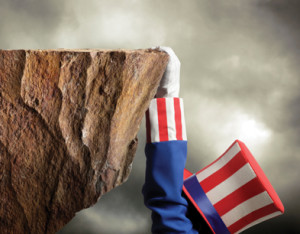
“Deficit” and “debt” both refer to when the government spends money it does not have. The big difference is that “deficit” refers to a yearly shortfall, whereas “debt” refers to the government’s accumulated shortfalls. “Deficit” is the money the government added to its credit cards just this year. “Debt” is the money that was already there, plus the new deficit. Add it all together, and the national debt now equals $18.96 trillion, or $58,700 for every American man, woman and child.

Another difference is that sometimes the deficit goes down, but the debt almost never does. In fact, the last time the United States government owed less than it did the year before was 1957 under President Eisenhower.

The one-year credit card additions, on the other hand, have been mostly shrinking since 2009, when the red ink hit $1.4 trillion, or more than $4,600 for every American. That was the year the economy was tanking, the banks were being bailed out, and the United States was still very much involved in Iraq and Afghanistan. Fiscal year 2009 started Oct. 1, 2008, when President George W. Bush was still in office. Under President Obama, yearly deficits stayed above $1 trillion each year until 2013, when the deficit dipped to $680 billion. In 2015, it was $439 billion.

As Obama pointed out in his State of the Union address, deficits have been cut by almost three-fourths since their peak. But with that $439 billon deficit, the government in 2015 still added about $1,400 in debt for every American.

Here’s another way to look at those numbers. As illustrated on the Department of the Treasury’s website, www.treasurydirect.gov, the $1.4 trillion in 2009 was equal to all the debt accumulated over the years from 1790 until 1983 – almost two centuries of combined borrowing. The $439 billion the president bragged about was equal to all the debt accumulated from 1790 until 1972.

That’s better. But no, the state of the union is not strong in this area.

Have I depressed you yet? Here’s the kicker. This brief period of falling deficits is now ending, and the yearly red ink will start rising faster again. On January 19, the Congressional Budget Office projected that the 2016 deficit will increase to $544 billion. From there, yearly deficits will keep expanding so that by 2026, a decade from now, we’ll be back to $1.4 trillion, and that’s assuming Congress doesn’t do anything to make the situation worse, that the United States isn’t in the middle of another recession or war, or that interest rates don’t spike. At that point, the deficit will be 4.9 percent of the nation’s gross domestic product, double what it is today.

This is occurring for several reasons. In December, Congress increased spending for defense and other areas while making permanent numerous tax breaks that were “temporary” but routinely extended every year. Meanwhile, the debt is being driven over the long term by Social Security, government health care programs such as Medicare and Medicaid, and interest payments for the money already owed.

People don’t like to read sentences like that last one. Aside from interest payments, those programs are generally very popular because they are seen as benefitting the needy and/or deserving.

But I’m just telling you where the money goes. The government is increasing spending by $2.7 trillion from 2015 to 2026. Ninety percent of that increase is in those areas.

So that’s where we are: The debt is still increasing, and now, so are the deficits. For the foreseeable future, the government will keep going deeper in debt, and it will do so faster and faster.

There are two types of debt that don’t show up on a balance sheet. One is the debt we owe to our ancestors, who sacrificed much and sometimes everything to build a better life for us. We owe it to them to do the same for our children.

The other debt is to those children. We owe them better than this.

Related columns: Tax-cut-and-spend Congress.

Reducing debt and cures for cancer

By Steve Brawner
© 2016 by Steve Brawner Communications, Inc.

During the president’s State of the Union address Tuesday, there was an elephant in the room, and I’m not talking about the Republican Party, whose mascot is the pachyderm.

The elephant would be the $19 trillion national debt, ignored by President Obama during an hour-long speech, which was otherwise pretty good, and alluded to a couple of times by South Carolina Gov. Nikki Haley in her Republican response, which was also pretty good.

What was good about the State of the Union speech was its optimistic tone and its call for reason on issues both at home and abroad. The United States should identify and respond to threats, not inflate them so that it makes bad decisions out of fear. Its politics should be messy, not ugly.

However, the president’s only referral to the government’s red ink was to say that annual budget deficits have been reduced amidst other aspects of an improving economy.

That’s true, but while deficits have decreased, they’re still occurring each year, and still adding to the national debt. At the tail end of the Bush administration and the first half of Obama’s, the United States government was spending more than $1 trillion more than it collected each year – more than $3,000 per American per year, and at its worst, $4,000. According to the Congressional Budget Office, the deficit for fiscal year 2015 was $439 billion, or almost $1,400 per American.

Yes, that’s an improvement. We’re adding to the debt less quickly than we were before.

But during this prolonged period of economic growth, policymakers have failed to act to reduce future deficits. They haven’t make changes to the government’s retirement and health care programs that soon will help drive those annual deficits back to $1 trillion levels. They’ve failed to reform a tax code to juice the economy by, if nothing else, reducing the time we all spend doing our taxes. They haven’t created a sustainable method to fund the country’s infrastructure.

The economy is much better than it was in the midst of the Great Recession. Unfortunately, it remains dependent on debt – and worse, the kind caused by in-and-out spending, not investment.

That’s why potentially one of the most important paragraphs in Obama’s speech was tucked in the middle, when he said the United States should cure cancer.

That’s exactly the kind of investment that can make life better for Americans and help reduce all that red ink described earlier in this column. According to the National Institutes of Health, cancer cost the health care system $124.6 billion in 2010 and will cost $158 billion in 2010 dollars in 2020 – and that’s not including the impact of each invaluable life lost, nor the financial and emotional losses suffered by cancer patients and their loved ones. The disease often strikes people during their most productive years, or before they’ve even reached those years. All those things slow the economy, cost taxpayer dollars, and add to the debt.

At the same time we’re spending that kind of money to treat the disease, Congress recently appropriated $5.2 billion for cancer research this fiscal year, which is actually a raise from the previous $4.9 billion. That’s pretty good, but we could do better.

Since 2009, the national discussion over heath care has been about bureaucracies – what kind and how much. At some point, it would be helpful to talk about health care when we’re talking about health care. Curing the various types of cancer would be one of the greatest investments America could ever undertake. It would increase Americans’ ability to enjoy their inalienable rights of life, liberty and the pursuit of happiness. It would be a far greater service to the world than many of the things we’ve been doing since 2001. It would be a wonderful gift to future generations and sort of make up for the debt we’re passing down to them.

The research must take into account not only medical effectiveness, but cost-effectiveness. The NIH assumes in its analysis that new technologies and treatments will cost more, not less. So not only must cures be found, but costs must be affordable – both for Americans and for poorer countries.

We can do it. Americans put a man on the moon. Let’s find cures for cancer next.

Related: Who gets first dibs on Uncle Sam’s money? Its creditors, of course.