I appeared on AETN’s “Arkansas Week” Friday with host Steve Barnes, longtime journalist Ernie Dumas, and KUAR’s Ernie Dumas. We discussed the upcoming runoff elections, the Pryor-Cotton Senate race, state revenues and the possible upcoming special session about school employee insurance.
Category Archives: State government
Pryor vs. Ross
By Steve Brawner
He’s a Democrat running for a high-profile statewide office. He’s developed a reputation through the years as a centrist willing to work with both sides of the aisle. He excels at retail, face-to-face politics. He faces a Republican attorney who doesn’t.
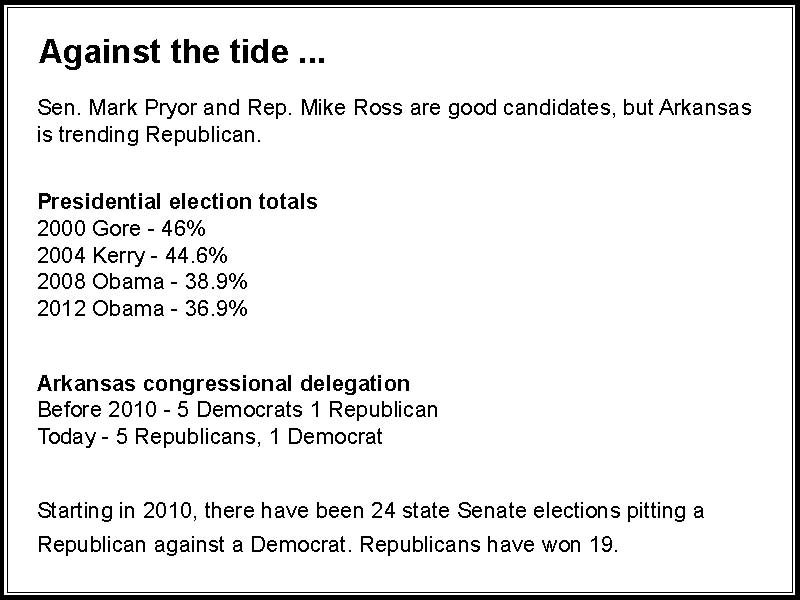
I could be describing Sen. Mark Pryor or Mike Ross. They’re similar elected officials facing similar opponents, and yet in the Senate race Pryor is usually polling several points ahead of his opponent, Rep. Tom Cotton, while Ross is polling behind Asa Hutchinson in the campaign for governor.
Why the difference between Pryor and Ross so far? One theory: They’re competing with each other a little bit, and Pryor is winning. Perhaps the most intriguing matchup this year is not Pryor vs. Cotton, or Ross vs. Hutchinson. It’s Pryor vs. Ross.
Let’s start with more conventional explanations for those polls, and then I’ll explain that theory. Pryor is a statewide figure who has represented all of Arkansas in the Senate for 12 years. He still enjoys good will because of his father, former Sen. David Pryor. Ross represented only one-fourth of the state as a member of the U.S. House of Representatives, and he’s been out of office for nearly a year-and-a-half.
As for their opponents, Hutchinson, the longtime Arkansas political figure, is a more polished candidate than Cotton. Hutchinson knows how to soften his stances and appeal to folks in the middle, while Cotton seems to know only one speed – full ahead. We like our politicians on a first-name basis here: Mike, Mark, Blanche, etc. We all know who “Asa” is, but Cotton, whom we just met a couple of years ago, is not yet “Tom.”
Other explanations? Because the Senate seat is so important nationally, the race has attracted millions of dollars in campaign ads that have taken the shine off Cotton. Hutchinson and Ross really haven’t laid a glove on each other yet. Meanwhile, Hutchinson was involved in a primary contest against an active opponent, Curtis Coleman, so his campaign has been somewhat in the public eye. Ross faced an inactive primary opponent and has been mostly laying the groundwork for the general election.
Let’s get back to the theory that Pryor and Ross are competing against each other.
Resources are limited. There is only so much campaign money, and there are only so many volunteers with only so much time and energy. There is only so much space for yard signs and bumper stickers.
That’s the case with any campaign season, but this year’s races are occurring in the context of a Republican surge in Arkansas that may have peaked but hasn’t ended. When there’s a trend, there’s more room for one outlier than two.
Of course, hanging over all of this is the fact that President Obama is still in office, he’s still a Democrat, and, right or wrong, he’s still deeply disliked by many Arkansans.
Arkansans like to think of themselves as independent. We have a history of splitting our tickets. Until 2010, this was one of the more Democratic states in the country, and Democrats still hold a lot of power at the local and state levels.
Given all that, some diehard Obama-dislikers will be prepared to vote for a member of Obama’s party in either the U.S. Senate or the governor’s race. But they won’t vote for a member of his party in both of this year’s major races. Doing so would be too much of an endorsement of him and what they believe he represents. Pryor and Ross are competing for those voters.
Republicans still have the momentum in Arkansas. Pryor and Ross – both very good politicians – are trying to swim against that tide. It’s foreseeable that one can do it. It’s harder, though certainly not impossible, to see both winning. They’ve both got a lot to compete against, including, in some ways, each other.
Anyway, that’s one theory.
Is this the way to select judges?
By Steve Brawner
In a democracy, how we select officeholders is more important than whom we elect in a single election. That being the case, it’s time to reconsider how we select judges and Supreme Court justices. It’s not been a good election cycle.
For example, last year, nursing home operator Michael Morton donated thousands of dollars through seven different political action committees to the campaign of Circuit Judge Mike Maggio, who at the same time reduced a jury verdict against one of Morton’s nursing homes from $5.2 million to $1 million. Morton has said the timing of the gifts and verdict were a coincidence, but the Arkansas Supreme Court has reassigned Maggio’s entire caseload.
Also, as reported in Sunday’s Democrat-Gazette, Morton donated $46,000 to the campaign of Supreme Court Justice Rhonda Wood, who doesn’t have an opponent. She later returned half of that. He also donated $20,000 to Judge Karen Baker, who also is running unopposed for Supreme Court. Both of these represented sizable percentages of the two candidates’ campaign hauls.
The only competitive Supreme Court race pitted Court of Appeals Judge Robin Wynne versus attorney Tim Cullen. (Tuesday is my deadline, so I don’t know who won.) In that race, a campaign ad funded by the out-of-state Law Enforcement Alliance of America made an issue of Cullen once serving as a court-appointed lawyer for a sexual predator who was appealing his sentence. In the legal brief, Cullen used the phrase “victimless crime” because the predator had been caught through a police sting operation. In typical negative campaign ad fashion, the LEAA pulled that quote out of context and painted Cullen as an ally of sexual predators and dismissive of child pornography.
The ad was not just an attack on Cullen. It was an attack on one of the most fundamental values of the American judicial system – the right to a fair trial and a vigorous defense. Wynne distanced himself from the ad, which wasn’t his, but he did not denounce it – a fact I remembered in the polling booth.
Misleading negative ads and big campaign donations are nothing new, of course, and one might argue that they are the price we pay for having a vibrant democracy and free speech. Some might say judges should go on the hot seat just like everyone else.
But the judiciary is unique among the three branches of government. While the executive and legislative branches should listen intently to popular will, the judiciary should be relatively independent of campaign-related passions. Also, the executive and legislative branches operate through collaboration, so there’s a limit to how much influence can be bought with a donation to a single candidate. Judges, however, make decisions that stand on their own. A group of four justices can change the way we live with a single decision.
Arkansas always has had an uneasy relationship with judicial elections. Judicial ethics have forbidden candidates from discussing how they would rule on cases, resulting in bland campaigns offering limited information to voters. Now that campaign dollars are flowing more freely, candidates are being placed in increasingly compromising situations. After all, unless they are independently wealthy, they must accept contributions in order to run a campaign.
Should judges be selected through an appointment process – perhaps by the governor with confirmation from the state Senate, as it’s done in Washington? Or would that simply import some of Washington’s troubles here? Maybe we should just trust the current process. Of course, the current process is also how we elect constitutional officers, and two of the seven have resigned in disgrace.
We’ll be fine regardless of whether Wynne or Cullen won on Tuesday. They’re both qualified. But in a democracy, how we select is often more important than whom we elect. It’s time for a judicious review of the process.
Walkers seek a home for every waiting child
Near midfield at Little Rock’s War Memorial Stadium Saturday stood displayed the photos of 140 children. Their ages and races differed, and the snapshots revealed their unique personalties. But they had this in common: They all are waiting to be adopted.
The Arkansas Heart Gallery is a coordinated effort involving the Arkansas Division of Children and Family Services and Project Zero, an organization seeking a home for every child in Arkansas who needs one. Project Zero’s slogan is “Imagine a world where 1+1 = 0.”
Project Zero founder Christie Erwin, who has fostered 50 children and adopted two, said the Heart Gallery personalizes the issue in a way that statistics cannot. More photos are coming thanks to volunteer professional photographers across the state.
“The exciting thing is when we’re taking kids out,” she said. “Like this morning, as we were setting it up, there was a little guy that was placed this week, so we took his picture out.”
The Heart Gallery was on display Saturday as part of the Walk for the Waiting, an annual event that raises money and awareness of the need for adoptive and foster families. The event has raised $186,000 so far, according to its website Tuesday. (Click on walkforthewaiting.org to donate.)
Along with Project Zero, the Walk is sponsored by two other organizations. One of those is The Call, which trains prospective adoptive and foster families and, like Project Zero, mobilizes churches to take up the cause. The other is Immerse Arkansas, which manages four houses for young people who are aging out of the foster system without ever finding a family.
About 3,900 children are currently in foster care in Arkansas, and about 7,700 spend some time in the system annually. Parental rights for 615 children were terminated last year. Those kids are the waiting.
Without much media fanfare, a church-based movement is making real progress in recruiting adoptive and foster families. Adoptions in Arkansas increased from 601 in 2010 to 677 last year thanks in part to these group’s efforts. One in four foster families in Arkansas was originally recruited by The CALL, which operates in 29 counties and is about to add three more, according to Executive Director Lauri Currier.
“Not everybody is called to foster or adopt, but everybody’s called to care,” she said in an interview somewhere near midfield. “Everybody’s called to do something.”
Nathan and Amy James of North Little Rock are among those doing something. After seeing a CALL video at church, they began fostering children and then adopted three, all sisters or half-sisters. Last year, the family raised the most of any Walk for the Waiting participants – $10,000 thanks to a series of Facebook videos where people declared, “No more waiting!” This year, life’s busyness and a balky computer hindered their efforts, but they still have raised $4,000.
They are giving their adoptive daughters opportunities they otherwise wouldn’t have had. But Nathan said having a diverse family also has benefited their biological children.
“We’re showing them sacrificial love,” he said. “We’re showing them what it’s like to sacrifice for someone else at a young age, that we think it’s important.”
Immerse Arkansas, meanwhile, helps never-adopted young people transition into adulthood. Founder Eric Gilmore said his clients, robbed of a stable home life during their childhood, sometimes lack purpose and motivation. But those traits can be learned, as they were by one young man who became involved in Immerse as an 18-year-old.
“He’s 21 now. A few weeks ago, he moved into his own place, and he’s working two jobs, paying for all his bills, taking care of his own needs and has surprised himself,” Gilmore said.
Gilmore told walkers that he hopes Immerse Arkansas is put out of business someday. That would only happen if every child has a family.
Can you imagine a world like that, where 1+1=0? Actually, I know some people who do more than imagine.
Help wanted for 400 jobs, and more
What would happen if an out-of-state employer was prepared to build a factory in Arkansas and pay 500 people a starting salary of $50,000 a year – but was having trouble finding the employees?
The state of Arkansas and the local community would pull out all the stops for that $25 million annual payroll. After ensuring the industrial park had adequate water, wastewater and electrical connections, there might be an offer of state-financed employee training. Then there would be a big press announcement with the governor, the mayor and the plant manager.
What if I told you a similar opportunity already exists with one of Arkansas’ established employers, immediately, with no need for a factory?
Here’s what Steve Williams, CEO of North Little Rock-based Maverick Transportation, told me about his trucking company’s situation.
“I’d go out and buy, easily go out and buy 500 trucks … and have more than enough business for those people to haul. I just can’t find 500 people to train to put in the trucks to do that. It’s literally, they do not exist.”
Because he can’t find enough drivers, Williams is buying about 100 trucks, leaving unfilled 400 jobs with starting salaries of about $50,000 a year. Some truck drivers earn $80,000.
Maverick Transportation is not the only trucking company looking for drivers. The American Trucking Associations estimates that the industry will need to find about a million in the next 10 years. There are many trucking companies in Arkansas. Those trucks also have to be maintained and repaired.
A person can go from unemployed to a truck driving job offer in 20 weeks at a cost of $10,400. That’s what it takes to earn a commercial driver’s license at the Diesel Driving Academy in Little Rock. Barry Busada, senior vice president, said many motor carriers will reimburse drivers for the cost of that tuition after hiring them.
I’ve oversimplified this situation. Many long-distance truck drivers are away from home a couple of weeks at a time, which is why turnover at many carriers is 100 percent a year. New government enforcement mechanisms have reduced the labor pool by forcing carriers to hire only drivers with clean records, which is not a bad thing.
Still, truck driving is a solid, middle class job requiring a skill that can be gained in 20 weeks. Very few college graduates make that kind of money after four or five years of a taxpayer-financed university education.
Two thoughts. First, jobs out there, even in this economy, and not just in trucking.
Second, Arkansas’ education system and workforce policies should be about filling jobs as much as creating them. Yes, Arkansas should nurture high-tech companies and the so-called “jobs of the future.” But Maverick is ready to hire 400 people now, and those jobs don’t require constructing college classrooms or remaking the K-12 public education system. Plus, truck driving jobs can’t be outsourced to China. Diesel Driving Academy students are eligible for federal student aid. Could Arkansas also create or at least encourage truck driving scholarships or loans?
This is not just about driving trucks. It’s about the value Arkansas places on work that doesn’t require a desk or a college degree. In the recent fiscal session, Sen. Jane English, R-Little Rock, changed her vote on the private option from a no to a yes as part of a deal to revamp the state’s workforce training system. English, who has worked years in this field, says the current system is too duplicative, too inefficient, and doesn’t meet the needs of employers or workers. Young people are not encouraged to work in skilled, blue-collar jobs. People aren’t being trained for the jobs that actually are out there.
That would include truck driving, where 400 people could make $50,000 a year, if Maverick Transportation could only find them.