Category Archives: State government

School work to be finished early

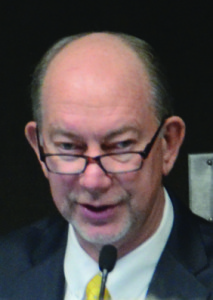
Bruce Cozart is chairman of the House Education Committee.

Bruce Cozart is chairman of the House Education Committee.

By Steve Brawner
© 2016 by Steve Brawner Communications, Inc.

The Arkansas Legislature goes into session in January, but some of the most important decisions will be completed this month, without much debate.

That’s because, by Nov. 1, the House and Senate Education Committees will complete the state’s adequacy report, the biennial (once every two years) document that governs how and how much (always more) the state spends on K-12 public education.

The adequacy report was created in the wake of the Lake View case, a lawsuit brought on by a poor, rural school district in the Delta. A series of court decisions said the state wasn’t spending enough on education and wasn’t spending it in the right places – including on students like those in Lake View. In response, Arkansas consolidated schools (Lake View ended up being one) and poured money into education at a time when other states were cutting spending.

Fear of returning to court has governed Arkansas policymakers ever since. No matter what the economic or budgetary situation has been, schools are funded first, and they always get a raise.

There was a time when the money spigot was wide open, but now it’s closed to a small stream. Basically, schools get a cost of living adjustment every year now. The chairman of the House Education Committee, Rep. Bruce Cozart, R-Hot Springs, figured out a raise of 1.15 percent this past weekend and challenged members to create their own figures.

That’s probably about what will end up happening. The committees will finish their work and present the adequacy report to Gov. Asa Hutchinson by Nov. 1. His administration will tweak it, it will be presented to the Legislature, and the Legislature will pass it without much debate. Any dissenting legislators will be cut off by two words: Lake View.

That’s roughly 41.5 percent of your general revenue budget right there – general revenues being the state spending over which legislators have the most control. The general revenue budget this past year was $5.3 billion, and of that, $2.2 billion went to the public school fund.

There will be arguments over smaller parts of the education budget, including funding for school transportation. Current funding is based on the number of students school districts have, not the number of route miles their buses travel, so some compact districts pocket extra money that they use for other purposes, while far-flung districts lose money driving all over the county. There’s been talk for years about basing funding on route miles, which seems obvious, but that would mean some districts would win and some would lose. When that happens, expect a fight to occur.

Education advocates will say a 1 percent raise isn’t enough, but they’d better be glad they’re getting it. The state does have other priorities – colleges and universities, human services, highways, prisons – that must fight for what’s left after schools, and advocates would say it hasn’t been enough.

A case can be made that the Lake View case set the stage for Arkansas being one of the few Republican-leaning states to expand Medicaid through Obamacare to create the controversial private option, which purchases private health insurance for lower-income Arkansans. The state was primed to take the money partly because it can’t cut funding for schools.

But starting next year, the private option, which has been funded almost entirely using federal dollars, will start to nibble at the state budget. The state will be responsible for 5 percent of the cost in 2017 and 10 percent by 2020. Meanwhile, the number of Arkansans receiving benefits has soared past the expected 250,000 and continues to rise.

That’s kind of scary. Schools will still get a raise, but everyone’s looking at rising health care costs. Meanwhile, highway advocates are begging for money that’s just not available. The state is trying to figure out how to slow the growth of prison costs without making crime worse. And amidst all that, the governor says he wants to cut taxes again.

How do you make the numbers work? The state’s economy must continue to grow, which it is doing to the tune of a 3.9% unemployment rate. And the state will continue to take federal dollars wherever it can, including for highways and health care.

There will be a big debate about that – taking money for health care. Legislators will have time because 41.5 percent of the budget will already be settled. Nothing starts an argument like the word “Obamacare.” Nothing shuts it down like the words “Lake View.”

When the governor crosses the line

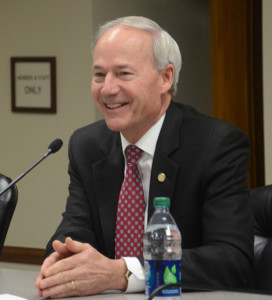
Gov. Asa Hutchinson

Gov. Asa Hutchinson

By Steve Brawner
© 2016 by Steve Brawner Communications, Inc.

If Asa Hutchinson is in Texarkana, Ark., he’s governor. If he crosses over into Texarkana, Tex., Tim Griffin, the lieutenant governor, becomes governor. If Griffin is also out of state, he isn’t the governor either, though he’s still lieutenant governor. In that case, Senate President Pro Tempore Jonathan Dismang, a legislator from Beebe, is governor – assuming he also hasn’t left the state.

Got it?

Under the Arkansas Constitution, the governor relinquishes his powers to the lieutenant governor whenever he’s out of state. But that could change. Issue 2 on the November ballot would allow governors to maintain their powers wherever they are.

Legislators placed the proposal on the ballot because this is the 21st century, and governors can maintain contact with home much more easily than in 1914, when voters created the position of lieutenant governor and assigned its duties.

Moreover, the governor has become, in addition to being chief executive, a traveling face-of-the-state and occasional globe-trotting salesman. For example, in the past 12 months Hutchinson has flown to China to help secure a $1 billion paper mill in Arkadelphia, and to Europe to attend an air show, meet with aerospace-related business prospects, and open the state’s European office. He’s going back to China in October. He was in Austin, Texas, for the Texas Tribune Festival Sept. 24.

The system works fine most of the time because Hutchinson and Griffin, like most governors and lieutenant governors, get along well, are members of the same party and know their roles.

But there have been times when things didn’t work so smoothly. When Gov. Mike Beebe, a Democrat, was at a National Governors Association meeting in 2013, his Republican lieutenant governor, Mark Darr, signed a gun bill Beebe did not intend to sign, though Beebe planned to let it become law unsigned. In 1993, when Gov. Jim Guy Tucker was out of state and the lieutenant governor’s office was vacant, Senate President Pro Tempore Jerry Jewell used his temporary powers to set free a convicted murderer and another convicted felon and pardon two men on parole. In 1987, Senate President Pro Tempore Nick Wilson fired Gov. Bill Clinton’s chief of staff, Betsey Wright, and vetoed some bills. Clinton rehired Wright when he returned. Wilson eventually went to prison, for other reasons.

This is the second time in 14 years Arkansas voters have had the chance to make this change. They rejected a similar proposal in 2002.

The arguments against? Even in the 21st century, there could be times when a governor might be out of state and inaccessible. On Sept. 11, 2001, Gov. Mike Huckabee was in Kentucky and could not return by air, and Lt. Gov. Win Rockefeller could act with authority on that terrible day because he legally was the governor. Plus, maybe it’s a good thing that the Constitution reminds the governor not to be too much of a globe-trotting salesman.

One other thing about Issue 2 is that it would add feminine pronouns to that part of the Constitution. Section 4 of Amendment 6, which would be amended, refers only to “his” and “he.” The assumption in 1914 was that the governor would be a male, which makes sense because women were six years away from having the right to vote.

I worked in the lieutenant governor’s office from 2003-06, and I can tell you that we don’t really need the position as it currently exists. Its only constitutional duties are to preside over the Senate and to serve as governor if the elected governor is out of state, dies or is incapacitated. No well-run business would have a “lieutenant CEO” with similar non-duties, a salary and staff.

So I will vote yes. The governor should still be fully governor when he or she leaves the state, just as when the president leaves the country, the vice president doesn’t take over the job.

But it’s not the reform that’s needed. What should happen is that the governor and lieutenant governor run together on the same party ticket, like the president and vice president, and work together as a team after elected. That way, Rockefeller could have managed the situation with plenty of authority as Huckabee’s lieutenant governor on Sept. 11, but Jewell wouldn’t have been able to let the convicted murderer out of prison.

At least Issue 2 will let the governor be governor whenever he crosses the line.

Casino vote makes strange bedfellows

By Steve Brawner
© 2016 by Steve Brawner Communications, Inc.

There’s a lot more to this debate over the proposed casino amendment than just whether or not Arkansas should have more slot machines than it already does – which is quite a lot between Oaklawn and Southland.

Issue 5 would create a constitutional amendment authorizing the building of one casino each in Washington County, Miller County and Boone County. The casinos would be required to pay the state 18% of their net and would pay 1.5% to the city where they are located and .5% to their local counties. An Arkansas Gaming Commission would regulate.

The amendment’s backers, Arkansas Wins in 2016, say Arkansas should have casinos here because they’re already just across the border elsewhere – in Mississippi, in western Oklahoma; in Caruthersville, Missouri; and in Shreveport, Louisiana. Adding three casinos in Arkansas would keep Arkansas gamblers at home and attract some out-of-staters. A lot of people think going to casinos is fun. If they’re going to gamble, eat at buffets and go to shows, they might as well do it in Arkansas, employing Arkansans, boosting tourism and paying state taxes.

Politics makes strange bedfellows, and that’s definitely true with this issue. Opposed to the effort are faith-based groups such as the Family Council along with the state’s existing gambling providers, Oaklawn and Southland, which race horses and greyhounds on a part-time basis and operate casino-like entities full-time. The Family Council doesn’t want the gambling; Oaklawn and Southland don’t want the competition.

They’ll be working in parallel but not really together. The Family Council will spread through its grassroots network of churches its message that gambling leads to social ills – addiction, divorce, etc. – without the promised economic benefits. Meanwhile, Oaklawn along with Southland’s parent corporation in August donated a total of $109,500 to the Committee to Protect Arkansas’ Values/Stop Casinos Now. In fact, they’re the only donors listed in the required campaign filing with the Arkansas Ethics Commission. That money is funding a lawsuit in the Arkansas Supreme Court to disqualify the amendment.

Four years ago, a group with a similar name and the same chairman, former Arkansas Sheriffs Association Executive Director Chuck Lange, raised more than $1 million from Southland, so that $109,500 is probably just seed money.

The Committee’s messaging so far has focused less on gambling’s ills and more on what the proposed amendment does and doesn’t do. The amendment defines gambling as whatever is legal in Arkansas’ surrounding states and in Nevada, meaning Arkansas policymakers would be handcuffed in defining terms and setting limits. It would allow sports betting and alcohol sales.

Like previous casino amendments that have either been tossed from the ballot or voted down by Arkansans, this one is backed by those who would make money off it. It would embed in the Arkansas Constitution a permanent monopoly granted to two Missouri businessmen, Bob Womack of Branson and Jim Thompson of Blue Eye, and their successors and assignees.

That means no one else could operate a casino anywhere in Arkansas except those two along with Oaklawn and Southland. Those two existing casinos are limited by law, for now, to “electronic games of skill,” such as blackjack tables with electronic “cards” rather than those dealt by humans.

So expect to hear opponents use the words “out of state” a lot, even though Arkansas’ two current gambling establishments also are owned by out-of-state entities – Oaklawn by the Cella family of St. Louis, and Southland by Buffalo-based Delaware North.

All of this very easily could become moot. The issue is now in the hands of the Arkansas Supreme Court, which is considering whether the ballot title is misleading and whether the signatures were collected improperly.

In fact, all four voter-led ballot initiatives – this, two that would legalize medical marijuana, and one that would limit judgments in medical lawsuits – are being sued for one reason or another.

Will at least one of them be disqualified? History shows that’s a pretty safe bet.

Whew, that’s a lot of debt for football seats

football-on-tee-150-dpiBy Steve Brawner
© 2016 by Steve Brawner Communications, Inc.

The next time you’re tempted to base your beliefs purely on political stereotypes, keep in mind that it was a former Democratic U.S. senator who stood, basically alone at first, against a huge government spending program financed by public debt.

That would be David Pryor, University of Arkansas trustee and leader of the opposition against a $120 million bond issue to help pay for adding 3,000 premium seats to Reynolds Razorback Stadium.

Pryor’s was one of two votes last Thursday – the other being Cliff Gibson’s – against the bond issue. The debt, which rises to $186 million counting interest and fees, will also pay for rounding out the stadium, adding a video board, updating the Broyles Athletic Center, and other improvements. The bond issue will be repaid over 20 years through ticket revenues and is not expected to affect students, who, unlike at the state’s other four-year universities, are not charged a fee for athletics.

The business case for the expansion isn’t unreasonable. The University of Arkansas Athletic Department is well managed and one of a relatively small number across the country that pays for itself. Athletic Director Jeff Long said the department has already secured millions of dollars in commitments for those premium seats. To be competitive in major college football, a program must invest resources into taking care of its wealthy fans. They’re the kind who donate extra money.

Still, I’m with Pryor on this one, for three reasons.

– It’s public debt. Neither taxpayers nor students are supposedly on the hook, but if the financial arrangement isn’t working, somebody must pay that money back. While the state’s Revenue Stabilization Act supposedly forces a balanced budget each year, the truth is that the state of Arkansas has billions of dollars in debt, and the University of Arkansas is a state institution.

The other thing about debt is that it becomes your master. Future decisions will be made with this bond issue in mind. The team must keep winning to fill the stadium to pay for the bond issue, so Coach Bret Bielema had better keep engineering these late game heroics. The need to raise revenue for the bond issue will be one more reason for the Razorbacks to stop playing games in Little Rock after 2018 when the current contract ends.

– It’s regressive government financing. The bond issue is adding expensive football seats – suites, semi-private loge boxes, club seats – that are being financed by the fans who buy regular seats. Those regular seats already are priced at just about the limit for a middle class fan – for nonconference games, $35 for upper level seats and $55 for lower level ones, with conference games priced higher. Taking your family to a game already sets you back $250, and the bond issue payments will raise the cost.

– It sends the wrong message and allocates resources in the wrong direction. Pryor called this the largest financial commitment the state has ever made for higher education, and it’s for a football stadium. In January, while the Board of Trustees was advancing the stadium project, the University of Arkansas for Medical Sciences begged for $97 million to renovate its aging facilities. So far, that money has not been found. What should be the higher priority: the football stadium, or the hospital? The entity that teaches college students to be football players, or the entity that teaches medical students to be doctors?

The Razorbacks are a tie that binds, and I’m glad they beat TCU Saturday. But sometimes this state forgets that the University of Arkansas is a school, not a football team. The vote by the board of trustees is not a scandal, because the money is probably going to be there and the Athletic Department has a history of good financial stewardship. Still, $120 million – actually, $186 million? Woo, pig sooie, but whew, that’s a lot of debt for football seats.

‘Tis the season for lawsuits

By Steve Brawner
© 2016 by Steve Brawner Communications, Inc.

Every calendar year has four seasons, and so does every campaign year. There’s the filing season, when potential candidates decide to run; the primary season, when the parties choose their nominees; the general election season, which ends in November; and, tucked in its own little spot about now, is a fourth season: the lawsuit season.

Yes, ’tis the season when opponents of various voter-initiated acts and amendments try to remove them from the ballot, or at least keep their votes from being counted, by filing suit in the Arkansas Supreme Court.

This year, four initiatives have qualified for the ballot by gathering enough signatures from registered voters: a constitutional amendment that would legalize marijuana for medical use; an initiated act that would do the same, with some differences; an amendment that would limit attorney fees and jury awards for pain and suffering in medical lawsuits; and an amendment that would authorize casinos in Boone, Washington, and Miller Counties.

All four have drawn legal challenges. Generally speaking, the groups are making the same arguments that are always made about these issues: that the ballot titles are misleading, and that technical violations occurred in the signature collecting process.

These lawsuits are just part of accepted campaign strategy, so both sides know they have to budget for legal fees. The lawsuits almost always happen when issues are this controversial and when someone stands to lose something. For example, the Arkansas Bar Association has filed suit to stop the amendment that would limit attorney fees and jury awards – which, when higher, produce higher fees. The casino amendment faces a lawsuit from a group supported in part by Oaklawn Park and Southland Gaming and Racing, which don’t want the competition.

That last paragraph sounded cynical, didn’t it? Human beings have complicated motivations. For example, the Arkansas Bar Association’s unanimous opposition to the medical lawsuit amendment probably is due partly from a desire to protect an income stream, at least with some members. At the same time, attorneys have a unique appreciation for the importance of why big verdicts sometimes are needed. Moreover, the amendment is being pushed primarily by nursing homes who want to reduce losses from big jury verdicts, some of which might be based on emotion and good lawyering. Can’t blame them for that.

So now the questions go straight to the Arkansas Supreme Court, where the wheels of justice will turn more swiftly than is normal. We’re reaching mid-September. Election Day is Nov. 8. Absentee ballots must be mailed to voters no later than Oct. 14. Early voting begins Oct. 24. That means the Supreme Court must consider arguments and render decisions as soon as possible. Even if it moves quickly, it’s not unusual for the ballot to be littered with proposals that the court has ruled invalid.

At this point, I’m definitely against one of the proposals, leaning against two and wavering on one. Still, my preference is to vote, even if something passes I don’t like.

In a state whose motto is, “The people rule,” it’s probably best if the measures stay on the ballot, if they can. All four were approved – actually, partly rewritten – by the attorney general’s office to comply with state law. All four’s signatures were validated by a small army of full-time and temporary workers with the secretary of state’s office. Should four Supreme Court justices override those efforts?

Also, all four represent the kind of issue for which voters are well-suited to express their will. These aren’t questions of bureaucratic minutiae. They’re big-picture questions about values and about what this state ought to look like. Whether there should be casinos in Arkansas when surrounding states already have them has been debated around many a kitchen table. So has whether marijuana’s clear harm to many means it shouldn’t be available to those it clearly helps. Would limiting a type of jury award help doctors and nursing homes lower costs for all of us, or would they become more negligent? The voters can decide.

If the legal minds on the Supreme Court believe that real problems exist with a ballot title or signature gathering process, then yes, disqualify a proposal. It’s their job to look at the details.

But if it’s in the gray area, let’s hope the Court errs on the side of not disqualifying. In a state whose motto is “The people rule,” the presumption should be to let the people rule.