
Category Archives: Politics

Is America governable?

By Steve Brawner
© 2015 by Steve Brawner Communications, Inc.
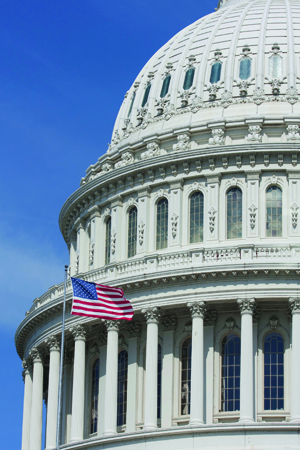
U.S. Capitol for blogThe American republic has limped past being dysfunctional and stumbled into being ungovernable. Even if you hate the government, this situation should concern you because it means big problems aren’t being addressed, while new ones are being created.

Two current legislative fights illustrate this reality – No Child Left Behind and the broken immigration system.

Congress has yet again stalled on its long overdue reauthorization of No Child Left Behind. That’s bad, because this law is completely unworkable. Signed by President George W. Bush in 2002 and passed with bipartisan support, it required that 100 percent of American students in grades 3-12 test at their grade level by the end of the 2014 school year, or the federal government would punish the schools where they didn’t. That’s every single child, regardless of language difficulty or intellectual challenge – a requirement so ridiculous that Congress ought to fix it, but it can’t. As a result, the Obama administration has been granting waivers to states telling them how they can disobey the law.

The president is supposed to enforce the law, and Congress is supposed to write laws that make sense, right?

The same applies to immigration. The president wants to ignore the laws Congress has passed, and Congress can’t agree on how to fund the Department of Homeland Security in response. Meanwhile, the border remains porous, and millions of people live in the shadows among us. Children brought here by their parents basically have no home country. Meanwhile, the United States quite effectively limits the influx of skilled overseas workers – exactly the people we need.

If these two issues were outliers, we could deal with them. Unfortunately, they’re the norm. A few other examples …

The national debt. Uncle Sam now owes $18 trillion, or the equivalent of $57,000 for each American. The debt has doubled since 2007 and tripled since 2001, and it’s still rising. The only possible solution is to reduce spending substantially while collecting more revenues somehow. There’s not a remote possibility that Republicans and Democrats in Washington will agree to do that.

Health care. Prior to the Obama administration, the United States already had the world’s most expensive health care system. It denied insurance because of pre-existing conditions and stopped paying for patient claims if they became too expensive. Then the Affordable Care Act was rushed through Congress, causing its own problems and leading to who-knows-what. Now the act faces a serious Supreme Court challenge over its wording regarding federal exchange subsidies. Pulling this leg from the stool could cause Obamacare to collapse. Lots of people would be happy about that, but … what’s the plan after that?

Infrastructure. The gas tax, which funds highways, has not been raised at the federal level since 1993. It is destined to produce less and less revenue because cars are becoming more fuel efficient through both market and government demands. Everybody knows the model is unsustainable, but there’s no agreement on its replacement.

It won’t be enough to vote for different people in 2016. Washington simply doesn’t work any more, regardless of who is in office.

That’s because Washington reflects American society, which itself is marked by contradictions and divisions. We simply don’t agree on how to solve problems, or even about what the problems are. We’re deeply divided culturally, morally, about what we want this place to look like, and about what we think it once was. That lack of consensus makes it very hard to solve difficult issues. Moreover, Americans say they don’t trust government but then choose to be profoundly dependent upon it, rarely recognizing the irony. The result is that we grow government without paying for it.

This is a depressing column, so let’s close with solutions. Congressional term limits? A balanced budget amendment? Campaign finance reform? All could help.

Meanwhile, many decisions should be returned to the state level, where democracy still manages to work sometimes. Red, blue and purple states could solve problems in their own ways, often learning from each other. Americans would be free to settle in states where they felt most comfortable.

This could cause its own problems, including irreconcilable legal definitions of discrimination and a race to the bottom on environmental regulations. A poor state like Arkansas might find its niche, or it might just get poorer.

Something big has to happen – bigger than the next election. When a country becomes ungovernable, problems can’t be solved simply by electing different people to that government.
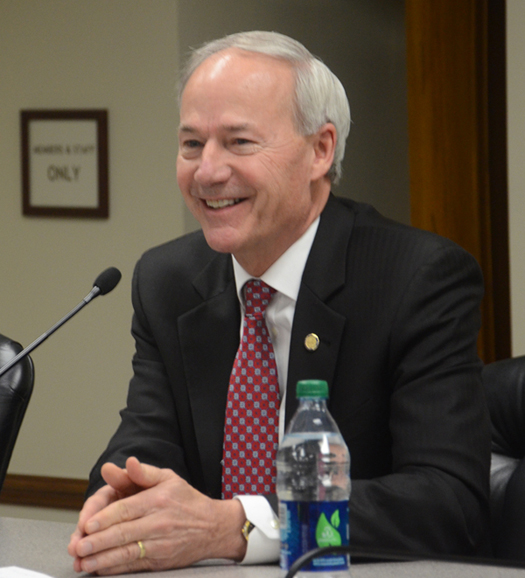
Hutchinson has rookie’s enthusiasm – but not about highways

By Steve Brawner
© 2015 by Steve Brawner Communications, Inc.

Asa for web

Being governor is not a job where practice makes perfect. In fact, in many ways, a governor is at his or her best as a beginner.

A new governor is fresh off the victory speech and is running off the adrenaline from the transition to power. He has a new title that carries with it an air of authority. He has ideas he can’t wait to implement. He hasn’t grown cynical from lost battles or grown paranoid from all the criticism. He’s younger than he’ll ever be again.

Circumstances can serve to magnify those early advantages. Gov. Asa Hutchinson came into office as the first Republican governor with a Republican Legislature since shortly after the Civil War. His predecessor, Gov. Mike Beebe, entered office after a landslide victory (over Hutchinson). Beebe’s predecessor, Gov. Mike Huckabee, became governor after demonstrating firm leadership amidst Gov. Jim Guy Tucker’s last-minute indecision about resigning.

Some of Huckabee’s and Beebe’s most notable policy accomplishments came early in their administrations. For Huckabee, it was ARKids First and the conservation tax. In his first session, Beebe and the Legislature increased school funding and cut the grocery tax in half.

They both were fine governors, but as would be the case with anyone, we’re better off that the Arkansas Constitution ensures we get some fresh blood in there after a while.

A good example of this is prison reform. This was not a focus of Hutchinson’s during the campaign, but it has become one now, and it may be the issue that most defines him when it’s all said and done. The state’s prisons are currently so overcapacity that 2,500 inmates are being housed in county jails. However, the state can’t afford to keep building cells, and simply letting inmates out of jail isn’t the best solution because many have a drug or alcohol problem, and 43 percent return to prison soon after being released. The only long-term solution, Hutchinson said, is to change inmates’ behavior, so his prison reform plan would create transitional centers to help parolees re-enter society.

Hutchinson was his usual reserved self when announcing his plans, but there was a fire in his eyes that I suspect won’t quite be there seven years from now. Again, fresh blood is a good thing.

Which brings us to highways. Last Feb. 19, Scott Bennett, director of the Arkansas Highway and Transportation Department, testified before a House panel in favor of House Bill 1346 by Rep. Dan Douglas, R-Bentonville, which would dedicate for highways sales tax revenues from the purchases of new and used cars and car parts.

Bennett has given this presentation so many times that he probably could do it in his sleep. The state has $20.3 billion in highway needs over the next 10 years but only $3.6 billion in expected revenues. While construction costs are rising, the primary means of funding highways, federal and state motor fuels taxes, have not been increased for decades and are producing less revenue because cars are becoming more fuel efficient. Yes, Arkansas voters passed an interstate bond issue in 2011 and a half-cent sales tax for highways in 2012. Together, those will affect less than 4 percent of the state’s roadways.

Bennett has been in his position long enough that the fire in his eyes that day was accompanied by a hint of desperation and frustration in his voice. Two years ago, a similar bill started out with broad support, but it failed under opposition from competing interests who feared highways would take a bigger slice of their pie. Gov. Beebe was adamantly opposed, and it failed.

Douglas’ bill did pass out of the committee, but, near the end of the meeting, Hutchinson’s Department of Finance and Administration director, Larry Walther, testified against it, saying it would create holes in the state budget. That was an ominous sign for the bill’s supporters: It meant Hutchinson is opposed. Highways at this point are not his thing – not at the expense of other things, anyway. This week, Douglas announced that, because of the governor’s opposition, he was putting the bill on hold for a while.

The funding model for highways is not sustainable, at the state or national levels. Highways and bridges that aren’t properly maintained now will have to be replaced later, at much higher costs.

How soon the problem is addressed matters. A lot more gets done when there’s fresh blood in the Governor’s Mansion and the governor still has fire in his eyes.

Another state government mandate – this one in writing

By Steve Brawner
© 2015 by Steve Brawner Communications, Inc.

This is the part of the legislative session where I look forward to lawmakers going home, because they do not always listen to me.

Last week, I asked them to approach their jobs with restraint after they voted to ban communities from passing anti-discrimination ordinances. That law was passed after Fayetteville enacted such an ordinance through its city council and then rescinded it by a vote of the people – an indication that democracy was working just fine there.

Then this past week, the Senate voted 30-1 to require all public school districts to teach cursive writing by the third grade. Some schools have stopped teaching this skill. Only Sen. Bruce Maloch, D-Magnolia, voted no. It passed in the House, 66-21.

It’s my experience as an observer that most state legislators are honorable, admirable and likable. Go to the State Capitol on any given day, and you may be encouraged by the civility and sobriety of most of what happens.

But legislators are people, and people tend to want to use power to make others see things their way. Legislators should beware of that temptation.

There is evidence that learning cursive writing may be beneficial for students. It may be good to write the entire word without lifting the pencil, and by learning both cursive and print, students learn to write the word in two different ways. A 2006 study by Dr. Virginia Berninger, a University of Washington psychologist, found that writing in cursive, writing in print, and keyboarding each activate different parts of young brains. Important historical documents were written in cursive or something like it. Someday, today’s kids may want to read their great-granddad’s letters home from the war.

Opponents, meanwhile, say it’s an antiquated and increasingly irrelevant skill in a digital age, and other skills are more important. When is the last time you wrote a capital “Q” in cursive?

But the question isn’t who’s right. The question is, who decides, after what process? Legislators, after debating the issue in a couple of committee meetings? Or local school educators, using their professional judgement while considering their communities’ unique situations?

Schools didn’t drop cursive writing because their teachers are lazy. They did it after weighing the benefits of teaching cursive against the realities that they have too much else to do, in large part because of No Child Left Behind, the Common Core, and other decisions by others, including the Arkansas Legislature. Teachers were not lined up outside the Capitol chanting for the right to teach cursive writing.

As is sometimes the case, there seems to have been very little thought given to this latest government mandate. The sponsor, Rep. Kim Hendren, R-Gravette, conceived of it because his granddaughter could not write in cursive. It was first debated in the House Education Committee on Feb. 10, where it was passed that day, and by Feb. 19 it was sent to the governor. It seemed like a good idea, and some legislators probably didn’t want to oppose a colleague whose vote they may need later.

Contrast this educational mandate with another one passed by the Legislature – Hutchinson’s requirement that all high schools teach a computer science class. Hutchinson spent a year talking about the issue on the campaign trail and made it the subject of his best commercial, the one with his granddaughter playing basketball. The public and professional educators had a chance to thoroughly vet the proposal. There was little opposition.

That’s the way to pass a mandate.

The opportunity to assert power should send chills up lawmakers’ spines. They should hesitate to do so, especially if they know little about a subject, and there are people who know more because of their education and experience, and those people make decisions at a local level, and those decision-makers are accountable to voters, as educators are through their locally elected school boards.

Notice I used the word “hesitate.” If local control were always the rule, it would have taken a lot longer to desegregate schools. Instead, legislators should take things issue by issue, and slow down. When asked to substitute their judgement for the judgements of others, they should be inclined to vote no unless given a really good reason to vote yes.

In other words, they should have left this one to the local schools.

Captain Legislature didn’t save the day in Fayetteville

By Steve Brawner
© 2015 by Steve Brawner Communications, Inc.

Arkansas is now a Republican state, and there is a strain in Republicanism (and in the Democratic Party, and in human nature in general) that seeks to assert power. It has already happened once in a big way this legislative session. Legislators should resist the temptation to do it again.

I’m referring to Senate Bill 202, which makes it illegal for local communities to create their own classes of citizens protected from discrimination. It passed easily in both houses. Gov. Asa Hutchinson opposed the bill because it usurps local control but, unwilling to fight this battle and issue a probably useless veto, he is letting it become law without his signature.

The new law comes in the wake of a local ordinance passed by the Fayetteville City Council last year that would have banned discrimination in the workplace against various groups – but really, it was all about gay rights. Business and religious groups collected enough signatures for a popular vote to overturn the measure. Voters narrowly overturned it. The Eureka Springs City Council recently passed its own now apparently meaningless anti-discrimination ordinance.

The sponsors of the bill said they did not want businesses to have to deal with varying rules city by city – which, by the way, happens all the time. Every locality has its own rules about a lot of things. Arkansas is a collection of wet and dry counties, gambling islands, speed traps, etc.

Senate Bill 202 ultimately isn’t about gay rights. It’s about how decisions are made in a democracy, which is why this was a bad bill. Each situation is different, but the principle should be that, whenever possible, decisions should be made at the level of government that is closest to the people. We regular folks have less say about what happens in the State Capitol than we do in our hometowns, and we have virtually no influence over what happens in Washington, D.C.

It’s often said that states are the laboratories of democracy, where ideas can be tried in one place and then adopted, improved or discarded elsewhere. It is good thing that California can pass all kinds of regulations and that Texas can be halfway its own country and that Arkansas can create the Medicaid private option and, then, if it chooses, get rid of it. We learn from each other’s successes and mistakes.

The same is true for local communities. What would have happened had state government minded its own business on this particular issue? Maybe there would have been a flood of discrimination lawsuits in Fayetteville that would have shut down businesses and put people out of work. Or, maybe Fortune 500 companies would have been attracted to the community because they saw it as forward-thinking. Either way, Fayetteville would have determined its next course of action, and other communities could have learned lessons and applied them to their own decision-making processes in their own city halls.

Fayetteville did not need to be rescued by Captain Legislature. The elected City Council openly passed an ordinance. Some people didn’t like the ordinance and collected signatures to overturn it. The citizens of Fayetteville debated the issue publicly and privately. The voters had their say, and majority will prevailed. Until legislators stepped in, maybe the City Council could have considered other ways of meeting the ordinance’s goals without possibly stifling commerce and infringing on religious beliefs. Or maybe in the next election, the people would have voted everybody out and been done with it.

In other words, real democracy was happening there. I’m having trouble seeing what state legislators meeting three hours away in Little Rock needed to fix.

It’s not about whether terrorists should rot

By Steve Brawner
© 2015 by Steve Brawner Communications, Inc.

“In my opinion the only problem with Guantanamo Bay is there are too many empty beds and cells there right now. We should be sending more terrorists there for further interrogation to keep this country safe. As far as I’m concerned every last one of them can rot in hell, but as long as they don’t do that then they can rot in Guantanamo Bay.”

That’s what U.S. Sen. Tom Cotton said Feb. 5 during a hearing of the Senate Armed Forces Committee. He got a lot of attention because of that.

Let’s start by pointing out that Cotton, a decorated war veteran who volunteered for duty, has a perspective that those like me who stayed safely at home cannot have.

That said, the issue is not if confirmed terrorists should rot, but where detainees should be held. And it should not be in the government’s little corner of Castro’s island.

According to the New York Times, 780 detainees have been sent to the Guantanamo Bay prison since it opened in 2002. Of those, 122 are still there, 649 have been transferred, and nine have died on the island.

Most of those remaining probably are terrorists, but how do we know? Because the government has told us they are? That’s not the way America is supposed to work.

In America, we’re supposed to be skeptical of the government, but that’s hard to put into practice at Guantanamo Bay because it lacks some of the checks on the government’s power that exist elsewhere – juries, journalists, churches, human rights activists, etc. There has been little that anyone outside of the government could do when the detainees have been sent there – or when they have been sent elsewhere. If President Obama says it’s worth the risk to send them back home, well, should we trust that’s so?

The nation’s founding document, the Declaration of Independence, states, “We hold these truths to be self-evident, that all men are created equal, that they are endowed by their Creator with certain unalienable rights, that among these are life, liberty and the pursuit of happiness.”

Did you catch that? Our rights aren’t granted by the government, and we don’t have rights because we are Americans. We have rights because we were created. All men are created.

We have to respect that. American citizens can’t just blindly trust the government when it says that every detainee is a terrorist, and it can do with them as it wishes for decades without any oversight by anyone else. If we accept that, then we could be next.

We’ve seen the best of America since the attacks of Sept. 11, including acts of heroism and sacrifice such as those performed by Cotton.

But those attacks also have brought out the less-than-best of America. Osama bin Laden not only succeeded in killing 3,000 people, but he also convinced us to change our way of life and sometimes to ignore our founding principles, all based on fear.

Guantanamo Bay has hurt the country’s standing in the world, which is why the president called it “a propaganda tool for our enemies and a distraction for our allies.” And by “president,” I mean President George W. Bush, who wrote that comment in his autobiography. He wanted to close the prison and send many of the detainees back to their own countries. “Cold-blooded killers,” on the other hand, should be tried in U.S. courts, he said while in office.

Yes, in U.S. courts, or at least in some kind of legitimate process allowing Americans to keep an eye on the government. First, because it needs to be determined one-by-one that the accused actually are cold-blooded killers. And second, because the nation’s principles include not only the pursuit of happiness but also the pursuit of justice. All men are created equal and endowed with certain unalienable rights, and all men should face the consequences of their actions.