Category Archives: Politics

Trump, Carson and the vaccine debate

By Steve Brawner
© 2015 by Steve Brawner Communications, Inc.

One of the most interesting moments in Wednesday’s l-o-o-ng Republican presidential debate came when two candidates sort of stopped debating.

Dr. Ben Carson, retired neurosurgeon, was asked about comments Donald Trump had made espousing a link between vaccines and autism. Carson responded that numerous studies have shown no link between the two. The only study that did show a link has been thoroughly discredited. However, he said children are vaccinated for many diseases and that parents should have some discretion for those not deadly or crippling.

Trump responded with a personal story about an employee whose child had developed autism shortly after being vaccinated. He said he favors vaccinations but would like to see smaller dosages stretched over a longer period of time. Carson again disagreed that vaccinations cause autism but suggested cutting down on the “number and proximity” of shots, not mentioning dosages.

Logic is a tough thing for human beings to achieve, which is one reason democracy is so hard. We have a difficult time separating correlation – things happening at the same time – with causation. We place too high a value on emotional personal anecdotes and not a high enough value on data. That’s why we need research.

On the other hand, researchers are human, too. For years, we’ve been told that silly old Mom was wrong and there’s no link between cold weather and people catching colds, other than the fact that we’re more likely to spread the disease while stuck indoors in the winter. The data was unequivocal, even though Mom’s personal experiences said otherwise. Now research indicates that cold temperatures in the nasal cavity might slow the body’s immune response to rhinoviruses after all.

The scientific process has resulted in an explosion of knowledge and a vast improvement in our living standards. But it is an imperfect way of arriving at truth. Instead of a straight line, it zigzags. It gets some things right and some wrong and then corrects itself.

It especially runs into trouble when generalizing about humans, which are extremely complex and similar but not identical. It’s very likely true that vaccines do not cause autism across the broad spectrum of humanity. But it is not necessarily true that vaccines do not ever cause autism – or some other adverse reaction – in a particular person. These many parents who say their child changed immediately after being vaccinated – are they all foolishly failing to see that it was just a coincidence? Every last one of them?

If you are a health professional, you might have responded to the Carson-Trump exchange (and that last paragraph) with horror. While studies show there’s no link between vaccines and autism, there’s clearly a link between a lack of vaccines and increased cases of childhood diseases.

But many parents are opting out of vaccines now, so maybe it’s time for the medical establishment to rethink its approach. An atmosphere of distrust is being created, which happens when people’s concerns about their children are summarily dismissed. Maybe it’s time to stop arguing with parents and start working with them. Certainly, medical professionals and not presidential candidates should determine dosages. But would alternative vaccination schedules really be completely unacceptable?

Carson and Trump are both Republicans, but they’re about as different as two candidates in the same party are going to be in this day and age. They addressed this issue from very different perspectives. Within three minutes, it was apparent that their positions actually were at least in the same ballpark.

The truth is that Americans are divided on a lot of issues, but on many of them, it’s a difference of degree or approach. Almost all Democrats enjoy making more money and do not enjoy paying more taxes. Very few Republicans favor completely dismantling the social safety net. Nobody wants Iran to develop a nuclear bomb.

None of us will get everything we want – even if we are completely right. The trick in a complex society is to find an acceptable common ground. Does one exist in the great vaccine debate? Isn’t it worth trying to find out?

In the most adversarial of circumstances, Trump and Carson, the two frontrunners standing next to each other, ended up not so far apart on an issue where they seemed at first to be totally at odds. If that can happen in a presidential debate regarding vaccines, maybe it can happen on other issues after the election, too.

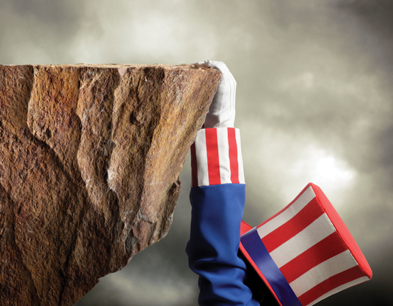
Who gets first dibs on Uncle Sam’s money? Its creditors, of course.

Uncle Sam hangs on for web
By Steve Brawner
© 2015 by Steve Brawner Communications, Inc.

Question: If the federal government were to reach the point where it couldn’t pay all its bills, who should be paid first?

A. Soldiers
B. Veterans
C. Investors, domestic and foreign, to whom the U.S. government owes money.

If you answered “C,” then you would agree with 24 Republicans on the House Ways and Means Committee. They voted last week to advance legislation that would allow the government to keep borrowing money to pay U.S. Treasury bond investors, even if the government reached its supposed debt limit. Payments to Social Security’s trust funds also would continue.

Unfortunately, all 25 of you would be right. The 15 Democrats who make up a minority of the committee voted no, but that’s politics. If the majority and minority roles were reversed, then the Democrats likely would have done what is necessary to keep the U.S. from defaulting on its obligations for the first time ever.

The topic has come up because Congress once again is approaching one of those entirely foreseeable and often manufactured financial crises that threaten the economy and cause the world to question if the United States still knows what it’s doing.

This time, the federal government will exhaust its ability to borrow money in late October, which means it would reach its debt limit in the weeks that follow. Supposedly, that would mean the government couldn’t create more debt. In reality, it just would mean the government temporarily would stop paying its bills – which, of course, would have to be paid later.

That probably won’t happen. What will probably happen is what almost always happens: In Washington, they’ll posture and threaten and argue right up until the last minute, each side accusing the other of “kicking the can down the road,” the most overused cliche in politics these days. And then they’ll pass some measure that keeps the government running for a while – probably until after the November 2016 elections. And then we’ll be stuck wherever that can stopped rolling.

So why even consider that bill approved by the 24 Ways and Means Republicans? The United States government is considered a very safe investment, which is why taxpayers are paying very low interest rates on the $18.2 trillion national debt. Investors – everyone from middle class Americans to the Chinese government – reason that if anyone will pay their money back plus a little interest, it’s Uncle Sam.

What would happen if investors started to doubt that? A U.S. government default would rattle world markets. Meanwhile, interest rates on the debt would rise because investors would see Uncle Sam as more of a risk and would demand a higher return. More of your tax dollars would go into the pockets of investors, domestic and foreign, to pay for the debt the government has already incurred. Less would be available for soldiers and veterans.

Bad things happen when you don’t pay your bills.

At some point, this nonsense must stop. It’s time for the country to stop tiptoeing up to these fiscal cliffs like a teenager trying to scare his girlfriend, One of these days the rocks will be less steady than they seem, and then … well, let’s not be too dramatic. Let’s just say the kid slips several feet down the slope, sprains his ankle, and barely makes it back up the ledge where his soon-to-be ex-girlfriend is waiting.

There’s a simple reason why this keeps happening: Because the voters tolerate it. In fact, they reward it. Members of Congress know that playing these games probably won’t cost them an election. They can always blame the other party and say they did their best as part of a dysfunctional institution. Voters don’t really expect them to do differently. Meanwhile, if they were really to try to balance the budget – by some combination of spending cuts and tax reform that would increase revenues – they’d risk being voted out. Voters like their government programs, but they don’t want to pay for them.

Ultimately, the investors who are financing the national debt will get their money. So will soldiers and veterans, though not enough.

Also pretty certain is that the costs will be passed on to our children and grandchildren. Kids don’t vote, and they don’t donate money to campaigns. They depend on older generations to look out for their interests.

We’ve all apparently decided not to vote for that.

Laws can’t fix tattletale nation

By Steve Brawner
© 2015 by Steve Brawner Communications, Inc.

“This is America. You’re going to be offended,” said my 13-year-old daughter and political philosopher.

Good thing she’s figured that out at 13. Can the rest of us?

Maintaining a peaceful society based on the rule of law is hard, which is why our Constitution includes very clear phrases such as these from the First Amendment: “Congress shall make no laws respecting an establishment of religion, or prohibiting the free exercise thereof.”

Unfortunately, such clarity only solves so much because societies are complex organisms made of complex people. This country values separating church and state but has a Judeo-Christian heritage – one that’s fading, which is troubling to many people, but it still matters. So what’s important to some is not important to others – or it may even be seen as a threat.

Moreover, how do you balance the bedrock guarantees of the First Amendment with those of the Fourteenth, which declares that no state shall “deny to any person within its jurisdiction the equal protection of the laws”? Lately, courts seem to be leaning toward the Fourteenth, even if it means violating the First.

So this is hard, and it will probably keep getting harder, as this past week has shown.

The obvious example from a national perspective is Kim Davis, the Kentucky county clerk who briefly went to jail rather than issue marriage licenses to gay couples.

Actually, this particular one was easy. A government magistrate receiving a government paycheck ($80,000 a year, in this case) must enforce the government’s laws. Otherwise, a police officer (or a president) could pick and choose which laws to enforce, which would be bad, right? If those laws so violate the official’s conscience that she can’t do her job, then she should resign, as did Cleburne Country Clerk Dana Guffey, who much more quietly left her job of 24 years earlier this year.

Where it gets harder is when it’s about private businesses such as bakers and wedding photographers. In Arkansas, those professions currently can’t be required to participate in a religious ceremony that violates their religion, but that could be changed by a legislative act (fat chance for now) or an unfavorable court ruling (looking more likely, eventually).

Fayetteville tried to settle the issue this past week. There, voters passed an ordinance prohibiting discrimination against gay people in many circumstances. The measure passed handily with support from the Chamber of Commerce after a similar one had failed with the Chamber opposing it, saying it was unclear. But the new measure may conflict with a state law passed earlier this year. Opponents sued after losing the election, so it’s not settled yet.

Meanwhile, Arkansas is dealing with another dispute – this one over a legislatively approved, privately funded monument to the Ten Commandments on the State Capitol grounds. Legislators who approved the monument argued that the Commandments are an important, historical basis of the law.

What has followed was entirely foreseeable. A group of Hindus requested a monument to their religion. Now Satanists want to erect a huge statue of a goat-like figure.

So we’re back to the issue posed at the beginning of this piece. What do you do in a country that values freedom of all religions but whose history is tied most closely to one of them, which is becoming less dominant? Accommodate only religions that the majority, for now, deems acceptable? Accommodate all, so that the Capitol grounds are littered with monuments? Try to push faith out of the public square entirely, and then squeeze it into houses of worship and tell it not to come out? When you value separating church and state, what do you do when the state is in so many places?

I don’t have the answers. I know this: Regardless of whether it’s a constitutional interpretation, as with the Kentucky case, or a state law, as with the Ten Commandments, or a local ordinance, as in Fayetteville, it’s impossible to codify into law a system that ensures that no one ever has to be exposed to beliefs and lifestyles with which they don’t agree. At some point, there has to be some give and take in our complex society. There is no legal remedy if this is going to be a nation of touchy tattletales running to the teacher over every issue.

This is America, after all, and we have to be willing to be offended.

What if the Republicans can’t pick a winner?

By Steve Brawner
© 2015 by Steve Brawner Communications, Inc.

In order to win the Republican nomination for president, one candidate must amass 1,144 delegates. What if no one does that?

That’s a possibility – not a probability, but a possibility – with 17 candidates splitting the vote. If that were to happen, the nominee would be chosen at the Republican National Convention in July. Instead of a boring speech-a-thon in Cleveland, such a “brokered convention” would be marked by candidates courting delegates and making deals.

Pundits bring up this possibility every election cycle, and every election cycle it doesn’t happen. The 2016 elections, however, could be different because of the number of viable candidates, their geographic distribution, and the resources available to them. The 17 candidates hail from 14 states, where many have strong political organizations. Meanwhile, because of the Supreme Court’s Citizens United decision removing many donor limits, candidates can stay in the race longer than in the past because they need only a few big contributors to pay the bills.

So here’s a possible scenario. Donald Trump or Dr. Ben Carson wins Iowa Feb. 1. Then Trump or former Florida Gov. Jeb Bush or Ohio Gov. John Kasich wins New Hampshire Feb. 9. Then on Feb. 20 comes South Carolina, home state of Sen. Lindsey Graham, who’s currently polling at only 5 percent there – far behind Trump, who has a big lead over everyone.

Then comes Nevada Feb. 23 and then the big one, March 1, when delegates are selected in about a dozen states, including Arkansas as part of a bloc of Southern states known as the “SEC primary.” Sen. Ted Cruz could be the big winner that day if he wins his home state of Texas and does well elsewhere in the South, while Gov. Mike Huckabee should win Arkansas. Four days later, Sen. Rand Paul could win his home state of Kentucky while struggling Gov. Bobby Jindal will try to turn things around and win his home state of Louisiana.

By that point, there’s usually a mass exodus from the race, leaving a clear front-runner with some diehard challengers. But candidates who have won a state will be able to tell their supporters (and themselves) that they can still win, so many may still be running.

Moreover, the campaign calendar and the party’s rules could give some candidates a reason to continue. Before March 15, most of the states will have awarded their delegates on a proportional basis. In other words, a candidate who wins 50 percent of the vote wins half the state’s delegates. Starting March 15, states can award their delegates on a winner-take-all basis, which is a big advantage for three candidates from big states whose elections occur that day: Ohio’s Kasich, and Florida’s Bush and Sen. Marco Rubio. If Bush loses Florida, he’s out.

By the end of that day, more than half the states will have had their primaries and caucuses. It’s conceivable that so many candidates will have won delegates that no one will have a big lead. From that point, it could be a long three months before June 7, when primaries are held in California, home state of former Hewlett-Packard CEO Carly Fiorina, and New Jersey, home of Gov. Chris Christie.

If 2016 is like previous elections, the race will be over before then. Someone will be on the way to a coronation, and the challengers will have dutifully given their endorsements.

Could that be Trump? Sure. Currently, he maintains a large lead that seems to get bigger whenever he says something controversial. Big poll numbers nationwide don’t necessarily translate to winning one state at a time – but he’s winning now.

I’ve always expected that Republican leaders eventually would pressure lesser candidates to leave the race so the party could coalesce behind an “anybody but Trump” alternative. But a recent poll by SurveyUSA found him beating not only Hillary Clinton but also other Democrats. At some point, Republican voters must seriously ask themselves if he’s really their best choice. But for now, he’s looking more and more legitimate, so instead of trying to stop him, the party may have to ride this wave wherever it goes.

Which could be all the way to a brokered convention in Cleveland. If that’s the case, there would be a lot of back room politics and dealmaking. And which of the candidates is the best at making deals? Trump, supposedly.

Flustrated America

By Steve Brawner
© 2015 by Steve Brawner Communications, Inc.

You hear people say the word “flustrated” sometimes. Is that a word? It should be.

English needs a word that blends “flustered” and “frustrated.” “Flustered” means “confused,” while “frustrated” means you’re angry about something you can’t accomplish or control.

So what if you’re both angry and confused about it? Then you’re flustrated.

Times of great, rapid change can leave a lot of us feeling that way. In recent years, the economy has shifted from a manufacturing economy, to a service economy, to an information economy where many jobs are best performed overseas or by automation. Workers, no longer able to grow their own food or fix their own cars, have been forced to adjust in order to be a small cog in a giant machine. That’s flustrating.

The character of American demographics is changing as well. Since 1950, the population of the United States has doubled, according to the Census Bureau. Eight percent of us then were 65 years and older, compared to today’s 14.1 percent, a number that is rapidly growing. Back then, immigrants were twice as likely to have come from Europe as from this side of the Atlantic, and half of those from this hemisphere came from Canada. Today, the United States has the second highest Spanish-speaking population in the world, after Mexico. That’s not necessarily a bad change, but it is a big one.

Values are changing, too. A woman in 1950 was 27 times more likely to be married than to be divorced. Today, more than half of all women under age 30 who are giving birth aren’t married. Earlier this year, the Supreme Court ruled that couples of the same sex have the right to marry, only a few years removed from some 30 states passing laws making gay marriage illegal. On these important issues, Americans simply don’t see eye to eye, and that can be flustrating for all of us.

While the definition of “marriage” is changing, so is the definition of “community,” which once referred to geographic proximity. Few of us had access to the internet 20 years ago and none of us owned an iPhone in 2006. Today, “friend” is a verb and it’s something you do on Facebook. We can connect with people all over the world but no longer know our neighbors.

These rapid changes can leave us flustered and frustrated. We want some of those old definitions back – the ones we understood – but the consensus has broken down. The American conversation has become one big argument that hardly anybody ever wins. Try as we might, we can’t make the world in our image.

Amidst all this, we don’t even know who to be mad at, or to fear. During the Cold War, Americans could unite against a single enemy that was easy to find and was as scared of us as we were of it, and for many of the same reasons. Today, the enemy can be ISIS in the Middle East or a hacker in China.

But we’ve got to blame somebody we recognize, right? So it’s all the president’s fault, or the Democrats’, or the Republicans’, or the media’s, or the rich’s, or the poor’s. We create conspiracy theories to explain which individuals are really in charge because the reality is harder to accept – that no one is, at least no human being, and that if something really goes wrong, none of us knows how to fix it.

To some degree, this flustration is reflected in the Republican presidential campaign. Donald Trump is a lot of things, but flustrated he is not, though he certainly is flustrating Jeb Bush and some of the other conventional candidates. For many voters, Trump offers an alternative to a system that has both angered and confused them. It’s no coincidence that he has been joined at the top of the latest Iowa poll by Dr. Ben Carson, another nonpolitician, each with 23%, while former Hewlett-Packard CEO Carly Fiorina was third with 10%. In fact, those three candidates who haven’t been part of the political system together are polling higher than the 14 candidates who have been.

How to deal with such a time as this? One option is simple humility. What if I admitted I can’t understand the world, much less decide how it all should work? I might focus on what I can understand and control. I might grant a little mercy to those who see things differently.

I’d definitely be less flustrated, if that’s a word.