Category Archives: Politics

The private option ink blot

By Steve Brawner
© 2015 by Steve Brawner Communications, Inc.

You know those tests where therapists ask clients to describe an ink blot because people see what they’re inclined to see? This week, legislators were given a 450-page one.

That would be the report by The Stephen Group, the consulting firm hired by the Health Reform Legislative Task Force to help it decide what to do about the private option in particular and Medicaid in general.

Here’s the ink blot part: Legislators who support the private option can be encouraged by the report because it recommends changing it but not ending it. Meanwhile, opponents can point to a finding that 43,000 people served by Medicaid and the private option may not live in Arkansas, while the programs combined enroll 500 people who are deceased.

Here’s the background. Medicaid is the government health program serving the poor, the disabled, and the aged who live in nursing homes. It’s mostly but not entirely funded by the federal government and mostly administered by states. The Affordable Care Act, which created Obamacare, expanded Medicaid in all the states to cover more lower-income people. In 2012, the Supreme Court ruled that Obamacare is constitutional but that the Medicaid expansion must be only voluntary. Many states said no.

Arkansas created the private option. Instead of expanding Medicaid, it uses those dollars to buy private health insurance for Arkansans not covered by Medicaid and having incomes of no more than 138 percent of the federal poverty level. Republican legislators had the idea and worked with then-Gov. Mike Beebe, a Democrat, to implement it.

In some ways, it’s been a success. It’s currently serving about 200,000 Arkansans, give or take tens of thousands because the state is in the process of redetermining eligibility. According to a Gallup poll, the state’s uninsured rate fell from 22.5 percent in 2013 to 9.1 percent during the first half of 2015. That’s the best in the country, and the private option was a big reason why. Without the private option, hospitals would provide $1 billion in uncompensated care from 2017-21, according to the report. The private option is bringing $1 billion in federal funds to the Arkansas economy every year.

But that’s still a billion dollars in taxpayer money, opponents say, which increases the national debt. While the feds are paying for all of it now, Arkansas will be responsible for 10 percent of the cost in the next few years. It was supposed to serve the working poor, but 40 percent of its beneficiaries had no income last year, so it’s still a health care entitlement program. It’s still Obamacare.

The private option was created in 2013. It must be approved by 75 percent of legislators each year. It barely passed the first time and barely survived in 2014. We can’t keep doing this. So this year, Gov. Asa Hutchinson asked legislators to extend the private option through 2016 while it created the task force to decide what to do next.

Back to the ink blot. The small consulting firm found what the state’s huge Department of Human Services could not: 42,891 Medicaid and private option beneficiaries whose best addresses appear to be located out of state, including 3,220 whose best addresses are in California. Almost 500 on the rolls were dead before they even became a part of the program.

It’s unknown how much of this represents waste and abuse. It’s unclear how many actual dollars are going to the wrong places. A program this big will have challenges with its mailing list. Some people with California addresses may have moved to Arkansas recently.

Still, private option opponents can point to this report and say they were right all along, that government can’t do anything correctly, and the private option should be scrapped.

But the report didn’t recommend that. Instead, it said the private option should be retooled to become more of a transitional program that encourages work and personal responsibility – which, supporters would say, was the plan all along. Participants should look for work and meet health and wellness goals. Legislators might consider limiting participation in the private option to a few years. Meanwhile, the state should create an office that monitors the eligibility of all Arkansans seeking state services, including the private option.

Members of the task force must make their own recommendation by the end of this year. Will they vote to end the private option, or change it? It depends on what they see in the ink blot.

Congress gets an “F” in finances

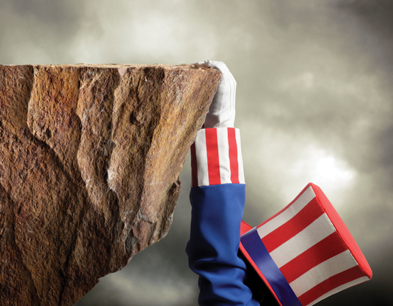
Uncle Sam hangs on for web
By Steve Brawner
© 2015 by Steve Brawner Communications, Inc.

This might only be early October, but for Congress, the fiscal year ended Sept. 30. If it were a school year, what kind of grade should Congress receive?

In math, probably an F.

In fiscal year 2015, the government spent $426 billion more than it collected, adding to a national debt that has now reached $18.2 trillion.

Congress should be looking for ways to improve those numbers. Instead, as pointed out by the Committee for a Responsible Federal Budget, this year it increased deficit spending over the next 10 years in a variety of ways.

Meanwhile, when it comes to its most important assignments, Congress gets an incomplete. The federal government is supposed to be funded through 12 appropriations bills dealing with various areas of spending. The 2016 fiscal year has started, and so far the House has passed six, and the Senate has passed zero.

Because the government has to be funded somehow, Congress this week passed a continuing resolution, which basically keeps things as they are. That’s a problem when the status quo is a $426 billion deficit. This latest one will keep the government functioning until December – just before an election year – when Congress probably will pass another last-minute deal that doesn’t solve much long term.

On some assignments, Congress didn’t score an incomplete, but it was tardy. It waited until Dec. 19, 2014, to extend a series of tax deductions that had expired at the end of 2013, which meant businesses and individuals spent the entire year uncertain if those deductions would continue. Waiting so late defeats the theoretical purpose of having deductions, which is to encourage behavior that is good for the economy.

Unfortunately, there is no way to hold back Congress a year until it learns the material. It must be promoted to the next grade, where it will face ever-growing challenges.

There are two ways of measuring the debt: the total debt; and the debt held by the public, which doesn’t include what the government owes itself as a result of activities such as raiding the Social Security Trust Fund. The total debt is $18.2 trillion. The debt held by the public is $13.1 trillion.

The second figure is 74 percent of the gross domestic product. That’s the highest it has been since World War II. Historically, since 1965 the average has been 38 percent.

How do we get back to just being average? The Committee for a Responsible Federal Budget says that, taking the long view and setting 2040 as a goal, lawmakers should reduce total deficits over the next 10 years by $5 trillion. That puts the country on a path to 38 percent. But remember, Congress actually made things worse this past year, not better. So it’s not headed in the right direction.

In the short term, Congress must make some tough decisions quickly. In December, the government reaches the debt limit, which by law sets a ceiling on how high the national debt can go. Ultimately, the limit will be raised. The government can’t just stop going into debt without changing its habits any more than you and I can. Over the next couple of months, Congress’ assigned project is to raise the debt limit responsibly by tying it to meaningful reforms. If it does that, it gets a passing grade. If it does what it usually does – bicker until the last second and then pass the buck – it flunks the test again.

It’s students’ fault when they fail to learn the material, but it’s also the schools’ and the parents’. Elected officials are failing to complete their assignments. However, the classroom where they operate makes success almost impossible. The two-party duopoly, campaign finance laws, the filibuster, political consultants, the media environment – they’re all conspiring to turn Congress into an unworkable institution. The Founding Fathers rightly designed a government that was not meant to run smoothly. In today’s political climate, it’s often not running at all.

Meanwhile, kids tend to do what their parents will allow, and certainly what their parents encourage. If voters demanded fiscal responsibility, then even the most ill-behaved members of Congress would oblige, and even this imperfect system could be made to work.

If that were to happen, there wouldn’t need to be a group called the Committee for a Responsible Federal Budget. We’d already have one, it would be composed of 535 members, and it would have a different name: Congress.

Why the GOP loses in a shutdown

By Steve Brawner
© 2015 by Steve Brawner Communications, Inc.

There’s been talk of two potential government shutdowns: one this week over funding Planned Parenthood that’s probably not going to happen, and one in December if the government reaches the debt ceiling. Whenever a shutdown occurs, Republicans will be blamed more than Democrats. That’s because of the brand Republicans themselves have created.

Branding is the process of creating a simple identity for a product, service or idea. It involves the entire organization’s efforts, from the product itself to the packaging to the advertising. Done correctly, it produce a powerful association with certain values and lifestyles (think Harley Davidson), overcoming temporary obstacles and even contrary facts.

How powerful is branding? At the beginning of the computer revolution, Apple branded itself as the company that sold easy-to-use personal computers. Its business model, however, was inferior to Microsoft’s, which copied Apple’s products and then made them widely available through Windows and Office. Apple almost went out of business.

Then Apple began a marketing campaign based on two words, “Think Different,” and introduced a series of revolutionary products and services, including the iPod, iTunes and the iPhone. In each case, Microsoft offered the same things, but none of them enjoyed great success. By then Apple didn’t just sell computer products; it sold thinking differently, while Microsoft just sold Windows and Office. Apple now is the world’s largest tech company.

But branding can backfire, as is currently the case with McDonald’s. For decades, McDonald’s branded itself as the place for a fast, inexpensive, tasty meal. It was the restaurant for families and kids. Its spokesman was a clown.

That brand still works with a lot of Americans, but for many, including many younger consumers, what once was considered inexpensive is now just cheap, and what once was considered a treat is now just fattening. Many American consumers would rather spend $8 for a better hamburger than spend $5 for a Big Mac. McDonald’s has tried to offer an upgraded menu, but it hasn’t caught on. If you have $8 to spend, you don’t spend it at McDonald’s.

Since 1980, Republicans have been better at branding than Democrats. Their message – “Less government” – fits neatly on a bumper sticker. Democrats, on the other hand, have been unable to sum up their message so succinctly. They don’t want to say they support a more activist government, so instead they’ve often simply branded themselves the “not Republican Party.” They need a better message. But that’s another column.

Whenever the government shuts down, it’s the result of decisions made by both parties. If the government were to shut down this week – which, as of this writing, it probably won’t – it would be because the Republicans forced the issue over Planned Parenthood. But Democrats also would be at fault. Republicans last week offered legislation that would run the government without funding Planned Parenthood, and Democrats blocked it.

But because of the two parties’ brands, whenever the government shuts down, casual observers of course will blame the Republicans. Who else would shut down the government but the anti-government party? Why would the Democrats shut down something they support?

At first, government shutdowns don’t have much of an effect. National parks close, but Americans can live without them for a while. Paychecks aren’t sent, so government workers take a few days off.

Over time, however, shutdowns start to sting. Paychecks are missed. National priorities go unfunded. Families cancel their once-in-a-lifetime trip to Washington, D.C., because the museums are closed. Credit agencies talk about downgrading the government’s rating. While anonymous members of Congress bicker from their little seats, the president steps off Air Force One and tells them it’s time to do their jobs.

Eventually, the anti-government activists capitulate, forced to concede that Uncle Sam really is necessary. The whole thing inevitably ends as a victory for big government. Then the blame games start.

A year before the election, voters would blame Republicans more than Democrats. Hillary Clinton’s campaign would tie the GOP nominee to the effort, knowing that, in the voting booth, casual voters tend to choose the party they think is least crazy.

So if Republicans force a government shutdown any time this year, they might as well call their efforts the “Hillary Clinton Employment Act.” When you’ve branded yourself the anti-government party, then you can’t use a government shutdown as a tactic. It looks a little clownish, which, as McDonald’s will tell you, isn’t working so well right now.

Free market requires moral core

By Steve Brawner
© 2015 by Steve Brawner Communications, Inc.

Life, the pope is telling us, is about more than the bottom line. This past week has given two examples of why people should listen to his big economic message even if they disagree with some of his little ones. One involves a giant automaker. The other manufactures a little pill.

The automaker, Volkswagen, doctored its diesel engines so they would temporarily meet EPA emissions regulations while they were being tested, and then they would emit much higher levels when actually driven by car buyers. As a result, those cars performed better on the highways while releasing up to 40 times more pollution than the legal amount. Volkswagen did this in 11 million vehicles sold worldwide.

Environmental considerations aside, the company lied and cheated its competitors and its customers. People thought they were buying a clean vehicle that ran great. Rule-abiding competitors were selling products that had a disadvantage against Volkswagen in the marketplace.

The pill manufacturer is Turing Pharmaceuticals, which bought the rights to Daraprim, a niche drug that fights deadly parasitic infections. The drug has been on the market for 62 years and has no generic equivalent. Shortly after buying the rights, the company raised the price – from $13.50 per tablet to $750 each.

This is not the first time a drug has been purchased and then inflated recently. But the company’s owner, a 32-year-old former hedge fund manager, seemed particularly proud of himself. He said the price needed to be raised to make the drug profitable (which would mean the previous rights holder must have been losing a ton of money at $13.50). Frankly, the drug would be cheap at $750, he said.

If your only guiding principle is the bottom line, then those arguments make sense. Guy’s just charging what the market will bear, right? Everything he’s done is legal. Under traditional laissez-faire economics, the free market’s unseen hand will correct all wrongs, and somebody eventually will produce a generic version if they can make money doing it.

But humans are more than economic beings. We’re also spiritual, moral and social ones. In fact, we must be for the free market to function.

The free market is the greatest anti-poverty mechanism ever created by humanity. It allows entrepreneurs to produce goods and services valued by the marketplace, thereby creating jobs and raising a society’s standard of living. Those who do this exceptionally well – people like Steve Jobs and Warren Buffett – are celebrated and richly rewarded, as they should be.

But the free market is only as good as the values of its practitioners. It can be perverted by those who, instead of producing goods and services, merely play games with money and take advantage of others. While Jobs created world-changing products, Turing’s hedge fund manager produced nothing new. He just bought the rights to a pill and then jacked up the price knowing people had to pay or die, and knowing there probably won’t be a generic competitor soon, if ever.

I watched a brief cable “news” segment where the host and a couple of his guests either defended the hedge fund manager or expressed ambivalence about his actions. The host said this kind of situation is preferable to having the government in charge of health care.

Which is ironic, because if the free market isn’t governed by both the unseen hand and a moral core, then bigger government is unfortunately what we’ll get. Two days after Turing Pharmaceutical’s price hike came to light, Hillary Clinton announced a plan to limit drug price gouging. Supporters of a single-payer government health system can use this episode to bolster their arguments. Meanwhile, Volkswagen’s actions likely will add to the regulatory burden faced by all automakers. They’ll have to do more to prove they’re not cheating.

In these two cases, it’s all ending as it should. Volkswagen stock has tumbled, it faces huge fines, and its CEO, who said he knew nothing about the cheating, has resigned. Meanwhile, overwhelming public condemnation wiped the smirk off the young hedge fund manager’s face, and he announced he would reduce the price hike.

That happened because humans are still spiritual, moral and social beings, instead of merely economic ones. Most of us know it’s wrong to cheat, and we know it’s wrong to take advantage of the vulnerable, or to use the vulnerable as a tool to take advantage of society.

We’re going to be governed by something. Preferably, it’s a conscience.

Arkansas Democrats becoming simply Democrats

By Steve Brawner
© 2015 by Steve Brawner Communications, Inc.

There’s a relatively new phenomenon in Arkansas politics: Democrats are starting to run alongside their national party instead of running against it.

For the past few decades, in-state candidates have followed a formula perfected by Bill Clinton, Sen. Dale Bumpers and Sens. David and Mark Pryor: campaigning as “Arkansas Democrats,” meaning they supported popular government spending programs like Social Security but shied away from their national party on cultural issues such as guns and gays.

That tightrope has become difficult to walk. Nationally, the two parties have become so polarized – the Democrats moving to the left and the Republicans moving to the right – that few can occupy the center. It’s much harder for Arkansas Democrats running for Congress to tell voters they are culturally conservative these days because often they’ll have to vote along their party’s line in Congress.

Geographically, Democrats are now concentrated in coastal and urban areas and have a dwindling presence in the South outside of districts led by racial minorities. That process was happening throughout much of SEC country before President Obama was elected and then happened here afterwards. In 2008, Democrats controlled five of the state’s six congressional offices, all seven statewide constitutional offices, and 102 of the 135 seats in the Legislature. Now Republicans control all six congressional offices, all state constitutional offices, and 88 of the 135 legislative seats. It’s 88 because last month, Rep. Mike Holcomb, who had represented Pine Bluff as a Democrat, announced he had switched parties.

Amidst the mounting evidence that what they are doing isn’t working, some in the party have stopped trying to be Arkansas Democrats and instead just be Democrats. Unlike Republicans, the Democrats are united in support of the private option, the state’s program that uses Obamacare dollars to purchase private insurance for lower income Arkansans. Led by its chairman, Vince Insalaco, the state party has vigorously defended Planned Parenthood since the release of those videos, which Arkansas Democrats like the Pryors never would have done. Holcomb cited that defense as a factor in his party switch. In response, Insalaco basically said the party was glad to see him go.

Then at a campaign rally in Little Rock Monday, Hillary Clinton enthusiastically endorsed not only Obamacare but also President Obama, saying, “It gives me great joy to go around bragging about Bill Clinton and Barack Obama every chance I get.”

Everything Clinton says is for national consumption, of course, and she was speaking before a supportive crowd. But Clinton knows the polls in Arkansas as well as anyone, and she knows how unpopular Obama is here. Instead of running away from him while in Arkansas, she ran alongside him.

The state’s Democrats have not unanimously decided to embark on a new strategy. In announcing he was running as a Democrat for U.S. Senate against incumbent Sen. John Boozman, former U.S. Attorney Conner Eldridge took a page from the old Arkansas Democrat playbook and almost sounded like a Republican. I’m sure that’s partly a political strategy and partly a reflection of who Eldridge is and where he came from. It’s hard to run as a Democrat in Arkansas now. However, if you really are an Arkansas Democrat at heart, then you might not be comfortable in today’s Republican Party.

Prior to Clinton’s speech, Insalaco told the crowd that the state’s Democrats would gain seats in the 2016 elections. That’s probably wishful thinking. Some incumbent Democrats are vulnerable just because they’re Democrats. Republicans are finding candidates – including former Democrats – to run in places where they traditionally haven’t been competitive. Candidates like Holcomb – white, conservative, rural – who used to default to the Democratic Party are now running as Republicans. It’s probably going to get worse for Democrats before it gets better.

And it probably will not get much better for them for a long time. Democrats controlled Arkansas for a century and a half after the Civil War, and now Republicans will control the state for a while. Too many Arkansans now culturally identify with the GOP in ways that are more deep-seated than simple policy positions. Democrats in Arkansas must look to the long game and be patient. More and more, they’ll embrace positions such as supporting gay rights, which is a popular position among young, up-and-coming voters.

That topic came up more in Insalaco’s speech than it did in Clinton’s. In fact, she didn’t mention it. She spent too many years as an Arkansas Democrat.