Category Archives: Independents and third parties

The four words Dr. Pakko forgot

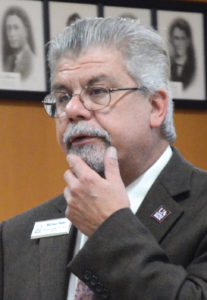
Dr. Michael Pakko

Dr. Michael Pakko, shown in a file photo.

By Steve Brawner, © 2019 by Steve Brawner Communications, Inc.

When Dr. Michael Pakko testified against a bill making it harder for third parties to compete Tuesday, he didn’t use the four words that would have been the most persuasive to lawmakers.

Pakko, the Libertarian Party of Arkansas chairman, spoke against Senate Bill 163 by Sen. Trent Garner, R-El Dorado. Garner’s bill would increase the number of signatures third parties must collect to qualify for the ballot. It’s currently 10,000. Garner’s bill would increase it to 3 percent of the total votes cast in the most recent gubernatorial election. In 2020, that would be about 26,746.

Under current law, any political party not attaining 3 percent of the vote in a presidential or gubernatorial election is a “new” party and must collect signatures the next time. Pakko’s Libertarians have been inching toward that percentage in recent elections. Last November, their candidate for governor, Mark West, won 2.9 percent of the vote.

On Tuesday, the Senate State Agencies and Governmental Affairs Committee met earlier than expected and dispensed with the bill on a voice vote before Pakko arrived.

Given a chance to speak at the meeting’s end, Pakko called it a “clear effort to suppress competition in Arkansas’ political process.” He pointed out that more than half the state legislative candidates in 2018 were unopposed, so it’s not like Arkansans have too many ballot choices.

“The fact that it includes an emergency clause makes it even more evident that it’s intended to stifle competition in the 2020 election to the benefit of current incumbent politicians and their entrenched political parties,” he said.

It also runs afoul of a 2006 case, Green Party of Arkansas v. Daniels. There, a judge ruled that a previous 3 percent limit was unconstitutional and required the state to give the Green Party a spot on the ballot. In fact, that ruling led the Legislature to adopt the 10,000-signature threshold, Pakko said.

And that’s when he didn’t use the four words that would be most effective with lawmakers as the bill moves through the House. Continue reading

The legislator without a party label

Mark McElroyBy Steve Brawner, © 2018 by Steve Brawner Communications, Inc.

Rep. Mark McElroy of Tillar says he’s “too conservative really to be a Democrat, but I’m too poor to be a Republican.” Earlier this year, he decided he didn’t want either label, and now he’s campaigning to see if his district’s voters will send him back to the Capitol as an independent.

McElroy spent 20 years as Desha County judge before winning election to the Arkansas House of Representatives in 2012. He represents District 11 in Arkansas’ southeastern corner along the Mississippi River. He’s always been elected as a Democrat, but he didn’t really fit into either party. He didn’t like the national Democrats’ stand on social issues like abortion, but he believed the Republican Party’s policies favored the top 1 percent. He chafed at morning caucus meetings where he felt he was being told how to vote, regardless of his district’s wishes. He drew a primary opponent from his own party in the last election and did again this year.

Faced with all that, this spring he decided to leave the party and become an independent. He’s the only one in the Legislature.

“I don’t see why you have to fit in,” he said Tuesday after attending a meeting of the House and Senate Education Committees. “I don’t know why you have to be a label to represent your people.” Continue reading

Will 3 percent vote for almost no government?

Mark West

Mark West is running for governor as a Libertarian.

By Steve Brawner, © 2018 by Steve Brawner Communications, Inc.

For Mark West, victory in the Arkansas governor’s race realistically will be measured using two numbers: 50 and 3.

He says if his votes keep Gov. Asa Hutchinson under 50 percent, that would be a measurable number that shows his third party campaign kind of caught on. Achieving that goal seems unlikely.

The more important number is 3 percent. If he wins that amount, his Libertarian Party won’t be a “new” party under Arkansas law in 2020, and it won’t have to expend its limited resources collecting 10,000 signatures to qualify for the ballot. The party’s 2014 candidate for governor, Frank Gilbert, won 1.92 percent.

How limited are those resources? Hutchinson as of the last campaign finance reporting deadline Aug. 15 had raised $4.3 million for his campaign. The Democratic challenger, Jared Henderson, had raised about $324,000. West has raised $6,000 to date. Continue reading

When 3 percent is a big win

Mark West is running for governor as a Libertarian.

By Steve Brawner

How can a candidate win by losing? By capturing enough of the vote to ensure his third party qualifies for the next election and has a better chance to be heard.

In Arkansas, parties must win 3 percent in gubernatorial and presidential elections to automatically qualify for the next election’s ballot, which is why the Democrats will surely find someone to run against seemingly unbeatable Gov. Asa Hutchinson in 2018.

Arkansas’ most organized third party, the Libertarians, failed to reach that standard in 2016, when former New Mexico Gov. Gary Johnson won 2.65 percent of the presidential vote despite a promising start. That meant the state party had to collect at least 10,000 signatures this year at a cost of about $30,000.

Continue reading

Can The Centrist Project pioneer a new way?

By Steve Brawner
© 2017 by Steve Brawner Communications, Inc.

Forty-four percent of Americans are independents, according to Gallup, but only 2 percent of United States senators are, and one of those is Sen. Bernie Sanders, who’s really a Democrat. Could a few more independents form a decisive voting bloc that would force Republicans and Democrats to solve problems?

That’s a question Joel Searby and the other founders of The Centrist Project are trying to answer.

Searby ran the 2016 independent presidential campaign of Evan McMullen, a former Republican congressional staff member and ex-CIA officer who won 21 percent of the vote in Utah and 1 percent in Arkansas.

Now, Searby and others with The Centrist Project are trying to recruit and strategically fund credible independent candidates in 2018, with one focus being the U.S. Senate where they could make the most difference.

Congress, you may have noticed, is a partisan mess where the focus is more on scoring political points than solving problems. In the past, the two parties were each a diverse mix of conservatives, liberals and moderates who could work across party lines. But Republicans have moved right while Democrats have moved left, with few left in the center to bridge the gap.

The Centrist Project is trying to step in and find a few states where the climate is best-suited to electing independents to the Senate and elsewhere who are fiscally responsible, practical minded, problem solving, environmentally responsible and socially tolerant.

What does all that mean? Searby said it’s more about an approach to government than a set of ideological beliefs. Regarding being “socially tolerant,” he says he’s a pro-life, pro-family conservative, but the centrist approach means not vilifying the other side or holding other issues hostage.

“That’s how (parties) frame every issue is around enemies and friends, and so we’re just really trying to overcome that,” he said.

Three to five independents in the U.S. Senate could control the balance of power by voting with one party or the other based on the issue, forcing Republicans and Democrats out of their us-versus-them comfort zone. The new independents could work with current independent Sen. Angus King of Maine along with Republicans and Democrats who have independent streaks, including Sen. Ben Sasse, R-Nebraska, and Sen. Joe Manchin, D-West Virginia.

Searby said the Project is looking for attractive candidates with the ability to self-fund or attract a potential network of supporters – like McMullin or Greg Orman, the Kansas businessman who ran a strong but ultimately losing campaign for the U.S. Senate in 2014. It is talking with potential Senate candidates in eight states where an independent might have success because of a state’s political climate and size – a small, cheap state like Maine being preferable to a big, expensive one like California. Meanwhile, it’s also targeting other races in an effort to get wins wherever it can.

Arkansas does not have a Senate race in 2018 is not a target, anyway. The state’s rapid transformation from a conservative Democratic state to a Trump-Republican stronghold makes it less likely an independent could emerge here, Searby said.

It’s going to be an uphill climb. Most Americans who tell pollsters they are independents aren’t really. The reality is, whether they admit it or not, most are reliably voting for one party or the other. Moreover, congressional gerrymandering (drawing lines to benefit a party) and Americans’ self-sorting personal decisions have made most districts reliably Republican or Democrat. In other words, we typically live amongst people who vote like us in states that are either red or blue. Meanwhile, the parties have huge, well-funded infrastructures and have written election laws to favor themselves. The system strongly encourages voters to choose one party over the other, even if it’s just to pick the lesser of two evils.

After running McMullin’s long-shot campaign, Searby believes that independents eventually will break through. He said political professionals who are fed up with the two parties seemed open to different kinds of candidates. Members of the media seemed ready to tell a new story.

“The bottom line is, we know we’re pushing against decades of trends and beliefs and partisan work and money, and it’s going to be hard, but just because something’s hard doesn’t mean that it’s not worth doing, and just because something’s hard doesn’t mean that it’s not going to come,” he said. “We really believe that we are pioneering a new way in American politics.”