Category Archives: Health care

Medical marijuana: Skip the growers?

By Steve Brawner

© 2018 by Steve Brawner Communications, Inc.

It’s been 18 months since Arkansas voters passed the medical marijuana amendment, and the drug is still not available – legally under state law, anyway. It may not be available for a while, now that a judge has put a halt to awarding growers’ licenses.

But there could be a way to change that. First, the Medical Marijuana Commission could follow the governor’s advice and award growers’ and dispensaries’ licenses the same way alcohol permits are awarded – through a lottery. Meanwhile, the amendment’s sponsor says growers aren’t really needed yet anyway because dispensaries can meet current demand. Continue reading

Trump change helps Arkansas Obamacare program continue

Seema Verna

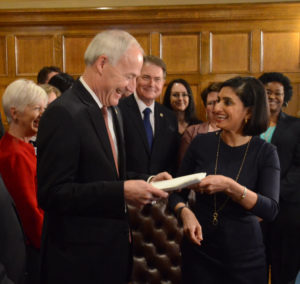
Seema Verna hands the work requirement waiver to Gov. Asa Hutchinson at the Capitol.

The presidential administration that tried to repeal Obamacare in 2017 just made it easier for some Arkansas legislators to vote to continue part of it.

I guess that’s ironic. But that’s how politics works sometimes.

On Monday, Arkansas was visited by Seema Verna, President Trump’s Centers for Medicare and Medicaid Services administrator. She granted a waiver letting the state require some Arkansas Works beneficiaries to work.  Continue reading

Your pharmacist doesn’t want to see you now

If your pharmacist doesn’t look happy to see you the next time you visit, it’s probably because she’s losing money filling your prescription.

The problems are occurring with two groups of patients. The largest are those covered by Arkansas Works, which uses Medicaid dollars to purchase private health insurance for 285,000 low-income Arkansans. The other problem patients are the 68,100 Arkansans who purchase their health insurance through the online Arkansas Health Insurance Marketplace. Like Arkansas Works, the Marketplace was created by the Affordable Care Act, otherwise known as Obamacare.

Who are the pharmacy benefit managers?

Pharmacists say that, in those plans, they aren’t being fairly reimbursed by their pharmacy benefit managers. Those PBMs act as middlemen between pharmacists and insurance companies, which in Arkansas are Blue Cross, Ambetter and QualChoice. Continue reading

America’s health care sickness: Paid to treat, not heal

RosenthalBy Steve Brawner

Dr. Denise Faustman believes type 1 diabetes might could be cured using a tuberculosis vaccine already sold as a generic. Unfortunately, she’s had trouble obtaining funding for research. Too many people have a financial incentive to keep the status quo.

Faustman, a Harvard Medical School researcher, found that  the vaccine, long sold on the market, showed promise when tested on mice.

That would be big news, especially for the 1.25 million Americans living with type 1 diabetes. And it did cause a stir when she published the initial results – in 2001.

However, the pharmaceutical industry wasn’t interested in funding further research because it didn’t see a pathway to profits using a drug that’s already on the generic market. The big medical foundations haven’t wanted to fund her research because they’re allied with the pharmaceutical industry – in fact, often financially invested in its products. Despite the roadblocks, Faustman managed to find enough funding to publish further research in 2012. Now she’s trying to raise money through her website, www.faustmanlab.org.

Rosenthal: They’re paid to treat, not heal

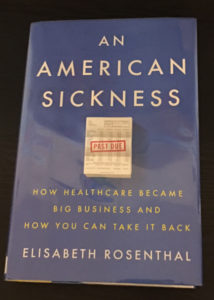
Faustman’s story is one anecdote in “An American Sickness,” a book by Elisabeth Rosenthal, a medical doctor who became a New York Times reporter and is now editor in chief of Kaiser Health News. If you want to better understand why the American health care system is failing, read this 330-page book. Continue reading

We can’t afford Alzheimer’s

Alzheimer's

Harry Johns is national president and CEO of the Alzheimer’s Association.

By Steve Brawner

The first sign that Walt Klusmeier’s had Alzheimer’s was when he asked his wife, Lisa, how to send an email on his phone. He was 49 years old.

Then he needed help with expense reports on his laptop. When that happened, Lisa assumed was the result of stress caused by his responsibilities as a father of three children and as a pharmaceutical sales rep.

“I just thought he had this huge territory, had a lot of responsibility,” she said. “Our kids were growing. We were a busy family.”

But it was more than stress. He would withdraw at home. While he learned to compensate for his failing cognition, his work was subpar, which his employer interpreted as a lack of commitment. Eventually he lost his job, which meant the family lost not only his income but his insurance, and he didn’t qualify for government benefits because of his age. The money ran out. After he was diagnosed with younger-onset Alzheimer’s, he became eligible for Social Security Disability payments and two years later for Medicare. He lived at home until his last month of life and died at age 58. Continue reading