Category Archives: Elections

What SS and Medicare reforms WOULD Sen Pryor support?

I asked Sen. Mark Pryor Tuesday what reforms to Social Security and Medicare he WOULD support during a press conference where he received the endorsement of the National Committee to Protect Social Security and Medicare.

He said he supported cutting waste, fraud and abuse in Medicare; allowing it to bargain for prescription drugs; and emphasizing preventive care. When pressed, he criticized his opponent’s votes and then called for bipartisan solutions.

We cannot balance the budget without reforming Social Security and Medicare. Mandatory spending, of which those two programs are the major part, composes 64 percent of the federal budget, and that number will rise as the baby boomers age.

Pryor knows this, but he’s not going to say so during an election year.

At least he acknowledged there’s a problem.

Pryor faces headwinds despite lead

Is Sen. Mark Pryor really ahead in the U.S. Senate race?

That’s the finding of a new Talk Business-Hendrix College Poll, which says that Pryor leads his opponent, U.S. Rep. Tom Cotton, 45.5 percent to 42.5 percent.

The race hasn’t moved much in that poll since October 2013, when Pryor led, 42-41 percent. To win, the campaigns and their allies will be focusing their efforts in two areas. One is motivating the base to turn out to vote, and the other is going after the other 12 percent – the 8 percent who are undecided, the 2 percent who say they will vote for Libertarian Nathan LaFrance, and the 2 percent who say they will vote for Green Party candidate Mark Swaney.

In other words, expect a lot of political commercials in the next seven months. Control of the U.S. Senate may depend largely on the outcome of this race.

I need to disclose this somewhere: I’m a freelance journalist, and one of my clients is Talk Business. Back to the column.

This is just one poll. Despite its findings, Pryor still faces considerable headwinds, which is why if I had to bet money on who’s going to win, I’d pick Cotton. Momentum, history, and the year the election is occurring are not on Pryor’s side.

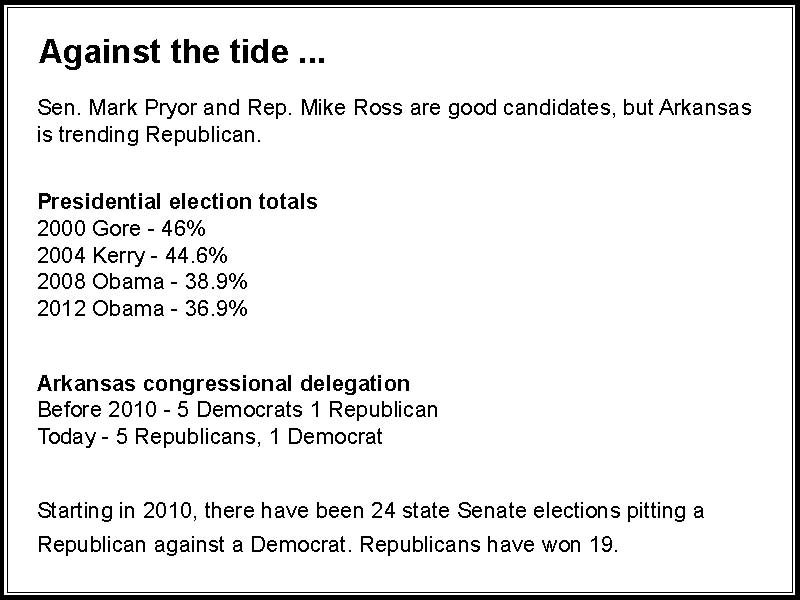
Let’s start with momentum – specifically, the Republican Party’s in Arkansas. Prior to 2008, much of the South – but not Arkansas – had switched from the Democrats to the Republicans. Since the election of President Obama, Arkansas has undergone a historic shift toward the GOP. When Obama was elected, the state’s congressional delegation was 5-1 Democrat. Now, it’s 5-1 Republican. Now-Sen. John Boozman defeated then-Sen. Blanche Lincoln by 21 points in 2010. The state Legislature has undergone a similar shift from Democratic domination to Republican leadership. In the 24 state Senate elections where the two parties have squared off since Obama was elected, the Republicans have won 19.

History also favors Cotton. Off-year elections often are unkind to members of the president’s party. Voters who oppose a sitting president are more motivated to vote than those who support him. In the 2006 elections during the second term of President George W. Bush’s administration, the Democratic caucus in the U.S. Senate gained six seats from 45 to 51 – the same number that Republicans need this year to take the Senate. In 1994 (after the Clintons also had tried to pass a health care plan), Republicans gained nine Senate seats.

Finally, there’s the year of the election. Under President Obama, two electorates have developed – a younger, more diverse one that votes only in presidential election years and leans Democratic, and an older, more conservative one that also votes in the other elections and gives Republicans an advantage. If Pryor would have faced re-election in 2016, he would be dealing with more favorable demographics. At the very least, President Obama would be less of an issue on his way out of the White House.

Of course, that would have meant Pryor would have had to run in 2010, when Lincoln lost by 21 points after Obamacare had passed. In 2008, Pryor didn’t even have a Republican opponent.

The issue that hangs over all of this, of course, is Obamacare. Pryor, as you must know if you are reading this kind of column, voted for it. To his credit, he hasn’t pretended that he didn’t, though I don’t see how he could. Obamacare will remain deeply unpopular in Arkansas through November, even if they do eventually get that website fixed.

Meanwhile, Pryor’s other disadvantages remain – momentum, which can be altered, and history and the year of the election, which can’t.

“Evil” in American politics

These days, it’s not enough to say your political opponent is wrong. You have to say he or she has bad intentions. This “the opposition is evil” narrative is effective for winning elections but not helpful for running a democracy. Here are three reasons why.

First, dismissing opponents as evil or ill-intentioned means we don’t have to seriously consider where they might be right and where we might be wrong – and we all have to be wrong about something, right? Democracy’s strength is based on the so-called “wisdom of the crowds” – that a diverse group of people will, collectively, come up with a better answer for societal problems than a monolithic group, even of experts. If the “government is always bad” crowd always got its way, we would never have had Social Security or the legal protections provided to minorities after the civil rights movement. If the “government can solve our problems” crowd got its way too often, the government would never stop growing.

Second, dismissing opponents as evil or ill-intentioned means we don’t have to consider the root causes of problems. Just vanquish the villains, and everything will be OK – just like on TV. Well, not exactly. The past 13 years have been one of the most fiscally irresponsible eras in American history. We’ve had government by Republicans, government by Democrats, and divided government. The results have been largely the same – big spending and more debt.

Getting rid of President Obama won’t change that any more than getting rid of President Bush did. They are merely symptoms of a larger disease that has infected the entire society: We demand more government than we are willing to pay for. Until Americans confront their own responsibilities and stop blaming one side or the other, that disease will fester.

Third, dismissing opponents as evil or ill-intentioned means we don’t give anyone else a chance. The two major parties have manipulated Americans into believing that the other side is so bad that we have no choice but to vote against them. It’s called the “spoiler effect.” We must vote for the Republican or Democrat we hate the least lest we inadvertently contribute to the election of the other party – even though there’s a third candidate we actually prefer.

The result is that the two parties have assured their own continued elections even as more Americans express their disgust with them and consider themselves independent. No one outside the two major parties can be competitive – much less have their ideas heard.

It’s really a neat deal for the two major parties. They trade seats every few years, but ultimately they stay in power.

And that simply contributes to the cycle – the two parties have less reason to consider where they might be wrong, and they don’t have to consider the root causes of problems. Why would they? They keep winning.

Potential reforms would improve the system. Instant runoff voting, for example, allows voters to rank the candidates from most agreeable to least – ideally, minimizing the spoiler effect. Australia does that in its House of Representatives.

Ultimately, though, no reforms can overcome a citizenry that allows itself to be manipulated. We get the government we deserve, and if we allow either of the two parties to convince us to vote for them merely because the other side is evil, then we’ll reap the results of our laziness. For the past 13 years, those results have been debt, war, a stagnant economy and bailouts without responsibility – regardless of who’s been in power.

Some people are evil, but not many. Some people are wrong a lot of the time, but few people are wrong all of the time. Nobody is right all the time.

But not seriously confronting our problems is always wrong. Not necessarily evil, but definitely wrong.

Hillary Clinton.

The thing that’s so difficult about writing a column – about communication in general – is that no matter what words one uses, others will interpret them through their own experiences and emotions. What I write or say is of far less consequence than what you say to yourself in response. As evidence, I present the following sentence.

Hillary Clinton.

If you are over 30 years old, your opinion about those words probably is set in cement. It wouldn’t have mattered if I had asked “Hillary Clinton?” or exclaimed “Hillary Clinton!”

Not that it will make much of a difference, but here’s my opinion about her. Politically, I think she’s more liberal than she presents herself but not as liberal as she’s painted to be. Personally, she has her good points and bad points like all of us, and that’s enough said about that. I do not think she is evil or scary, but I do not intend to vote for her if she runs for president.

That said, a guy who actually changed his mind about her spoke at the Clinton School of Public Service in Little Rock Tuesday. David Brock said that, as a young man, he was part of the “vast right wing conspiracy.” Employed by a conservative-leaning magazine, he was the first journalist to print the name “Paula Jones.” He now says he wrote inaccurately about the Clintons. Over the course of his reporting career, he had a change of heart, apologized, and became their passionate defender.

He also became an opponent of the conservative media. On Tuesday he called Fox News “Orwellian,” which is a ridiculous adjective. How about just “biased”?

Your opinion about Fox News in particular and the media in general is probably set in cement, too, but I’ll share mine. Of course, most members of the mainstream media have been liberal, and their reporting has reflected that bias – purposely at times, unconsciously at others. There have been good and bad reporters, but there won’t be any unbiased ones unless human nature somehow changes. It would have been good had more moderates and conservatives become regular reporters to create more balance.

That didn’t happen. Instead, more and more Americans are getting their news from well-organized message machines that reinforce what we already believe rather than present us with challenging information. As with David Brock, Hillary Clinton is either wrong all the time, or she’s right all the time.

Brock also said that, if Clinton runs, she will be the most thoroughly examined candidate in history.

That’s true, and it will continue. People complain about “Clinton fatigue,” but that family is a story, and the media will continue to report on it.

Meanwhile, Republican political operatives already are doing what political operatives on both sides always do: Attack and destroy. That’s what they are paid to do. They don’t know how to do anything else.

They might personally discourage Clinton, who’s 66, from entering the race. That’s part of their goal.

But if she does run, the Republicans will lose yet another presidential election – they’ve lost the popular vote in five of the last six – unless their candidate also presents a positive vision for America. The party can’t just rely on a billion dollars in negative ads and dozens of congressional hearings about Benghazi. Those efforts will reinforce the GOP’s image, particularly among women, as the “party of no,” but they won’t move the needle much on a Clinton candidacy.

After all, if you don’t already have an opinion about her, you’re probably not a registered voter. She’s Hillary Clinton.

Medical weed’s November fate still hazy

Medical marijuana is legal in 20 states plus Washington, D.C. Whether or not it becomes legal in Arkansas this year depends on if it makes the ballot and who shows up at the polls.

Two competing proposals have been certified by Arkansas Attorney General Dustin McDaniel. One group of supporters is actively collecting signatures, while the other is trying to raise money.

Melissa Fults, campaign director of Arkansans for Compassionate Care, said 464 volunteers have collected about 10,000 signatures and will become more active now that the weather is prettier. They must collect 62,507 signatures – eight percent of voters in the last gubernatorial election – by July 7. That’s a lot, in a short amount of time.

The other proposal, submitted by Arkansans for Responsible Medicine, will rely on paid canvassers if it can raise the money, said organizer David Couch.

The groups are trying to build on the momentum from 2012, when the Arkansas Medical Marijuana Act almost passed with 48.56 percent of the vote and 507,757 Arkansans saying yes.

Still, this a nonpresidential election, which means the electorate will be smaller, older, more settled and more conservative – as opposed to 2012, when lots more young people voted in the big election. Couch said the thinking among many advocates is that it’s better to hold your fire – and save your money – until you have the best chance to win. That would be 2016.

Fults disagrees. The national mood seems to be shifting in favor of the idea. It’s hard to ignore those cancer patients asserting how marijuana helps them tolerate their disease. People, especially older ones, seem less hesitant when signing petitions than they did before, she said. She also thinks a competitive governor’s race this year will drive up turnout.

Fults, a 59-year-old dairy goat farmer from outside Little Rock, became involved in the cause after a family member was injured in a debilitating accident. She said the opiates he was taking were turning him into a “zombie” and literally were killing him. Marijuana, taken in pill form, has allowed him to live a normal life.

You can argue that she’s wrong about the policy. You can’t tell her she’s wrong about her family member.

History shows that medical marijuana can pass in a nonpresidential election. According to the website ProCon.org, of the 11 states that have legalized medical marijuana through a ballot initiative instead of a legislative act, five originally did so in nonpresidential years. Four of those, however, did so in the 1990s.

Even if Arkansans vote to legalize, there remains the thorny issue that, under federal law, possession of any amount of marijuana for any reason is a misdemeanor offense punishable by up to a year in prison. Even if medical marijuana is legal in Arkansas, it’s still illegal in America.

This is working in states that have legalized partly because the Obama administration, as it has a habit of doing, is selectively enforcing the law, which is not the way the system is supposed to work. Instead, Congress should pass a bill letting states decide for themselves if they will legalize medical marijuana. Then the president should sign the bill into law. Then Arkansas should legalize marijuana for medical purposes.

That would require Congress and the president to resolve a difficult issue in a statesmanlike way that increases freedom and reduces the federal government’s power.

Recent history would suggest that, if you believe that’s going to happen any time soon, you must be smoking something.