Category Archives: Elections

Arkansas Democrats becoming simply Democrats

By Steve Brawner
© 2015 by Steve Brawner Communications, Inc.

There’s a relatively new phenomenon in Arkansas politics: Democrats are starting to run alongside their national party instead of running against it.

For the past few decades, in-state candidates have followed a formula perfected by Bill Clinton, Sen. Dale Bumpers and Sens. David and Mark Pryor: campaigning as “Arkansas Democrats,” meaning they supported popular government spending programs like Social Security but shied away from their national party on cultural issues such as guns and gays.

That tightrope has become difficult to walk. Nationally, the two parties have become so polarized – the Democrats moving to the left and the Republicans moving to the right – that few can occupy the center. It’s much harder for Arkansas Democrats running for Congress to tell voters they are culturally conservative these days because often they’ll have to vote along their party’s line in Congress.

Geographically, Democrats are now concentrated in coastal and urban areas and have a dwindling presence in the South outside of districts led by racial minorities. That process was happening throughout much of SEC country before President Obama was elected and then happened here afterwards. In 2008, Democrats controlled five of the state’s six congressional offices, all seven statewide constitutional offices, and 102 of the 135 seats in the Legislature. Now Republicans control all six congressional offices, all state constitutional offices, and 88 of the 135 legislative seats. It’s 88 because last month, Rep. Mike Holcomb, who had represented Pine Bluff as a Democrat, announced he had switched parties.

Amidst the mounting evidence that what they are doing isn’t working, some in the party have stopped trying to be Arkansas Democrats and instead just be Democrats. Unlike Republicans, the Democrats are united in support of the private option, the state’s program that uses Obamacare dollars to purchase private insurance for lower income Arkansans. Led by its chairman, Vince Insalaco, the state party has vigorously defended Planned Parenthood since the release of those videos, which Arkansas Democrats like the Pryors never would have done. Holcomb cited that defense as a factor in his party switch. In response, Insalaco basically said the party was glad to see him go.

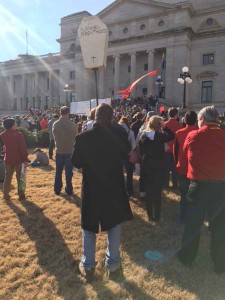
Then at a campaign rally in Little Rock Monday, Hillary Clinton enthusiastically endorsed not only Obamacare but also President Obama, saying, “It gives me great joy to go around bragging about Bill Clinton and Barack Obama every chance I get.”

Everything Clinton says is for national consumption, of course, and she was speaking before a supportive crowd. But Clinton knows the polls in Arkansas as well as anyone, and she knows how unpopular Obama is here. Instead of running away from him while in Arkansas, she ran alongside him.

The state’s Democrats have not unanimously decided to embark on a new strategy. In announcing he was running as a Democrat for U.S. Senate against incumbent Sen. John Boozman, former U.S. Attorney Conner Eldridge took a page from the old Arkansas Democrat playbook and almost sounded like a Republican. I’m sure that’s partly a political strategy and partly a reflection of who Eldridge is and where he came from. It’s hard to run as a Democrat in Arkansas now. However, if you really are an Arkansas Democrat at heart, then you might not be comfortable in today’s Republican Party.

Prior to Clinton’s speech, Insalaco told the crowd that the state’s Democrats would gain seats in the 2016 elections. That’s probably wishful thinking. Some incumbent Democrats are vulnerable just because they’re Democrats. Republicans are finding candidates – including former Democrats – to run in places where they traditionally haven’t been competitive. Candidates like Holcomb – white, conservative, rural – who used to default to the Democratic Party are now running as Republicans. It’s probably going to get worse for Democrats before it gets better.

And it probably will not get much better for them for a long time. Democrats controlled Arkansas for a century and a half after the Civil War, and now Republicans will control the state for a while. Too many Arkansans now culturally identify with the GOP in ways that are more deep-seated than simple policy positions. Democrats in Arkansas must look to the long game and be patient. More and more, they’ll embrace positions such as supporting gay rights, which is a popular position among young, up-and-coming voters.

That topic came up more in Insalaco’s speech than it did in Clinton’s. In fact, she didn’t mention it. She spent too many years as an Arkansas Democrat.

Trump, Carson and the vaccine debate

By Steve Brawner
© 2015 by Steve Brawner Communications, Inc.

One of the most interesting moments in Wednesday’s l-o-o-ng Republican presidential debate came when two candidates sort of stopped debating.

Dr. Ben Carson, retired neurosurgeon, was asked about comments Donald Trump had made espousing a link between vaccines and autism. Carson responded that numerous studies have shown no link between the two. The only study that did show a link has been thoroughly discredited. However, he said children are vaccinated for many diseases and that parents should have some discretion for those not deadly or crippling.

Trump responded with a personal story about an employee whose child had developed autism shortly after being vaccinated. He said he favors vaccinations but would like to see smaller dosages stretched over a longer period of time. Carson again disagreed that vaccinations cause autism but suggested cutting down on the “number and proximity” of shots, not mentioning dosages.

Logic is a tough thing for human beings to achieve, which is one reason democracy is so hard. We have a difficult time separating correlation – things happening at the same time – with causation. We place too high a value on emotional personal anecdotes and not a high enough value on data. That’s why we need research.

On the other hand, researchers are human, too. For years, we’ve been told that silly old Mom was wrong and there’s no link between cold weather and people catching colds, other than the fact that we’re more likely to spread the disease while stuck indoors in the winter. The data was unequivocal, even though Mom’s personal experiences said otherwise. Now research indicates that cold temperatures in the nasal cavity might slow the body’s immune response to rhinoviruses after all.

The scientific process has resulted in an explosion of knowledge and a vast improvement in our living standards. But it is an imperfect way of arriving at truth. Instead of a straight line, it zigzags. It gets some things right and some wrong and then corrects itself.

It especially runs into trouble when generalizing about humans, which are extremely complex and similar but not identical. It’s very likely true that vaccines do not cause autism across the broad spectrum of humanity. But it is not necessarily true that vaccines do not ever cause autism – or some other adverse reaction – in a particular person. These many parents who say their child changed immediately after being vaccinated – are they all foolishly failing to see that it was just a coincidence? Every last one of them?

If you are a health professional, you might have responded to the Carson-Trump exchange (and that last paragraph) with horror. While studies show there’s no link between vaccines and autism, there’s clearly a link between a lack of vaccines and increased cases of childhood diseases.

But many parents are opting out of vaccines now, so maybe it’s time for the medical establishment to rethink its approach. An atmosphere of distrust is being created, which happens when people’s concerns about their children are summarily dismissed. Maybe it’s time to stop arguing with parents and start working with them. Certainly, medical professionals and not presidential candidates should determine dosages. But would alternative vaccination schedules really be completely unacceptable?

Carson and Trump are both Republicans, but they’re about as different as two candidates in the same party are going to be in this day and age. They addressed this issue from very different perspectives. Within three minutes, it was apparent that their positions actually were at least in the same ballpark.

The truth is that Americans are divided on a lot of issues, but on many of them, it’s a difference of degree or approach. Almost all Democrats enjoy making more money and do not enjoy paying more taxes. Very few Republicans favor completely dismantling the social safety net. Nobody wants Iran to develop a nuclear bomb.

None of us will get everything we want – even if we are completely right. The trick in a complex society is to find an acceptable common ground. Does one exist in the great vaccine debate? Isn’t it worth trying to find out?

In the most adversarial of circumstances, Trump and Carson, the two frontrunners standing next to each other, ended up not so far apart on an issue where they seemed at first to be totally at odds. If that can happen in a presidential debate regarding vaccines, maybe it can happen on other issues after the election, too.

What if the Republicans can’t pick a winner?

By Steve Brawner
© 2015 by Steve Brawner Communications, Inc.

In order to win the Republican nomination for president, one candidate must amass 1,144 delegates. What if no one does that?

That’s a possibility – not a probability, but a possibility – with 17 candidates splitting the vote. If that were to happen, the nominee would be chosen at the Republican National Convention in July. Instead of a boring speech-a-thon in Cleveland, such a “brokered convention” would be marked by candidates courting delegates and making deals.

Pundits bring up this possibility every election cycle, and every election cycle it doesn’t happen. The 2016 elections, however, could be different because of the number of viable candidates, their geographic distribution, and the resources available to them. The 17 candidates hail from 14 states, where many have strong political organizations. Meanwhile, because of the Supreme Court’s Citizens United decision removing many donor limits, candidates can stay in the race longer than in the past because they need only a few big contributors to pay the bills.

So here’s a possible scenario. Donald Trump or Dr. Ben Carson wins Iowa Feb. 1. Then Trump or former Florida Gov. Jeb Bush or Ohio Gov. John Kasich wins New Hampshire Feb. 9. Then on Feb. 20 comes South Carolina, home state of Sen. Lindsey Graham, who’s currently polling at only 5 percent there – far behind Trump, who has a big lead over everyone.

Then comes Nevada Feb. 23 and then the big one, March 1, when delegates are selected in about a dozen states, including Arkansas as part of a bloc of Southern states known as the “SEC primary.” Sen. Ted Cruz could be the big winner that day if he wins his home state of Texas and does well elsewhere in the South, while Gov. Mike Huckabee should win Arkansas. Four days later, Sen. Rand Paul could win his home state of Kentucky while struggling Gov. Bobby Jindal will try to turn things around and win his home state of Louisiana.

By that point, there’s usually a mass exodus from the race, leaving a clear front-runner with some diehard challengers. But candidates who have won a state will be able to tell their supporters (and themselves) that they can still win, so many may still be running.

Moreover, the campaign calendar and the party’s rules could give some candidates a reason to continue. Before March 15, most of the states will have awarded their delegates on a proportional basis. In other words, a candidate who wins 50 percent of the vote wins half the state’s delegates. Starting March 15, states can award their delegates on a winner-take-all basis, which is a big advantage for three candidates from big states whose elections occur that day: Ohio’s Kasich, and Florida’s Bush and Sen. Marco Rubio. If Bush loses Florida, he’s out.

By the end of that day, more than half the states will have had their primaries and caucuses. It’s conceivable that so many candidates will have won delegates that no one will have a big lead. From that point, it could be a long three months before June 7, when primaries are held in California, home state of former Hewlett-Packard CEO Carly Fiorina, and New Jersey, home of Gov. Chris Christie.

If 2016 is like previous elections, the race will be over before then. Someone will be on the way to a coronation, and the challengers will have dutifully given their endorsements.

Could that be Trump? Sure. Currently, he maintains a large lead that seems to get bigger whenever he says something controversial. Big poll numbers nationwide don’t necessarily translate to winning one state at a time – but he’s winning now.

I’ve always expected that Republican leaders eventually would pressure lesser candidates to leave the race so the party could coalesce behind an “anybody but Trump” alternative. But a recent poll by SurveyUSA found him beating not only Hillary Clinton but also other Democrats. At some point, Republican voters must seriously ask themselves if he’s really their best choice. But for now, he’s looking more and more legitimate, so instead of trying to stop him, the party may have to ride this wave wherever it goes.

Which could be all the way to a brokered convention in Cleveland. If that’s the case, there would be a lot of back room politics and dealmaking. And which of the candidates is the best at making deals? Trump, supposedly.

Flustrated America

By Steve Brawner
© 2015 by Steve Brawner Communications, Inc.

You hear people say the word “flustrated” sometimes. Is that a word? It should be.

English needs a word that blends “flustered” and “frustrated.” “Flustered” means “confused,” while “frustrated” means you’re angry about something you can’t accomplish or control.

So what if you’re both angry and confused about it? Then you’re flustrated.

Times of great, rapid change can leave a lot of us feeling that way. In recent years, the economy has shifted from a manufacturing economy, to a service economy, to an information economy where many jobs are best performed overseas or by automation. Workers, no longer able to grow their own food or fix their own cars, have been forced to adjust in order to be a small cog in a giant machine. That’s flustrating.

The character of American demographics is changing as well. Since 1950, the population of the United States has doubled, according to the Census Bureau. Eight percent of us then were 65 years and older, compared to today’s 14.1 percent, a number that is rapidly growing. Back then, immigrants were twice as likely to have come from Europe as from this side of the Atlantic, and half of those from this hemisphere came from Canada. Today, the United States has the second highest Spanish-speaking population in the world, after Mexico. That’s not necessarily a bad change, but it is a big one.

Values are changing, too. A woman in 1950 was 27 times more likely to be married than to be divorced. Today, more than half of all women under age 30 who are giving birth aren’t married. Earlier this year, the Supreme Court ruled that couples of the same sex have the right to marry, only a few years removed from some 30 states passing laws making gay marriage illegal. On these important issues, Americans simply don’t see eye to eye, and that can be flustrating for all of us.

While the definition of “marriage” is changing, so is the definition of “community,” which once referred to geographic proximity. Few of us had access to the internet 20 years ago and none of us owned an iPhone in 2006. Today, “friend” is a verb and it’s something you do on Facebook. We can connect with people all over the world but no longer know our neighbors.

These rapid changes can leave us flustered and frustrated. We want some of those old definitions back – the ones we understood – but the consensus has broken down. The American conversation has become one big argument that hardly anybody ever wins. Try as we might, we can’t make the world in our image.

Amidst all this, we don’t even know who to be mad at, or to fear. During the Cold War, Americans could unite against a single enemy that was easy to find and was as scared of us as we were of it, and for many of the same reasons. Today, the enemy can be ISIS in the Middle East or a hacker in China.

But we’ve got to blame somebody we recognize, right? So it’s all the president’s fault, or the Democrats’, or the Republicans’, or the media’s, or the rich’s, or the poor’s. We create conspiracy theories to explain which individuals are really in charge because the reality is harder to accept – that no one is, at least no human being, and that if something really goes wrong, none of us knows how to fix it.

To some degree, this flustration is reflected in the Republican presidential campaign. Donald Trump is a lot of things, but flustrated he is not, though he certainly is flustrating Jeb Bush and some of the other conventional candidates. For many voters, Trump offers an alternative to a system that has both angered and confused them. It’s no coincidence that he has been joined at the top of the latest Iowa poll by Dr. Ben Carson, another nonpolitician, each with 23%, while former Hewlett-Packard CEO Carly Fiorina was third with 10%. In fact, those three candidates who haven’t been part of the political system together are polling higher than the 14 candidates who have been.

How to deal with such a time as this? One option is simple humility. What if I admitted I can’t understand the world, much less decide how it all should work? I might focus on what I can understand and control. I might grant a little mercy to those who see things differently.

I’d definitely be less flustrated, if that’s a word.

Squashing the wrong problems

By Steve Brawner
© 2015 by Steve Brawner Communications, Inc.

You know when you’re on your porch, and you notice a spider crawling by, but then you look closer and realize it’s not a black widow or a brown recluse, so it’s not poisonous, but then you wonder if maybe you could be wrong, so therefore it could be a threat, and plus it’s a nuisance? Those things multiply, and maybe they’ll get into the house, so you squash it just to be sure.

That’s kind of what the state’s establishment has done to independent candidates in Arkansas.

This past week, District Judge James Moody ruled in a case, Moore v. Martin, in favor of a 2013 law that requires independents to submit their required signatures – 3 percent of the voters in the last election, or 10,000 in statewide races – to the secretary of state by the end of the filing period. In a typical year, that’s the beginning of March.

Before the law was passed, independents could file at the same time as Democrats and Republicans and then collect their signatures while party candidates were campaigning for their May primaries.

The practical effect of the new law is that independents can’t survey the landscape like party candidates can do and then jump in the race. They must have already gathered their signatures to qualify for office by the same deadline that major party candidates sign up to run. They have to be walking the streets months in advance asking people to sign a petition. And instead of walking those streets in March and April as before, they now have to do it in January and February.

Except not this coming election. Because the Legislature moved next year’s primary elections to March 1, the filing deadline this year is Nov. 9. Independents have only 90 days to collect signatures, which means they would have to be beating the streets now for an election that won’t occur until November 2016.

The lead plaintiff in the case, Mark Moore of Pea Ridge, who ran for the state Legislature in 2012 as an independent, filed suit. Judge Moody agreed that the law creates a burden for independent candidates, but he accepted the state’s argument that it’s too difficult to verify those signatures in time, considering all the other things the state must do in an election cycle.

Which is a stretch. In 2014, there was one independent candidate for the Legislature, requiring the secretary of state’s office to verify only hundreds of signatures. In 2012, before the law was passed, there were seven. There’ve been a few other independent candidates run for other offices, but not many. Meanwhile, the secretary of state’s office will verify 67,887 signatures for each voter initiative and 85,859 signatures for any constitutional amendment that will be on the ballot in 2016.

What independents usually are is a nuisance for the establishment. In a given election, combined they represent a few thousand signatures that the secretary of state’s office has to verify. Meanwhile, for the major party candidates, they’re a variable they’d rather avoid dealing with. They’d rather just have one opponent, if it can’t be none.

I wish the halls of the Legislature and the Congress would become infested with independents scurrying around doing the people’s business without regard to party politics. But that’s not going to happen. Despite George Washington begging us to do otherwise, we’ve created a political system that almost guarantees that candidates will be a member of one of two parties. That’s the way it’s been for more than 200 years.

So why even bother with independents at all? Because there needs to be an option for candidates and voters who don’t agree with the two big parties or any of the smaller ones. The other reason is because the system needs an occasional nuisance – in fact, sometimes even a threat.

In the 1992 presidential campaign, Ross Perot won 19 percent of the vote campaigning as an outsider on one issue: the need to reduce the national debt, which at that point was $4 trillion. In the years following that election, President Clinton and Congress actually sort of balanced the budget. Was Perot the only reason? No, but he certainly helped. He changed the conversation, and 19 percent was a number even the major parties couldn’t ignore.

No candidate since then – Republican, Democrat or other – has been so effective at calling attention to the national debt. Few have even really tried. It’s now more than $18 trillion.

I think we’re trying to squash the wrong problems.