Category Archives: Education

Done: Arkansas students have fast internet

Arkansas Gov. Asa Hutchinson

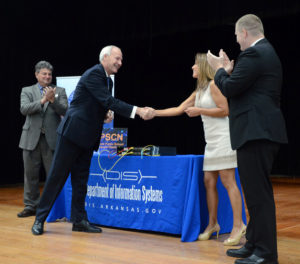
Gov. Asa Hutchinson shakes hands with Yessica Jones, Department of Information Systems director, at Glen Rose.

By Steve Brawner

It’s not often a public policy problem can be completely checked off the to-do list. Last month, one was.

That’s when 100 percent of Arkansas’ school districts reached broadband internet connections of 200 kilobits per second per student. That’s twice the national standard, at no more cost than the previous slower speeds. According to the group Education Superhighway, only five states had reached the 100 kbps standard as of 2016, though others may do so along with Arkansas this year.

Gov. Asa Hutchinson marked the occasion July 21 in Glen Rose, a small school district between Benton and Malvern. It had been one of the state’s last districts to obtain its high-speed fiber connection the previous week. Continue reading

The return of recess?

By Steve Brawner
© 2017 by Steve Brawner Communications, Inc.

Can more time in recess and less time in class help students learn better? That’s a question some schools in Arkansas will try to help answer.

Under state law, elementary students must have 40 minutes of physical education each week and 90 minutes of additional physical activity, such as recess. That’s 18 minutes per day.

Act 1062 sets up a pilot program for the 2018-19 school year that basically triples that amount in some schools. In addition to physical education, students in grades K-4 will get 60 minutes of “unstructured and undirected play” each day, while students in grades five and six will have 45 minutes. Two schools in each of the state’s 15 education service cooperatives – groups of school districts that share resources – will participate, along with two more schools not involved in cooperatives. The Arkansas Department of Education will write the rules. The results will be studied and used to enact future policy.

The law was sponsored by two legislators on opposite sides of the political spectrum – Sen. Gary Stubblefield, R-Branch, a conservative farmer, and Sen. Joyce Elliott, D-Little Rock, a former teacher and one of the Senate’s most liberal members.

The background for this is when the federal No Child Left Behind law was passed in 2001, schools were held more accountable for their students’ test scores, and as a result, they began to focus more on core academic subjects. With the stakes raised higher, recess was considered an expendable part of the day and reduced.

In recent years, many have questioned the wisdom of that philosophy, for several reasons, the obvious one being health. One in five school-aged children is now obese – triple the percentage of the 1970s, according to the federal Centers for Disease Control and Prevention. Spending more time sitting and less time playing certainly doesn’t help.

But there are also potential academic and social benefits to recess, which may help explain why students who get more breaks elsewhere, like Finland, outperform American students. According to a 2013 paper by the American Academy of Pediatrics, children benefit when concentrated learning is followed by unstructured play. Research by Anthony Pellegrini and Catherine Bohn found that recess made students more attentive and productive in class whether they were outdoors or indoors. Moreover, students learn important social skills when engaged in unsupervised play away from adults.

It’s unclear how many schools will volunteer to participate. Sixty minutes a day is a lot of time to take kids away from the classroom. Not only will it require a major reconfiguration of the school day – for a one-year program – but it also will require schools to take the risk that the reduced instruction time won’t hurt test scores.

Moreover, much has changed in the past couple of decades. Americans don’t do “unstructured and undirected” very well anymore when it comes to children. We’ve become a more risk-averse, less playful society, so what’s the response if more recess means more kids get injured or bullied or suffer some other bad outcome? What happens if we give the kids time to play and develop their social skills, and all they do is stare at their phones?

The way these things work is that the Legislature passes a law with broad goals, the agency sets the specific rules, and school districts implement them based on their local situations.

So here’s a couple of suggestions. First, the research shows that kids need a lot of short breaks to recharge their minds, not hours sitting in class and then an hour on the playground. In Finland, it’s 45 minutes of learning followed by 15 minutes off. Let’s do something like that. Second, the Department of Education should interpret “unstructured and undirected play” loosely so that teachers still can offer helpful guidance when appropriate – maybe show the kids how to play kickball, and then get out of the way.

The question isn’t going to be whether recess is beneficial for students. That one’s already been answered. The real questions are, how much recess is best, and how best can it be implemented?

Can those questions be answered with a one-year pilot program? Don’t ask me. I’ve been working on this column for hours, and I need a break. Kickball, anyone?

Blessed is the peacemaker

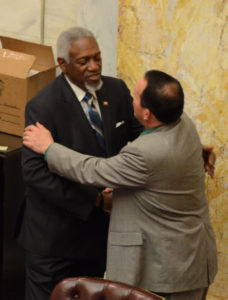
Rep. George McGill, D-Fort Smith, left, and Rep. Andy Mayberry, R-Hensley, share an embrace after McGill’s speech.

By Steve Brawner
© 2017 by Steve Brawner Communications, Inc.

Over the course of a three-month session, legislators make thousands of speeches at the Capitol. Last Friday, Rep. George McGill, D-Fort Smith, gave one of the most memorable – ever.

The issue was Senate Bill 519 by Sen. David Wallace, R-Leachville, and Rep. Grant Hodges, R-Rogers, which reserves each third Monday in January as a day to honor Dr. Martin Luther King.

This year, Arkansas was one of three states, the others being Alabama and Mississippi, that honored King and Gen. Robert E. Lee on the same day – the result of an unfortunate historical coincidence along with a lack of sensitivity. In 1947, Arkansas made a state holiday out of Lee’s birthday Jan. 19. King’s birthday was made a federal holiday in 1983, which meant there would be two state holidays at about the same time each year. Lawmakers did not want state employees to have another paid vacation day, so in 1985, Gov. Bill Clinton signed a bill combining the holidays.

It’s impossible to know every lawmaker’s intentions in 1985, but regardless, for some people it reasonably has felt like this once-Confederate state was unwilling to give Dr. King his own day. Visitors to the State Capitol on the holiday have been greeted by a sign saying offices were closed to celebrate both King, the civil rights leader, and Lee, the Southern Civil War general. For some, that combination was hurtful.

Two years ago, legislators made an effort to separate the holidays, but it failed under heavy pressure from opponents and fans of Lee and because of the Legislature’s general aversion to upsetting the status quo. For a mostly white Legislature, the combined holiday didn’t seem that big of a deal.

Gov. Asa Hutchinson, newly elected at the time, supported that bill but did nothing to pass it. This year, he announced before the session that a separate King Holiday was one of his priorities, and he testified about the bill before House and Senate committees – the first time he has done so.

The bill says Arkansas will now celebrate only King’s birthday on each third Monday in January while Robert E. Lee Day will be the second Saturday in October – a state memorial day, not a holiday, coinciding with the time of his death. Schools are required to develop teaching materials about the civil rights struggle and the Civil War corresponding to those days.

That arrangement felt to some legislators less like a separation and more like a demotion for Lee. On the House floor Friday, one said it appeared the state was ashamed of its past. Another feared the next step was to remove the star in Arkansas’ flag commemorating its membership in the Confederacy. There was some emotion in the room.

That’s when stately, gray-haired McGill sensed the mood and made his way to the well. “Good afternoon,” he said with a smile, and then repeated the greeting so the House would return it. He then spoke highly by name of his fellow legislators, including one who had vocally opposed the King bill.

Speaking off the cuff, he talked about his great-great-grandfather, also named George McGill, who had fought in the war on the Union side, and he wondered what it had been like for him when the war ended. Did they let him keep his weapon or give him rations? He talked about his own experiences at the University of Arkansas when he was denied a dormitory room because of his race. Looking back at his youth, he recalled his afro hairstyle, his use of the black power salute, and his vow never to return to the University of Arkansas – now, he said, “one of my favorite places to go.”

McGill told House members that Senate Bill 519 would be just one more piece of paper stuck in a big binder in a room full of other big binders. What mattered, he said, was legislators were giving educators space to teach about the past.

No way anyone was following that speech. The vote was 66-11, with 5 voting present and the rest not voting. Hutchinson signed the bill into law Tuesday.

McGill’s biggest accomplishment wasn’t the passage of the bill. It was going to pass anyway. His greatest achievement was bringing healing to what was becoming a racially divisive moment in a chamber that has seen many others through the decades. He reminded everyone listening that it’s possible, even necessary, to both remember and forgive.

He was a peacemaker. Someone once said such are blessed.

Note: Here is the speech. Great job, Brian Fanney.

Death, taxes and Lake View

By Steve Brawner
© 2017 by Steve Brawner Communications, Inc.

We’ve all heard the old Benjamin Franklin adage that the only certainties in life are death and taxes. For many years Arkansans have been able to add “public schools getting more money” to that list.

That’s because of a series of 1992-2007 court decisions in a case initially filed by the Lake View School District, a small, poor district in the Delta. Those decisions clarified that the state has a constitutional responsibility to ensure schools everywhere are adequate and equitable. The decisions basically required the state to fund schools first without regard to how much money was readily available or how it would affect other state priorities.

Since then, any debate about public school funding started and ended with two words: “Lake” and “View.” Nobody has wanted a repeat of that experience, where judges, justices and special masters stood over the state’s shoulder making sure it was filling in all the circles to their satisfaction.

As a result, while other states have cut education funding, Arkansas has always increased it – not by much lately, but by at least enough to stay out of court. In fact, the state’s public school districts not only have enough to fund their operations but between them have saved up $790 million in their net legal balances. A bill filed this legislative session by Rep. Mark Lowery, R-Maumelle, would require districts to keep no more than 20 percent of their revenues in those balances and use the rest for other purposes.

This year, as in years past, a legislative committee decided months ago that schools would receive an increase – this time about 1 percent in total per pupil foundation funding, the primary way schools are funded. Under that so-called adequacy report, whose recommendations the full Legislature generally accepts with little debate, in 2018 each school district will receive $6,713 per pupil, and that’s not including numerous other sources of local, state and federal funding that pushed the cost of educating each Arkansas student to about $9,400 as of 2013, according to the Census Bureau.

That’s right. If you have two kids in school, you’re getting about $19,000 worth of government benefits every year, and that’s before you drive on a road, call a fire department, get help with your parents’ health care costs through Medicare and/or Medicaid, or are protected by the military and law enforcers.

Anyway, back to Lake View, which is very slowly exerting less control, as evidenced by the fact that the 1 percent increase was less than it used to be, for a lot of reasons. One, naturally, is that the longer something fades into the past, the less it’s remembered, and there aren’t many policymakers left in Little Rock who were serving when all those Lake View decisions were coming down from the courts. Meanwhile, some state expenses have continued to rise – a good example being health care – at the same time that schools have always been guaranteed a raise. Plus, legislators always want to cut taxes, and that’s harder to do when you always must spend more money on schools.

Finally, there’s this really, really important fact: There are no Supreme Court justices left who had anything to do with those Lake View decisions. The last, Justice Paul Danielson, retired after the 2016 elections. No other justice has been on the court longer than since 2010, so no one knows how they would rule if Lake View were to be reconsidered. For what it’s worth, some of those justices have ruled in one 2012 case, Kimbrell v. McCleskey, that went a little against Lake View by saying certain school districts that collect extra money through property taxes can keep them rather than share them with other districts.

So schools have gotten a lot of money for a long time, other needs must be addressed, legislators always would love to cut taxes, and a whole new cast of policymakers remember less and less about Lake View, and are less scared of stepping past the vague line it drew in the sand. Plus, lawyers can make some pretty good money suing the state over this stuff.

So here’s a prediction and another certainty. The prediction is the state will wind up in another school funding case eventually.

The certainty is that it won’t be called “Lake View.” That district was forced to consolidate with Barton-Lexa in 2004 and no longer exists.

School work to be finished early

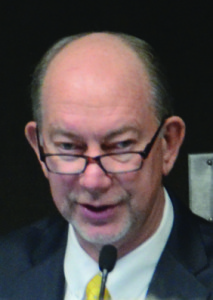
Bruce Cozart is chairman of the House Education Committee.

Bruce Cozart is chairman of the House Education Committee.

By Steve Brawner
© 2016 by Steve Brawner Communications, Inc.

The Arkansas Legislature goes into session in January, but some of the most important decisions will be completed this month, without much debate.

That’s because, by Nov. 1, the House and Senate Education Committees will complete the state’s adequacy report, the biennial (once every two years) document that governs how and how much (always more) the state spends on K-12 public education.

The adequacy report was created in the wake of the Lake View case, a lawsuit brought on by a poor, rural school district in the Delta. A series of court decisions said the state wasn’t spending enough on education and wasn’t spending it in the right places – including on students like those in Lake View. In response, Arkansas consolidated schools (Lake View ended up being one) and poured money into education at a time when other states were cutting spending.

Fear of returning to court has governed Arkansas policymakers ever since. No matter what the economic or budgetary situation has been, schools are funded first, and they always get a raise.

There was a time when the money spigot was wide open, but now it’s closed to a small stream. Basically, schools get a cost of living adjustment every year now. The chairman of the House Education Committee, Rep. Bruce Cozart, R-Hot Springs, figured out a raise of 1.15 percent this past weekend and challenged members to create their own figures.

That’s probably about what will end up happening. The committees will finish their work and present the adequacy report to Gov. Asa Hutchinson by Nov. 1. His administration will tweak it, it will be presented to the Legislature, and the Legislature will pass it without much debate. Any dissenting legislators will be cut off by two words: Lake View.

That’s roughly 41.5 percent of your general revenue budget right there – general revenues being the state spending over which legislators have the most control. The general revenue budget this past year was $5.3 billion, and of that, $2.2 billion went to the public school fund.

There will be arguments over smaller parts of the education budget, including funding for school transportation. Current funding is based on the number of students school districts have, not the number of route miles their buses travel, so some compact districts pocket extra money that they use for other purposes, while far-flung districts lose money driving all over the county. There’s been talk for years about basing funding on route miles, which seems obvious, but that would mean some districts would win and some would lose. When that happens, expect a fight to occur.

Education advocates will say a 1 percent raise isn’t enough, but they’d better be glad they’re getting it. The state does have other priorities – colleges and universities, human services, highways, prisons – that must fight for what’s left after schools, and advocates would say it hasn’t been enough.

A case can be made that the Lake View case set the stage for Arkansas being one of the few Republican-leaning states to expand Medicaid through Obamacare to create the controversial private option, which purchases private health insurance for lower-income Arkansans. The state was primed to take the money partly because it can’t cut funding for schools.

But starting next year, the private option, which has been funded almost entirely using federal dollars, will start to nibble at the state budget. The state will be responsible for 5 percent of the cost in 2017 and 10 percent by 2020. Meanwhile, the number of Arkansans receiving benefits has soared past the expected 250,000 and continues to rise.

That’s kind of scary. Schools will still get a raise, but everyone’s looking at rising health care costs. Meanwhile, highway advocates are begging for money that’s just not available. The state is trying to figure out how to slow the growth of prison costs without making crime worse. And amidst all that, the governor says he wants to cut taxes again.

How do you make the numbers work? The state’s economy must continue to grow, which it is doing to the tune of a 3.9% unemployment rate. And the state will continue to take federal dollars wherever it can, including for highways and health care.

There will be a big debate about that – taking money for health care. Legislators will have time because 41.5 percent of the budget will already be settled. Nothing starts an argument like the word “Obamacare.” Nothing shuts it down like the words “Lake View.”