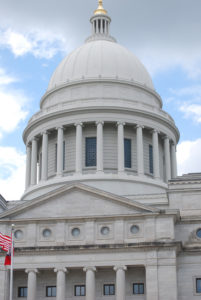
Highway tax supporters might keep this in mind

By Steve Brawner, © 2019 by Steve Brawner Communications, Inc.

Supporters of the legislatively referred constitutional amendment that’s most likely to pass in 2020 might want to think about how they’ll distance their proposal from the two that probably won’t.

The one that’s most likely to pass would indefinitely extend a half-cent sales tax for highways. Voters first passed the tax with 58 percent support in 2012 to fund the Connecting Arkansas Program, but it’s due to expire in 2023. Pre-legislative session polling by supporters found an extension had similar support. Gov. Asa Hutchinson made fixing roads a priority this session. The state’s most powerful business groups were big supporters. Lawmakers were hearing from constituents who want the potholes filled.

In response, legislators placed the extension on the 2020 ballot – one of three proposals the Constitution allows them to make.

One problem for highway supporters could be the other two. Continue reading

Did you know there’s an election coming up?

Alabama, blue wave, school boards, Hixson, Breanne, red tide, judicial electionsBy Steve Brawner, © 2019 by Steve Brawner Communications, Inc.

Elections are approaching, but they won’t be covered by the 24-hour national news stations. You won’t see 30-second ads on any Arkansas TV stations, either.

I’m talking about the annual school elections, which will be May 21. Early voting begins May 14.

When it comes to political glamor, school board elections rank somewhere around the county clerk’s race. The state’s nearly 1,500 board members don’t run under party labels and aren’t paid for their service. (Pay varies across the country. Many make nothing. In Mississippi, they get $67 per meeting or a flat $2,400 a year. In Los Angeles, they received a 174 percent raise in 2017 to $125,000.) In Arkansas, board members have no power individually and no power when not participating in a called meeting. If you complain to your board member about some issue at school, he or she is supposed to direct you to someone who gets paid to fix it.

But they do play important roles. Probably their most important is hiring and firing the superintendent. They work with school administrators to pass a budget and set policy (while being constrained by many state and federal dictates). School boards decide when it’s time to ask the community for a millage increase to pay for a new building. There is evidence that good boards are associated with improved student performance. Continue reading

Bismarck school success based on teamwork, expectations

Art teacher Whitney Thornton teaches students to draw a monster.

By Steve Brawner, © 2019 by Steve Brawner Communications, Inc.

If I were to tell you that one school district was singled out this year by the Arkansas School Recognition Program, you probably wouldn’t guess it would be Bismarck.

The rural district outside of Hot Springs doesn’t have an international corporate behemoth in its backyard. Sixty-three percent of its students qualified for free and reduced lunch prices last school year, compared to a state average of 60 percent.

But when almost $7 million was awarded to 175 schools based on test scores and improvement, all three of Bismarck’s schools specifically were honored by Gov. Asa Hutchinson at the State Capitol Oct. 29. School personnel and students attended the event.

Through the program, the 51 schools in the top 5 percent in performance and growth received $99.18 per student. The top 6-10 percent received $49.58 per student.

Bismarck Elementary received almost $36,500 for ranking in the top 5 percent in student performance, and that same amount for ranking in the top 5 percent in student growth. Ranking as one of the state’s best schools in both performance and improvement is an impressive achievement, especially considering the school already was in the top 6-10 percent for performance the previous year. Bismarck Middle School and Bismarck High School each received more than $15,000 for ranking in the top 6-10 percent.

It was the second straight year all three schools received awards through the program, which began in 2013. No wonder schooldigger.com ranks Bismarck the state’s fifth best district.

So what’s Bismarck doing right? Continue reading

One solution: Make them legal, and make them pay for it

By Steve Brawner, © 2019 by Steve Brawner Communications, Inc.

The head of the Arkansas State Chamber of Commerce hears often from employers who can’t find workers, so here’s his solution: Let those workers come from south of the border, make them pay for a work permit, and use the money to enhance border security.

That plan produces many winners, Randy Zook told me.

First, there are 7.1 million open jobs, but not enough Americans who are available to work, want to work, and/or have the necessary skills. Immigrants can help farmers, construction firms, and employers like the Peco Foods chicken plant in Pocahontas meet their labor requirements. Business and industry would do much of the vetting to ensure immigrants are job seekers, not drug dealers.

Meanwhile, immigrants could pay for a work permit – say $2,500 for two years. That’s a lot, but it beats paying a coyote to make the dangerous journey across the border. Then they’d be legal, though not citizens, and wouldn’t have to worry about being deported. Continue reading

Sanctuary bill: Prevention, or fixing the unbroken?

LegislatureBy Steve Brawner, © 2019 by Steve Brawner Communications, Inc.

In politics, is an ounce of prevention worth a pound of cure? Or if it isn’t broken, don’t fix it?

With one bill dealing with illegal immigration, Arkansas lawmakers went with the first adage, despite Gov. Asa Hutchinson’s concerns.

On the day the Legislature recessed April 10, the House voted to ban Arkansas municipalities from adopting “sanctuary city” policies.

Act 1076 by Sen. Gary Stubblefield, R-Branch, is a response to some cities like Los Angeles and Chicago that have declared themselves sanctuary cities for illegal immigrants.

“Sanctuary cities” is a political term, not a precise legal one, but this bill does describe the policies it seeks to counteract. Among its provisions are these: Cities could not limit municipal employees and officials from cooperating with federal immigration agencies such as Immigration and Customs Enforcement. They also could not grant to illegal immigrants the right to a lawful presence.

No Arkansas cities have enacted sanctuary policies, so lawmakers are using an “ounce of prevention” to fix something that’s not broken. Continue reading