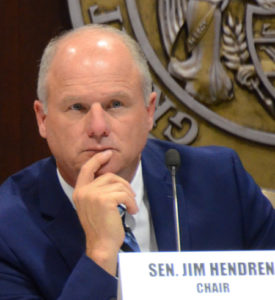
Hendren builds an independent home

Jim Hendren, tobacco taxBy Steve Brawner
© 2021 by Steve Brawner Communications, Inc.

The Arkansas Legislature’s former Republican Senate leader is no longer a Republican.

On Feb. 18, state Sen. Jim Hendren of Gravette announced he was becoming an independent.

Hendren served until recently as Senate president pro tempore. He is also Gov. Asa Hutchinson’s nephew and close ally, which increased his influence.

But Hendren’s standing in the Republican Party has been diminished by his increasing bipartisanship, some of the stances he’s taken, and his obvious discomfort with the party’s direction.

Once a hard-right conservative, Hendren has evolved into a pragmatic problem-solver – like his Uncle Asa. He had a hard time making his peace with former President Trump’s style and rhetoric going back to 2016. He voted for him in November, but Trump’s and the party’s actions since then and the attack on the Capitol Jan. 6 were the last straw. Continue reading

1,200 educators get their shots

By Steve Brawner
© 2021 by Steve Brawner Communications, Inc.

Bryant High School wrestling coach Shane Clancy did not wrestle with his decision to be vaccinated for COVID-19. After his big right arm was stuck with a small needle at the River Center gym in Benton Feb. 13, he explained, “I’m ready to ditch the mask and just be normal.”

Clancy was one of 1,200 teachers and staff members from five area school districts who received their second and final shots at a mass clinic organized by six local pharmacies.

Among the others was John Goff, a junior high math teacher who’s at increased risk as a diabetic. Goff said this has been the most stressful year of his teaching career. In addition to his health concerns, teaching quarantined students online has been challenging. It’s particularly difficult for a math teacher who needs to see a face light up when a student understands a concept, and who needs to see the sheet of paper as the student works through a problem. Continue reading

When will we pay back all this newly borrowed money?

By Steve Brawner
© 2021 by Steve Brawner Communications, Inc.

As Congress and President Biden debate yet again how much to spend in response to the COVID-19 pandemic, one detail is missing: How are we going to pay all this borrowed money back?

Since the pandemic began, the federal government has provided $3.4 trillion in COVID-19 relief, which is equal to $10,300 for every American, according to the New York Times.

Biden has proposed another $1.9 trillion that, among other provisions, would send $1,400 to adults making $75,000 or less. This would follow the $600 checks many of us received in December. The package also includes unemployment benefits, rental assistance, money for state and local governments, and $170 billion for schools, colleges and universities.

Whatever the final amount is, Arkansas will get a piece of the pie. Its previous pieces, in fact, are why the state is running a budget surplus this year. Continue reading

A year of Hope

By Steve Brawner, © 2021 by Steve Brawner Communications, Inc.

It’s been a challenging 12 months for all of us. For the Brawner family, it’s also been full of Hope.

Hope Renee Brawner was born one year ago at 1:10 p.m. on 1-10-20. “Renee” is French for “reborn.”

Her “old man” really is an old man – middle-aged, actually. I was 50 when she was born. Her mom was 44, and her sisters were 18 and 15. Yes, we’ve been asked by strangers if she’s our grandchild. And no, Hope was not planned. She was an unexpected and precious gift from God.

Hope’s childhood will be different from her sisters’. Her parents are older, hopefully wiser and definitely less spry. Her remaining grandparents are older, too. Her maternal grandmother has passed away. Her sisters are her second and third mothers.

Her first year occurred when the world was at war with a virus. For the first time in many decades, infectious disease has been an ever-present threat. The pandemic has lasted long enough that it’s changed life in both small and profound ways – just as life was changing when our oldest daughter was born one week after the Sept. 11 attacks.

What will those changes look like? Will Hope grow up in a world where people shake hands, or will we be bumping fists? More importantly, how long will we look upon each other suspiciously as potential disease-carriers and as members of opposing tribes? Or when this is over, will we get back to business, as we did the last time a worldwide war was won?

Our first two children were passed around to family and friends as babies. Hope doesn’t get out much, and we keep her with us when she does. She’s very pleasant and happy, but she can be a little shy around other people, at least at first. Will she be part of a generation of shy COVID babies, and will it matter long term? Or will they be well-adjusted and more family-centered than previous generations?

Life is changing in other ways. If Hope were a person of color, she would be among the first set of girl babies who could see on screen a female vice president of the United States with a similar background and skin tone. That wouldn’t have happened when I was born 51 years ago.

Regardless of when a person comes into the world, life is full of unexpected gifts and hardships. On Dec. 6, 1941, people were meeting their future spouses, having babies, and finding their callings. And then the next day Pearl Harbor happened.

So what do we humans do with the fact that life is but a vapor? We’d better take joy in the moment. Embrace hope.

Hope, her mother and her sisters are inseparable, but I can also report that she’s a bit of a daddy’s girl. And because I’m a journalist, you know I’m unbiased and objective.

I was washing dishes the night of Jan. 1 when she crawled up behind me, pulled on my pants leg, and looked at me sweetly and expectantly. I acknowledged her and returned to the dishes. She pulled on my pants leg again. Her sister offered to take her. Hope wanted Daddy.

The dishes could wait. I scooped her up and carried her to the rocking chair next to the fireplace. She was a little fussy, but she calmed down with help from her sister, her favorite stuffed bear, a pillow and a pacifier. I sang to her, terribly off-key, but she didn’t seem to mind. In a few minutes, she’d fallen asleep in my arms.

That’s always been Mommy’s job, but that night it was mine. A new year had begun, and I’d been given the gift of embracing Hope.

Related: The story of Hope’s birth.

Should the law make hospitals allow visitors during COVID?

By Steve Brawner, © 2021 by Steve Brawner Communications, Inc.

Should hospitals allow patient visitors during the COVID-19 pandemic? Should the government require them to do so?

For some Arkansas state legislators, the answer to both is “yes.”

House Bill 1061 by Rep. Julie Mayberry, R-Hensley, would create the No Patient Left Alone Act requiring medical providers to let at least one person be present with patients each day at reasonable times.

Mayberry introduced the bill because many hospitals are severely limiting patient visitors during the pandemic. It has 11 co-sponsors in the House and six in the Senate.

Here’s the thing about being a journalist sometimes: You talk to a smart, persuasive person offering one side of the argument and decide they make sense. Then you talk to a smart, persuasive person on the other side. And then you rub your forehead and mutter, “I’m so confused.” Often, both sides have good arguments. Continue reading