
Category Archives: U.S. Congress

Uncivil discourse

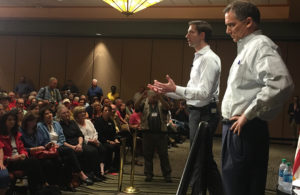
Sen. Tom Cotton, center, and Rep. French Hill at the town hall.

By Steve Brawner
© 2017 by Steve Brawner Communications, Inc.

There’s regular intelligence, and there’s emotional intelligence, which is the ability to recognize and control your own emotions and to influence the emotions of others. If you’re a member of Congress, you need both, but if you’re a member of Congress participating in a town hall, and you can only be blessed with one, it’d better be emotional intelligence.

I write that paragraph after attending Monday’s 2 p.m. raucous town hall hosted by Sen. Tom Cotton and Rep. French Hill, where it didn’t matter what kind of intellectual arguments they made because they weren’t going to change many minds among the 750 attendees – some of whom totally supported them and many of whom were totally opposed. All that mattered was that they kept their cool amongst the booing, jeering, shouted interruptions and personal attacks, and they did.

This is one odd way we do political discourse these days. A Republican congressman – just as Democrats did in 2009 – hosts a town hall for some reason. Advocates alert the like-minded to converge and attack. The member of Congress stands on a stage before a mostly hostile room where audience members take their turns asking questions – most pointed, some insulting, and some better than the ones asked by journalists. Many in the audience cheer. The member of Congress answers – sometimes well, sometimes lamely. Many boo regardless.

That was the case Monday. When Hill said Congress must repeal Obamacare, the crowd reacted with a mixture of loud boos and cheers. Asked if Congress would subpoena President Trump’s tax returns, Cotton said Trump is still being audited, that he has completed a statement of financial interest, and that everyone knows where he does business because he attaches his name to his buildings. Few were convinced. At one point, some audience members chanted, “Lock him up” regarding Trump, an echo of the “Lock her up” chant in the 2016 campaign that Republican politicians unfortunately did little to tame.

The frustration expressed by many in the audience is explainable. All of us have a vision for how this country should look, but, in a democracy of 300 million people, none of us will get our way. Average Americans of all persuasions feel silenced in comparison to big money donors. The system is beset by partisan bickering and is unable to solve problems, even when compromise should be possible. Elected officials inflame the uncivil climate with their own rhetoric. If a politician uses the word “liberal” as an insult, then it should not be surprising that his liberal constituents feel insulted.

Town halls can be useful. They let members of a political minority express themselves in solidarity with kindred spirits. They remind elected officials, who tend to focus on their base of supporters, that some of their constituents feel intensely differently. At their best, they may even expose a member of Congress to new information. I don’t know if it has anything to do with the town halls, but Cotton’s rhetoric on health care has become more balanced after years of his merely criticizing Obamacare. Certainly, I would rather live in a country where average citizens loudly express their disapproval with the authorities than one where such behavior is not tolerated.

But we’ve all learned certain rules for dealing with other people, and those rules shouldn’t change in a town hall setting. Interrupting, shouting insults, putting people on the defensive, speaking without listening – these are not the most effective communication tools. Elected officials, especially polarizing ones like Cotton, know some of their constituents disagree with them, but for every person jeering at them in a town hall, there are hundreds at home or work whose votes cancel theirs out. Some make the calculation that it’s worth being yelled at for an hour or two in order to look like they’re representing everyone. Playing the martyr may even form the basis for a fundraising letter somewhere down the road.

If I were to design these meetings, I’d keep the disagreement and some of the passion, but I’d add a lot more civility to the discourse. I’d have less yelling and jeering, and more shows of hand – importantly, with the expectation that they might actually affect a congressman’s thinking. And I’d have more town halls, period, at accessible times of day.

But then, while all of us have a vision for how this country should look, none of us will get our way. I’ll try to keep my cool about it.

British States of America

By Steve Brawner
© 2017 by Steve Brawner Communications, Inc.

In 1776, the United States declared its independence from the British monarchy. In 2017, the United States government looks like the British Parliament.

In Britain’s parliamentary system, there aren’t really separate legislative and executive branches, and partisanship is designed into the system. Voters elect members of Parliament (MPs) based largely on the MP’s party affiliation. The party winning a majority (or leading a majority coalition, because there are more than two) forms a government. The party’s leading MP becomes prime minister – currently Theresa May, who represents the town of Maidenhead. Other leading MPs administer parts of the government, much like our Cabinet. The other ruling party members, known as “backbenchers,” go along with their leaders on important matters unless they feel compelled to engage in a “backbench rebellion” – enough of which can bring down the government. The minority party, meanwhile, functions as a loyal opposition with limited power as it awaits the next election.

That sounds a lot like how we do things here, now. Last Friday, Justice Neil Gorsuch became the Supreme Court’s latest member based on the wishes of the ruling party, the Republicans. They pushed his nomination through the Senate over the objections of the minority party, the Democrats, who never had any intention but to oppose him. Democrats tried to use one of the minority party’s last remaining tools, the filibuster, where debate continues indefinitely unless ended with a 60-vote majority. In response, Republicans changed the rules to end the filibuster for Supreme Court nominees, a move Democrats had done for lower courts and Cabinet officials in 2013. The changes are permanent.

A couple of weeks earlier in the House of Representatives, the majority party leaders, Speaker Paul Ryan and his lieutenants along with President Donald Trump, attempted to replace the Affordable Care Act (Obamacare) with their own concoction, the American Health Care Act. The AHCA was created with little involvement from many rank-and-file Republicans and with absolutely no input from the minority Democrats. It failed as a result of a backbench rebellion when various Republicans said no.

In the past, the next step in the American political system might have been for Republican leaders to work with Democrats to write a bill that could win majority support from the centers of both parties while the wings on the right and left were left out. But we’re a British system now. Such bipartisan cooperation happens less often these days because the centers of the two parties are now far apart and pitted against each other. If Republicans go back to the drawing board, it will be to create something to appease their own backbenchers.

This is happening because of evolving political norms and larger societal forces. The United States is no longer so united. The country whose motto once was the Latin phrase “E pluribus unum” – “out of many, one” – increasingly might be better described by “E unum pluribus.” As a result, American voters, once cussedly independent, increasingly are becoming straight-ticket voters who pull the lever based on the “R” or the “D” by the candidates’ names.

Acting like a parliamentary system would be acceptable if it matched the designs of the Constitution. Unfortunately, it doesn’t. The Constitution doesn’t even mention parties, and George Washington warned against them in his farewell address. The struggle for power is supposed to be between the three branches of government, not two political parties. Members of Congress are elected not to follow their party leadership but to serve their own constituents and states.

The United States government can at least function as a parliamentary system when one party controls both the presidency and Congress, as Republicans do now. However, American voters commonly elect one party to control one branch and the other party to control all or part of the other, which can’t happen in Britain. When that happens, as it did from 2011-16, the result is gridlock and, potentially, abuse of power by one of the branches, probably the executive.

In short, American democracy’s informal habits reflect a British system without that system’s formal structure. Either the structure needs to change, or the habits. I’m not sure which would be easier, or even if either would be possible.

Reform instead of repeal and replace

By Steve Brawner
© 2017 by Steve Brawner Communications, Inc.

After the American Health Care Act failed in the House Friday, Speaker of the House Paul Ryan said this: “I don’t know what else to say other than Obamacare is the law of the land. It’s going to remain the law of the land until it’s replaced. We did not have quite the votes to replace this law, and so, yeah, we’re going to be living with Obamacare for the foreseeable future.”

For seven years, Ryan and other Republicans, including Arkansas’ congressional delegation, have said Obamacare is ruining the health care system – and by extension, the rest of the country. But once they gained control of everything in Washington, they obviously did not have a replacement ready, spent a total of 18 days debating a very bad one, held one vote and then announced their focus will now be on tax reform, though now they’re talking about revisiting health care again.

Because Republicans believe Obamacare is bad for the country but repealing and replacing it is very hard, why not try plan B – reform it? Members of Congress could do what once was done often with major legislation – reach across the aisle, compromise, and produce something that a majority coalition from both parties can support, even if some on both sides are unhappy. That would give shared ownership in the project and therefore less desire by one party to see it fail. Then, later, they could work to change it again.

Naive, I know. In today’s political environment, everything is about total victory and defeating the enemy, once known as “your fellow Americans.” Republicans know if they compromise with Democrats on health care, they’ll be scorned by conservative media sources and attacked by big money. Democrats are hoping the whole effort fails, knowing if it does, they get to be the majority again.

But not so long ago, Congress acted quickly and spent billions on a bipartisan basis to save the banking industry. We’ve been told by Republicans for years that Obamacare is a disaster already happening and a crisis in waiting. Maybe sooner rather than the “foreseeable future” is the best time to act.

“Obamacare” has always been a political term meant to fire up the political base, but solving a problem requires first defining it accurately, and Obamacare is not the root of the problem. Yes, the Affordable Care Act made significant changes to the health care system, but the system’s fundamental processes have remained the same. Profit-driven medical providers make more money when Americans are sick than when they are well, while insurance companies and government programs give Americans limited financial incentives to control the costs of their own health care. Meanwhile, the modern American lifestyle is simply too unhealthy to be cheap. We really can’t decide if we want a free market system or not. As a result of all this, health care was really expensive and didn’t insure everybody before Obamacare, and it’s really expensive and doesn’t insure everybody now.

Simply repealing and replacing one law isn’t enough to fix all that. The whole system – really, the culture – needs a reorientation, which the Republican leadership is clearly not ready to do if they can’t pass a single bill through one house of Congress. So if the status quo is unacceptable and radical change proves to be impossible, then the only alternative is incremental change the way the Constitution meant it to occur – through debate and compromise.

I’m not sure if congressional leaders even consider that possibility anymore. Ryan opened his press conference by saying, “Moving from an opposition party to a governing party comes with growing pains,” which would cause George Washington to roll over in his grave. The Constitution does not say anything about opposition parties or governing parties, or even mention parties at all. It’s as if we’ve become a British parliamentary system led by a prime minister and a king, rather than an American constitutional republic.

The system can’t work that way. Health care can’t be “fixed” by one piece of legislation, but it can be made better many small steps at a time. Let’s go back to the drawing board, give everybody a piece of chalk, and keep the eraser handy.

We won the lottery, but who bought the ticket?

By Steve Brawner
© 2017 by Steve Brawner Communications, Inc.

Should welfare recipients be required to pay back the state if they win the lottery? Maybe the better question is, should all of us?

Those questions came to mind after hearing a presentation by Rep. John Payton, R-Wilburn, of his House Bill 1825 before the House Rules Committee at the State Capitol Wednesday.

The bill would require lottery winners to reimburse the state for their last 10 years of Department of Human Services benefits, such as the Supplemental Nutrition Assistance Program, formerly the food stamp program.

Payton said the lottery is a bad deal for poor people, who gamble their sparse dollars with the odds stacked mightily against them. This arrangement would make them think twice about doing that and remind them that their benefits come from the taxpayers.

In addition to Payton, the bill has 26 co-sponsors in the House, but it’s likely not going far. One committee member requested a fiscal impact statement, which will delay the bill’s progress. Legislators are hoping to go home at the end of March, which is fast approaching.

Still, if part of the idea is to make welfare recipients consider the source of their government benefits, then let’s consider the bigger picture: As a nation, we are all receiving government freebies.

In 2017, the Congressional Budget Office projects the United States government will spend $4 trillion but collect only $3.4 trillion, producing a deficit of $559 billion. That means the government is spending about $1,700 more than it collects per American, or almost $7,000 for a family of four.

Think you don’t benefit from that? Of that $4 trillion, almost a fourth went to Social Security in 2016, which benefits all of us – recipients directly, future recipients because it offers a guaranteed retirement plan, and families because they expend fewer resources taking care of their elderly relatives. (Yes, there’s a trust fund – but not really. In effect, the tax dollars go into one pot.) Another $588 billion goes to Medicare, which offers the same benefits. About that same amount pays for the United States to maintain by far the largest military in the world, which we’re all generally glad we have even if some of us would be OK with it being a little smaller.

Need more examples? The interstates on which we drive are no longer funded entirely by the gas taxes we pay at the pump. They are now funded partly out of the indebted general fund. The public schools we attend at a cost of $9,400 per Arkansas student annually also are funded partly by federal dollars and therefore by federal debt. And contrary to popular belief, only 1 percent of the budget goes to foreign aid, which often directly benefits Americans (for example, by buying food produced in America).

Finally, and this is really important, deficit spending does more than just allow these popular programs to continue. It infuses the economy with extra cash borrowed from future generations without their permission – stolen, in other words. We all live better because the government is writing $559 billion in hot checks this year, and putting it into the economy. Modern American life is being propped up by our grandchildren’s labor.

The frustration that many Americans feel toward welfare recipients is based on their belief that they are receiving unearned benefits that trap them in a cycle of poverty. And yet as a nation we are all receiving unearned benefits that trap us in a cycle of debt. These habits enable us to buy prosperity and security we have not fully earned. We’re all welfare queens, which is why the national debt – the accumulation of all these annual deficits – has reached $19.9 trillion, or more than $61,000 for every American. Most of that has accumulated in the last 16 years, meaning we were the ones who benefitted most.

There will come a point when the nation either chooses a different path, or is forced to do so. At some point in the future, the bill will come due. It always does.

If you and I are not around, then congratulations to us. We lived in a rich country during a rich era, and we received a lot of government benefits we never had to pay for.

In other words, we already won the lottery.

How can an unhealthy nation fix health care?

By Steve Brawner
© 2017 by Steve Brawner Communications, Inc.

You may have noticed that a while back, a Democratic president and a Democratic-led Congress tried to fix health care, and while more people do have health insurance, health care costs are still rising. You also may have noticed that a Republican president and a Republican-led Congress now promise to fix the fix. It won’t work either.

The truth is that no health care reform can create an affordable system in an unhealthy nation.

Modern American life, in fact, is profoundly unhealthy. Americans eat too much and eat the wrong things: too much sugar, fast “food” and processed conglomerations with unpronounceable ingredients; too few fruits, vegetables and healthy protein sources. We stay up too late bombarding our brains with flashing electronic lights rather than getting the sleep we need. We drive everywhere, take elevators up one flight of stairs, and spend most of our days sitting, which research has shown is very bad for us. We are addicted to all kinds of drugs – caffeine, opiates, alcohol. Then we try to fix all of this, quickly, with short bursts of exercise that often injure us, and with diets we cannot maintain, and with pills that have harmful side effects.

But it’s more than just about what we put into and take out of our bodies. We are disconnected from nature and from the natural rhythms of life. We are replacing healthy personal interactions with shallow distant relationships and unproductive disagreements on social media. We are fueled by a sense of outrage triggered by 24-hour media sources that might as well be plugged into our brains. We seek “more” rather than “enough,” filling our lives with stress and worry, flitting like gnats from responsibility to responsibility, and climbing ladders that are leaning against the wrong buildings.

And then after all of that, we think our members of Congress and a president are going to create an affordable, workable health care system, just because they happen to be members of a certain party?

The costs of our lifestyle were illustrated in a recent report by the Arkansas Center for Health Improvement. As reported by the Arkansas Democrat-Gazette, state and school employees and spouses were given the opportunity to save $75 on their insurance premiums if they completed a survey. More than 69,000 did.

It found that health insurance plans spent $4,302 in 2015 on employees and their spouses who were obese – 43 percent of the respondents – compared to $3,270 on employees who were not. The costs of obesity, in fact, were significantly higher than for those who smoked tobacco, who averaged $3,703. The plans spent an average of $6,043 for employees who exercised fewer than 20 minutes per week, compared to $3,776 for employees who said they exercised moderately at least 20 minutes just once a week. Those who exercised moderately three times a week or vigorously once a week cost their health plans $3,345.

No study tells the whole story, of course. Some people don’t exercise because they already have health problems, perhaps through no fault of their own.

Still, these are large differences in a sample size of more than 69,000 people. The difference in costs between those who exercise very little and those who exercise not that much was almost $2,700 a year. That one habit almost cut health care costs in half.

The United States has by far the most expensive health care system among the industrialized nations. According to the World Bank, the country spent $9,403 in 2014 per person on health care. Health care costs accounted for more than 17 percent of the country’s gross domestic product, compared to an average of 12.3 percent among all high-income nations – a number that we skew upwards.

As the study of 69,000 Arkansans makes clear, healthier lifestyle choices would make us a lot healthier as individuals and significantly reduce the nation’s health care costs, which is the key to increasing access to everyone. Think of what could be done with that extra money now spent on taxes, insurance, and the costs of preventable health problems.

You can’t overcome the actions of 300 million people with a legislative act. Regardless of what elected officials do, if we’re going to reform health care, we’re going to have to reform ourselves.