
Category Archives: Politics

What if the Republicans can’t pick a winner?

By Steve Brawner
© 2015 by Steve Brawner Communications, Inc.

In order to win the Republican nomination for president, one candidate must amass 1,144 delegates. What if no one does that?

That’s a possibility – not a probability, but a possibility – with 17 candidates splitting the vote. If that were to happen, the nominee would be chosen at the Republican National Convention in July. Instead of a boring speech-a-thon in Cleveland, such a “brokered convention” would be marked by candidates courting delegates and making deals.

Pundits bring up this possibility every election cycle, and every election cycle it doesn’t happen. The 2016 elections, however, could be different because of the number of viable candidates, their geographic distribution, and the resources available to them. The 17 candidates hail from 14 states, where many have strong political organizations. Meanwhile, because of the Supreme Court’s Citizens United decision removing many donor limits, candidates can stay in the race longer than in the past because they need only a few big contributors to pay the bills.

So here’s a possible scenario. Donald Trump or Dr. Ben Carson wins Iowa Feb. 1. Then Trump or former Florida Gov. Jeb Bush or Ohio Gov. John Kasich wins New Hampshire Feb. 9. Then on Feb. 20 comes South Carolina, home state of Sen. Lindsey Graham, who’s currently polling at only 5 percent there – far behind Trump, who has a big lead over everyone.

Then comes Nevada Feb. 23 and then the big one, March 1, when delegates are selected in about a dozen states, including Arkansas as part of a bloc of Southern states known as the “SEC primary.” Sen. Ted Cruz could be the big winner that day if he wins his home state of Texas and does well elsewhere in the South, while Gov. Mike Huckabee should win Arkansas. Four days later, Sen. Rand Paul could win his home state of Kentucky while struggling Gov. Bobby Jindal will try to turn things around and win his home state of Louisiana.

By that point, there’s usually a mass exodus from the race, leaving a clear front-runner with some diehard challengers. But candidates who have won a state will be able to tell their supporters (and themselves) that they can still win, so many may still be running.

Moreover, the campaign calendar and the party’s rules could give some candidates a reason to continue. Before March 15, most of the states will have awarded their delegates on a proportional basis. In other words, a candidate who wins 50 percent of the vote wins half the state’s delegates. Starting March 15, states can award their delegates on a winner-take-all basis, which is a big advantage for three candidates from big states whose elections occur that day: Ohio’s Kasich, and Florida’s Bush and Sen. Marco Rubio. If Bush loses Florida, he’s out.

By the end of that day, more than half the states will have had their primaries and caucuses. It’s conceivable that so many candidates will have won delegates that no one will have a big lead. From that point, it could be a long three months before June 7, when primaries are held in California, home state of former Hewlett-Packard CEO Carly Fiorina, and New Jersey, home of Gov. Chris Christie.

If 2016 is like previous elections, the race will be over before then. Someone will be on the way to a coronation, and the challengers will have dutifully given their endorsements.

Could that be Trump? Sure. Currently, he maintains a large lead that seems to get bigger whenever he says something controversial. Big poll numbers nationwide don’t necessarily translate to winning one state at a time – but he’s winning now.

I’ve always expected that Republican leaders eventually would pressure lesser candidates to leave the race so the party could coalesce behind an “anybody but Trump” alternative. But a recent poll by SurveyUSA found him beating not only Hillary Clinton but also other Democrats. At some point, Republican voters must seriously ask themselves if he’s really their best choice. But for now, he’s looking more and more legitimate, so instead of trying to stop him, the party may have to ride this wave wherever it goes.

Which could be all the way to a brokered convention in Cleveland. If that’s the case, there would be a lot of back room politics and dealmaking. And which of the candidates is the best at making deals? Trump, supposedly.
Flustrated America

By Steve Brawner
© 2015 by Steve Brawner Communications, Inc.

You hear people say the word “flustrated” sometimes. Is that a word? It should be.

English needs a word that blends “flustered” and “frustrated.” “Flustered” means “confused,” while “frustrated” means you’re angry about something you can’t accomplish or control.

So what if you’re both angry and confused about it? Then you’re flustrated.

Times of great, rapid change can leave a lot of us feeling that way. In recent years, the economy has shifted from a manufacturing economy, to a service economy, to an information economy where many jobs are best performed overseas or by automation. Workers, no longer able to grow their own food or fix their own cars, have been forced to adjust in order to be a small cog in a giant machine. That’s flustrating.

The character of American demographics is changing as well. Since 1950, the population of the United States has doubled, according to the Census Bureau. Eight percent of us then were 65 years and older, compared to today’s 14.1 percent, a number that is rapidly growing. Back then, immigrants were twice as likely to have come from Europe as from this side of the Atlantic, and half of those from this hemisphere came from Canada. Today, the United States has the second highest Spanish-speaking population in the world, after Mexico. That’s not necessarily a bad change, but it is a big one.

Values are changing, too. A woman in 1950 was 27 times more likely to be married than to be divorced. Today, more than half of all women under age 30 who are giving birth aren’t married. Earlier this year, the Supreme Court ruled that couples of the same sex have the right to marry, only a few years removed from some 30 states passing laws making gay marriage illegal. On these important issues, Americans simply don’t see eye to eye, and that can be flustrating for all of us.

While the definition of “marriage” is changing, so is the definition of “community,” which once referred to geographic proximity. Few of us had access to the internet 20 years ago and none of us owned an iPhone in 2006. Today, “friend” is a verb and it’s something you do on Facebook. We can connect with people all over the world but no longer know our neighbors.

These rapid changes can leave us flustered and frustrated. We want some of those old definitions back – the ones we understood – but the consensus has broken down. The American conversation has become one big argument that hardly anybody ever wins. Try as we might, we can’t make the world in our image.

Amidst all this, we don’t even know who to be mad at, or to fear. During the Cold War, Americans could unite against a single enemy that was easy to find and was as scared of us as we were of it, and for many of the same reasons. Today, the enemy can be ISIS in the Middle East or a hacker in China.

But we’ve got to blame somebody we recognize, right? So it’s all the president’s fault, or the Democrats’, or the Republicans’, or the media’s, or the rich’s, or the poor’s. We create conspiracy theories to explain which individuals are really in charge because the reality is harder to accept – that no one is, at least no human being, and that if something really goes wrong, none of us knows how to fix it.

To some degree, this flustration is reflected in the Republican presidential campaign. Donald Trump is a lot of things, but flustrated he is not, though he certainly is flustrating Jeb Bush and some of the other conventional candidates. For many voters, Trump offers an alternative to a system that has both angered and confused them. It’s no coincidence that he has been joined at the top of the latest Iowa poll by Dr. Ben Carson, another nonpolitician, each with 23%, while former Hewlett-Packard CEO Carly Fiorina was third with 10%. In fact, those three candidates who haven’t been part of the political system together are polling higher than the 14 candidates who have been.

How to deal with such a time as this? One option is simple humility. What if I admitted I can’t understand the world, much less decide how it all should work? I might focus on what I can understand and control. I might grant a little mercy to those who see things differently.

I’d definitely be less flustrated, if that’s a word.

Welcome to your country

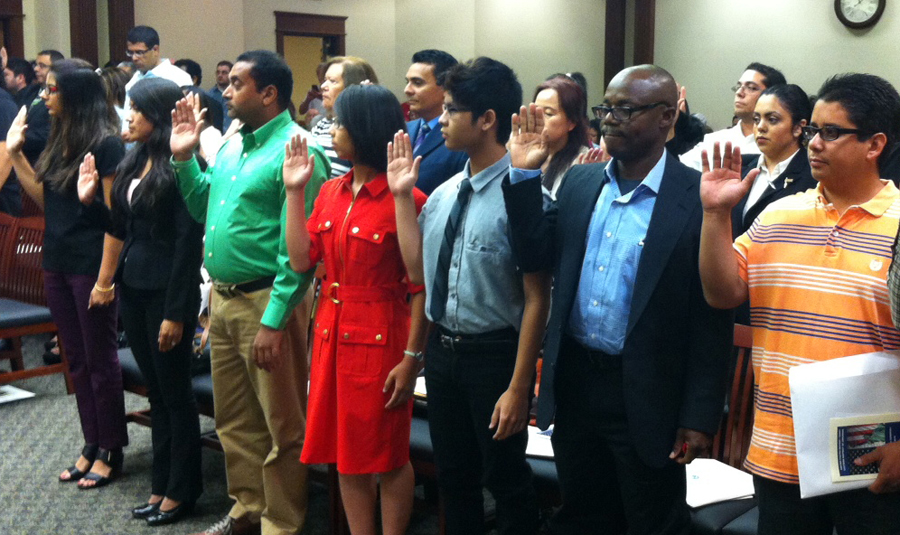
New Americans take the Oath of Allegiance in Little Rock Friday. Aristides Urdaneta is in the blue jacket with blue tie behind the woman in the red dress. Wife Jeannette is to his left.

New Americans take the Oath of Allegiance in Little Rock Friday. Aristides Urdaneta is in the blue jacket with blue tie behind the woman in the red dress. Wife Jeannette is to his left.

By Steve Brawner
© 2015 by Steve Brawner Communications, Inc.

Fifty people from 22 countries raised their right hands Friday in U.S. District Judge Beth Deere’s courtroom. Journeys that had taken decades were ending in an 11 a.m. ceremony. The participants had been examined by the Immigration and Naturalization Service, met English language requirements, and passed a citizenship test that many native-born Americans would fail. After taking the Oath of Allegiance, they were no longer from 22 countries. They were from one.

Afterwards, each came forward to receive a certificate and a small American flag, and to introduce themselves and their countries of origin. Their foreign accents ranged from thick to nonexistent. Eleven were from Mexico, including one who finished his introduction with “Woo, pig sooie.” Another said, “I’m from Egypt. No, I’m from USA. USA! USA!” Afterwards, U.S. Rep. French Hill said in a brief speech, “My fellow Americans … welcome to your country.”

Among the 50 were Aristides and Jeannette Urdaneta, immigrants from Venezuela. They came to the United States in 2003 on a work visa with their son, Kevin, now a teenager who also became an American citizen that day by virtue of his parents’ new citizenship. He’s an Eagle Scout and the state president of Health Occupation Students of America, and he wants to be a doctor someday. While in the United States, the Urdanetas had a daughter, Albanie, who will be 10 next month and is an American by birth. She’s about to join a dance company, she said.

The Urdanetas are the second and third generations in their family to escape oppression. Jeannette’s father had immigrated to Venezuela from Albania years earlier to escape its communist dictatorship. (That’s where the name “Albanie” comes from.) As socialist dictator Hugo Chavez grabbed more and more power in Venezuela, her father would predict with eerie accuracy the government’s next move based on his own experiences. “Things were getting worse by the month, by the day,” Aristides said.

In search of a better life, Aristides began looking for jobs where he could put his computer skills to work in America, Canada, Australia or Spain. The best opportunity came with CAT Squared, a Conway-based software company serving the food industry and founded by immigrants from South Africa. They spent six years under a work visa and then applied for permanent residency. Eventually, Jeannette became a Spanish teacher at Maumelle Charter High School.

By taking the Oath of Allegiance, the new American citizens declared that they “absolutely and entirely renounce and abjure all allegiance and fidelity” to their home countries.

That’s a powerful statement – to say that you’re no longer associated with the country of your birth. I asked them how difficult it was to take that step. Their Venezuelan heritage will always be a part of who they are, they said, but they’re not looking back. “We made a decision that this is our country, and we have to stand for the United States now,” Aristides said.

Yes, I asked them about illegal immigration – specifically, about their level of sympathy for those who didn’t do it the right way, like they did. They did not have an easy answer. They said it is unacceptable for people to do things illegally, but the situation is complex, and individual situations need to be considered.

From the front of the room, the 50 people taking the oath of office seemed to be a stoic group. Not many showed much emotion, although one new Ukranian-American shed quite a few tears, perhaps related to the turmoil her homeland is experiencing. I picked out Aristides because his face seemed the most joyful of anyone I saw. Both he and Jeannette said they got a little emotional. Kevin said he did, too. “I had a moment when the judge first said, ‘My fellow Americans,’ I was holding back the tears. … At that moment, I felt just all the history in my family, from oppression to freedom back to oppression back to freedom,” he said.

Albanie feels the same weight, and she has plans to do something about it. “When I grow up, what I would like to do is, I would like to get a job where I could get a lot of money and I could buy tickets for the rest of my family to move here and experience what freedom is like,” she said.

I hope she can, and I hope Kevin becomes a doctor. Welcome to your country, Urdanetas family. It’s your home now.

Chelsea Clinton for president?

By Steve Brawner
© 2015 by Steve Brawner Communications, Inc.

Veteran newsmen Steve Barnes and Ernie Dumas have forgotten more about politics than I know. Sitting across the table from them after taping the AETN public affairs show “Arkansas Week” last Friday, I asked them this question, or a variation of it: Who are the young Democrats moving into national leadership who soon could run for president?

What followed was several seconds of silence, and then none of us could produce any names.

The topic came up because of the problems facing Hillary Clinton, who I argued recently in this space would probably be the next president of the United States. With her email problems not going away, that’s looking less certain.

The problem for Democrats is, who would be the alternative – not just among younger Democrats, but even young-ish ones? The closest current rival for Clinton, 67, is Sen. Bernie Sanders, a 73-year-old Vermont socialist. Even though it’s very late in the process, some Democrats have been flirting with Vice President Joe Biden, who is 72. There’s even talk of former Vice President Al Gore, 67, entering the race.

So far, the Democrats have four announced candidates, but three of them have no shot at the presidency. Meanwhile, the Republicans have a wide open race with 17 candidates – governors and ex-governors, senators, business leaders, a neurosurgeon – most of whom are plausibly presidential.

It’s not that the president should be a young person. It’s that political parties should develop their talent. Democrats don’t necessarily need a candidate like the Republicans’ Sen. Marco Rubio, who’s 44, or Wisconsin Gov. Scott Walker, who’s 47. They need viable candidates in their 50s and early 60s who could have run this year. And they don’t have them.

Why not? The most important reason probably is the hold the Clintons have had on the party since 1992. She has been the heir apparent since Gore lost in 2000, with her seemingly inevitable nomination in 2008 derailed only by then-Sen. Barack Obama’s emergence. The party hasn’t merely been ready for Hillary. It’s been holding the door open for her – and slamming it shut on others.

Other factors? in Congress the party has been led by Sen. Harry Reid and Speaker Nancy Pelosi, both 75, neither of whom ever seemed interested in running for president. Their iron rule has kept other Democrats in Congress from making names for themselves. Also, Democrats don’t have as strong a media apparatus keeping the party’s talent in front of their own voters. MSNBC is no Fox News, and Democrats don’t have a Rush Limbaugh at all.

Democrats also have fewer officeholders in the places where many presidential candidates are produced: governor’s mansions. There are only 18 Democratic governors, compared to 31 Republican ones.

There are many reasons for this disadvantage, including President Obama’s unpopularity. But another reason may be simple population distribution. Remember those electoral maps that show the country painted county by county with a wide swath of Republican red bordered by Democratic blue on the coasts? Democrats are concentrated in urban areas, while Republicans are spread through the middle of the country. If a Democratic governor is going to run for president, he or she probably will come from a blue state like California, which is currently led by Gov. Jerry Brown, 77.

This also gives the Republicans an advantage in controlling the U.S. Senate, by the way.

Americans tend to hand the White House keys from one party to the other every eight years or so, which favors Republicans in 2016. But otherwise, Democrats enter this cycle with many advantages. They have won the popular vote in five of the last six presidential elections and the election itself four of those times. Most of the country’s demographic trends favor them. They lead among women, who vote more frequently than men; among minorities, who become a greater percentage of the population every day; and among young people moving into the voting population.

But to take advantage of this situation, Democrats need young and young-ish candidates who can run for president. In fact, both parties should have numerous candidates ready to run in every election cycle, despite whose “turn” it is. Sure, there are advantages to anointing a candidate two years before the election. But what if that candidate runs into big problems?

So quick – name a young Democrat with a name, money, connections, and national stature.

Chelsea Clinton?

Hutchinson will wrestle less with execution role than previous governors

By Steve Brawner
© 2015 by Steve Brawner Communications, Inc.

Sometime in the very near future, a night will come when Arkansas will execute its first inmate since 2005.

Eight inmates have exhausted their appeals, and a recent U.S. Supreme Court ruling seems to remove the biggest obstacle that has kept them alive – concerns over the effectiveness of the sedative that puts the condemned to sleep before the lethal drugs are administered. Still, there will be legal challenges, including one already filed over a state law passed this year that shields the identities of the drugs’ vendors.

The night of the first execution, assuming it occurs, Gov. Asa Hutchinson will be the one person in the world who could throw a life preserver to a drowning man – who, of course, will have been convicted beyond a reasonable doubt of drowning someone else. Hutchinson alone could stop the execution with a phone call.

Asked in his office if he’d considered what that night will be like, the former director of the Drug Enforcement Administration, undersecretary of the Department of Homeland Security, and U.S. attorney, said, “I’ve been in law enforcement a long time, but I haven’t thought about that. … It’s a serious thing. My objectives in life in terms of these type of cases is that you’re sure that the system works; that innocence is protected; guilt is established; and the system works; and it is reviewed; and they have competent counsel; then it’s my responsibility to carry out the law. We’re not there yet, so … you just simply do your duty until you get to that moment and you address it then.”

Some previous governors have felt more personally responsible. Hutchinson’s predecessor, Gov. Mike Beebe, never had to preside over an execution and said he was glad he didn’t. Gov. Mike Huckabee did preside over executions, and it troubled him to his core.

In January 1997, Arkansas efficiently executed three men in one night. Three weeks before it happened, I asked the then-new governor in a press conference how he felt about his role in the process. It was not his first execution. He said it was much easier to talk about the death penalty before he was responsible for carrying one out. Tears appeared in his eyes as he described the burden he felt.

“”There’s never a night in a person’s life that’s more god-awful, gut-wrenching than the night you personally have the responsibility to stop a man’s death, or not,” he said. “Anybody who feels good about it is a very sick person.”

Despite his misgivings, Huckabee allowed those executions, and others, to proceed. One of his predecessors, Gov. Winthrop Rockefeller, did not. Deeply opposed to the death penalty, he ordered a stay of all executions. After his defeat in 1970, he announced that he was commuting the sentences of all 15 men on Death Row.

“What earthly mortal has the omnipotence to say who among us shall live and who shall die? I do not,” he said in an emotional news conference. “Moreover, in that the law grants me authority to set aside the death penalty, I cannot and will not turn my back on lifelong Christian teachings and beliefs merely to let history run out its course on a fallible and failing theory of punitive justice.”

On Dec. 31, 1970, two days after that announcement, Rockefeller visited what had been Death Row and personally spoke to each inmate there. His 22-year-old son, Win, was at his side as an observer. The man who defeated Rockefeller, Dale Bumpers, later said he appreciated his predecessor commuting those sentences because it meant he would not have to preside over any executions.

Will Hutchinson be as conflicted as Huckabee, Bumpers or Beebe? It seems unlikely.

For a man who has spent much of his life in law enforcement, the execution will be the last act in a process that has involved many steps and many people. It will be the judicial process that will be responsible – and of course, the condemned. A horrific crime was committed, a fair trial occurred, and guilt was determined beyond reasonable doubt. And so while theoretically on that night he could toss that life preserver, I don’t think he’ll see that as part of his role.

He’ll see his role as carrying out the law regarding executions, while some previous governors couldn’t help but feel like they were sort of the executioner itself.