Category Archives: Politics

Blessed is the peacemaker

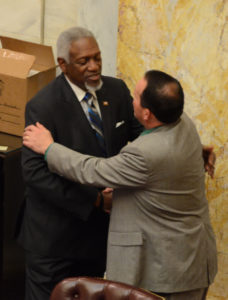
Rep. George McGill, D-Fort Smith, left, and Rep. Andy Mayberry, R-Hensley, share an embrace after McGill’s speech.

By Steve Brawner
© 2017 by Steve Brawner Communications, Inc.

Over the course of a three-month session, legislators make thousands of speeches at the Capitol. Last Friday, Rep. George McGill, D-Fort Smith, gave one of the most memorable – ever.

The issue was Senate Bill 519 by Sen. David Wallace, R-Leachville, and Rep. Grant Hodges, R-Rogers, which reserves each third Monday in January as a day to honor Dr. Martin Luther King.

This year, Arkansas was one of three states, the others being Alabama and Mississippi, that honored King and Gen. Robert E. Lee on the same day – the result of an unfortunate historical coincidence along with a lack of sensitivity. In 1947, Arkansas made a state holiday out of Lee’s birthday Jan. 19. King’s birthday was made a federal holiday in 1983, which meant there would be two state holidays at about the same time each year. Lawmakers did not want state employees to have another paid vacation day, so in 1985, Gov. Bill Clinton signed a bill combining the holidays.

It’s impossible to know every lawmaker’s intentions in 1985, but regardless, for some people it reasonably has felt like this once-Confederate state was unwilling to give Dr. King his own day. Visitors to the State Capitol on the holiday have been greeted by a sign saying offices were closed to celebrate both King, the civil rights leader, and Lee, the Southern Civil War general. For some, that combination was hurtful.

Two years ago, legislators made an effort to separate the holidays, but it failed under heavy pressure from opponents and fans of Lee and because of the Legislature’s general aversion to upsetting the status quo. For a mostly white Legislature, the combined holiday didn’t seem that big of a deal.

Gov. Asa Hutchinson, newly elected at the time, supported that bill but did nothing to pass it. This year, he announced before the session that a separate King Holiday was one of his priorities, and he testified about the bill before House and Senate committees – the first time he has done so.

The bill says Arkansas will now celebrate only King’s birthday on each third Monday in January while Robert E. Lee Day will be the second Saturday in October – a state memorial day, not a holiday, coinciding with the time of his death. Schools are required to develop teaching materials about the civil rights struggle and the Civil War corresponding to those days.

That arrangement felt to some legislators less like a separation and more like a demotion for Lee. On the House floor Friday, one said it appeared the state was ashamed of its past. Another feared the next step was to remove the star in Arkansas’ flag commemorating its membership in the Confederacy. There was some emotion in the room.

That’s when stately, gray-haired McGill sensed the mood and made his way to the well. “Good afternoon,” he said with a smile, and then repeated the greeting so the House would return it. He then spoke highly by name of his fellow legislators, including one who had vocally opposed the King bill.

Speaking off the cuff, he talked about his great-great-grandfather, also named George McGill, who had fought in the war on the Union side, and he wondered what it had been like for him when the war ended. Did they let him keep his weapon or give him rations? He talked about his own experiences at the University of Arkansas when he was denied a dormitory room because of his race. Looking back at his youth, he recalled his afro hairstyle, his use of the black power salute, and his vow never to return to the University of Arkansas – now, he said, “one of my favorite places to go.”

McGill told House members that Senate Bill 519 would be just one more piece of paper stuck in a big binder in a room full of other big binders. What mattered, he said, was legislators were giving educators space to teach about the past.

No way anyone was following that speech. The vote was 66-11, with 5 voting present and the rest not voting. Hutchinson signed the bill into law Tuesday.

McGill’s biggest accomplishment wasn’t the passage of the bill. It was going to pass anyway. His greatest achievement was bringing healing to what was becoming a racially divisive moment in a chamber that has seen many others through the decades. He reminded everyone listening that it’s possible, even necessary, to both remember and forgive.

He was a peacemaker. Someone once said such are blessed.

Note: Here is the speech. Great job, Brian Fanney.
Should do, can do about bathrooms

By Steve Brawner
© 2017 by Steve Brawner Communications, Inc.

Sometimes, it’s more about what the government can do instead of what it should do.

Such might be the case with the topic Governor Asa Hutchinson was hoping to avoid, a bathroom bill, the Arkansas Physical Privacy and Safety Act.

Senate Bill 774 by Sen. Linda Collins-Smith, R-Pocahontas, was discussed in the Senate Judiciary Committee Wednesday but not voted upon because a potential yes vote, Sen. Greg Standridge, R-Russellville, wasn’t present and wasn’t available by phone. It will probably be discussed again Monday as this year’s legislative session enters the home stretch.

The bill requires all multi-person restrooms and changing facilities in government buildings to be designated for one gender, defined as “a person’s immutable biological sex as objectively determined by anatomy and genetics existing at the time of birth.” The bill requires government agencies to take “reasonable steps” to prevent individuals from entering the wrong bathrooms. Government entities, including schools, could be sued up to four years after an unwanted intrusion, with plaintiffs able to recover damages “for all psychological, emotional, and physical harm suffered.”

Collins-Smith has strong feelings about whether a person born male should use a ladies’ restroom, and so do a lot of Arkansans. She said the bill is necessary to protect bathroom users’ privacy, dignity and safety.

Speaking against the bill were Michael Marion, general manager of Verizon Arena, and Gretchen Hall, president and CEO of the Little Rock Convention and Visitors Bureau.

They made some what-should-the-government-do arguments. When North Carolina passed a bathroom bill, the state found itself the new ground zero in the culture war. Paypal cancelled plans to open a 400-job global operations center, the NBA and NCAA cancelled events, and entertainers such as Bruce Springsteen cancelled concerts. Even though Collins pointed out that her bill is much less restrictive than North Carolina’s – it explicitly doesn’t apply to private entities – Marion and Hall fear a similar backlash against Arkansas, as does Hutchinson.

That’s a legitimate economic argument. On the other hand, how much of a state’s policies should be based on the political beliefs of outsiders?

Marion and Hall also made some what-can-the-government-do arguments. Marion said that when Joyce Meyer Ministries appeared at the publicly owned Verizon Arena, some of the men’s restrooms temporarily were converted to women’s restrooms, and some men mistakenly walked into them. Meanwhile, sometimes women use the men’s room because they don’t want to wait in line at the ladies’ room. What happens in those situations? Hall pointed out that some people born one gender look completely like the other, so how do you even know if they are using the wrong restroom, much less keep them out? Collins-Smith said entities comply with other rules and would figure out how to comply with this one.

This issue isn’t going away. Last year, the Obama administration released a heavy-handed guidance telling schools across the nation to let transgender students use bathrooms and locker rooms of their choice, which the Trump administration has rescinded. The same day the bill ran in the Senate Judiciary Committee in Arkansas, the Texas Senate approved a bathroom bill applying to public buildings. It faces a tougher road in the Texas House.

This may be a “can do” instead of a “should do” situation where we’re just going to have to keep doing what we’ve been doing without a new government solution. Police cannot patrol millions of bathrooms across the country making sure people use the right one – or that those inside welcome them. It’s not against the law for people to use the wrong bathrooms, but laws do apply for what they do inside them. We’ll continue to put up signs for male, female, or either, and people will frequent the places where they feel welcome and safe. Meanwhile, entities will respond to prevailing cultural norms. More establishments will do what my new local Kroger did: Install only gender-neutral, private, locking bathrooms.

During the committee meeting, Sen. Jeremy Hutchinson, R-Little Rock, worried that a lawsuit could arise from an accidental intrusion, which all of us have experienced – including, ironically, me. The day before the meeting, I opened what I thought was a committee room door but instead was the ladies’ restroom.

Naturally, I did what almost everyone else does in that situation – turn around and escape. While we can argue about whether a person born male can ever use the ladies’ room, I know this one can’t.

Why this year’s Legislature wouldn’t make much of a movie

By Steve Brawner
© 2017 by Steve Brawner Communications, Inc.

A good movie features lead characters facing a high-stakes challenge that they overcome after considerable tension and drama, leading to a satisfying conclusion. If that’s the case, this year’s General Assembly of the Arkansas Legislature would not be much of a movie.

Consider what recent sessions have involved. In the 1990s and 2000s, state legislators were forced to react to the Lake View court case, so they spent billions of additional dollars on schools and engaged in impassioned debates about consolidation. Since 2013, each regular and fiscal session has revolved around a similar central plot point: Should the private option be created/continued/modified into Arkansas Works? Like sequels that are similar to the original, legislators each time debated questions about the role of state government regarding that program, which uses federal Medicaid dollars to purchase private health insurance for low-income individuals. In 2015, additional drama was created by the Religious Freedom Restoration Act (RFRA), which was about citizens’ ability to refuse to participate in activities they said violated their conscience but which opponents said allowed them to discriminate. That issue brought crowds of protestors to the Capitol and national attention to Arkansas.

Those sessions all had an external source of tension where the response had significant consequences. With school funding and consolidation, court decisions forced legislators to make difficult decisions that everyone knew would affect schoolchildren’s future and disrupt communities. With health care policy and the RFRA, legislators were responding to far-reaching changes in the federal government and the wider culture, forcing them to make difficult, conflicted choices.

And that’s why this session would not make much of a movie. There’s no external challenge – no court decision, no law, and no decision in Washington that requires a reaction. Republicans now control everything in Washington and dominate Arkansas state government, and it’s all happened so recently that the internal conflicts that make good movies better haven’t really developed.

So while legislators have made some big decisions this year, they haven’t made dramatic ones. They voted to place a lawsuit reform measure on the ballot, which means the action there is to be continued until November 2018. They passed a small tax cut at the beginning of the session that won’t change anyone’s life or break the bank. The implementation of the Medical Marijuana Amendment, which could have been a mess, has been mostly routine. Meanwhile, the governor, who sees himself first and foremost as the state economic-developer-in-chief, so far has tamped down any movement to address transgender bathrooms, the session’s potential national headline creator.

Legislators are still meeting, which means there’s still time for a plot twist. The long-running subplot about guns on college campuses continues to draw attention. Also ongoing is the potentially dramatic debate about removing General Robert E. Lee from the Martin Luther King Holiday. But while these are important, they’re not bring-everything-else-to-a-halt issues like the private option or school consolidation.

The thing about the Legislature is that it’s not a standalone movie but instead is an ongoing series, and 2017 merely has been one episode. The external conflict that’s been missing the past few months could return in a big way later in the year. If Congress and the Trump administration make major changes to health care – and that’s a big if – then legislators will be back in Little Rock having to rethink policies affecting hundreds of thousands of Arkansans. It will literally be life and death stuff.

If anything about this column is meant to sound like a complaint, it’s not. Government is not a movie. In fact, one of the reasons Washington has become so dysfunctional is that it’s increasingly treated as entertainment, with the same characters playing either a hero or a villain depending on which screen we’re watching.

But whether or not it’s entertaining, it is important. So stay tuned, because average citizens aren’t just viewers but also help write the script, and there’s no ending.

We won the lottery, but who bought the ticket?

By Steve Brawner
© 2017 by Steve Brawner Communications, Inc.

Should welfare recipients be required to pay back the state if they win the lottery? Maybe the better question is, should all of us?

Those questions came to mind after hearing a presentation by Rep. John Payton, R-Wilburn, of his House Bill 1825 before the House Rules Committee at the State Capitol Wednesday.

The bill would require lottery winners to reimburse the state for their last 10 years of Department of Human Services benefits, such as the Supplemental Nutrition Assistance Program, formerly the food stamp program.

Payton said the lottery is a bad deal for poor people, who gamble their sparse dollars with the odds stacked mightily against them. This arrangement would make them think twice about doing that and remind them that their benefits come from the taxpayers.

In addition to Payton, the bill has 26 co-sponsors in the House, but it’s likely not going far. One committee member requested a fiscal impact statement, which will delay the bill’s progress. Legislators are hoping to go home at the end of March, which is fast approaching.

Still, if part of the idea is to make welfare recipients consider the source of their government benefits, then let’s consider the bigger picture: As a nation, we are all receiving government freebies.

In 2017, the Congressional Budget Office projects the United States government will spend $4 trillion but collect only $3.4 trillion, producing a deficit of $559 billion. That means the government is spending about $1,700 more than it collects per American, or almost $7,000 for a family of four.

Think you don’t benefit from that? Of that $4 trillion, almost a fourth went to Social Security in 2016, which benefits all of us – recipients directly, future recipients because it offers a guaranteed retirement plan, and families because they expend fewer resources taking care of their elderly relatives. (Yes, there’s a trust fund – but not really. In effect, the tax dollars go into one pot.) Another $588 billion goes to Medicare, which offers the same benefits. About that same amount pays for the United States to maintain by far the largest military in the world, which we’re all generally glad we have even if some of us would be OK with it being a little smaller.

Need more examples? The interstates on which we drive are no longer funded entirely by the gas taxes we pay at the pump. They are now funded partly out of the indebted general fund. The public schools we attend at a cost of $9,400 per Arkansas student annually also are funded partly by federal dollars and therefore by federal debt. And contrary to popular belief, only 1 percent of the budget goes to foreign aid, which often directly benefits Americans (for example, by buying food produced in America).

Finally, and this is really important, deficit spending does more than just allow these popular programs to continue. It infuses the economy with extra cash borrowed from future generations without their permission – stolen, in other words. We all live better because the government is writing $559 billion in hot checks this year, and putting it into the economy. Modern American life is being propped up by our grandchildren’s labor.

The frustration that many Americans feel toward welfare recipients is based on their belief that they are receiving unearned benefits that trap them in a cycle of poverty. And yet as a nation we are all receiving unearned benefits that trap us in a cycle of debt. These habits enable us to buy prosperity and security we have not fully earned. We’re all welfare queens, which is why the national debt – the accumulation of all these annual deficits – has reached $19.9 trillion, or more than $61,000 for every American. Most of that has accumulated in the last 16 years, meaning we were the ones who benefitted most.

There will come a point when the nation either chooses a different path, or is forced to do so. At some point in the future, the bill will come due. It always does.

If you and I are not around, then congratulations to us. We lived in a rich country during a rich era, and we received a lot of government benefits we never had to pay for.

In other words, we already won the lottery.

Death, taxes and Lake View

By Steve Brawner
© 2017 by Steve Brawner Communications, Inc.

We’ve all heard the old Benjamin Franklin adage that the only certainties in life are death and taxes. For many years Arkansans have been able to add “public schools getting more money” to that list.

That’s because of a series of 1992-2007 court decisions in a case initially filed by the Lake View School District, a small, poor district in the Delta. Those decisions clarified that the state has a constitutional responsibility to ensure schools everywhere are adequate and equitable. The decisions basically required the state to fund schools first without regard to how much money was readily available or how it would affect other state priorities.

Since then, any debate about public school funding started and ended with two words: “Lake” and “View.” Nobody has wanted a repeat of that experience, where judges, justices and special masters stood over the state’s shoulder making sure it was filling in all the circles to their satisfaction.

As a result, while other states have cut education funding, Arkansas has always increased it – not by much lately, but by at least enough to stay out of court. In fact, the state’s public school districts not only have enough to fund their operations but between them have saved up $790 million in their net legal balances. A bill filed this legislative session by Rep. Mark Lowery, R-Maumelle, would require districts to keep no more than 20 percent of their revenues in those balances and use the rest for other purposes.

This year, as in years past, a legislative committee decided months ago that schools would receive an increase – this time about 1 percent in total per pupil foundation funding, the primary way schools are funded. Under that so-called adequacy report, whose recommendations the full Legislature generally accepts with little debate, in 2018 each school district will receive $6,713 per pupil, and that’s not including numerous other sources of local, state and federal funding that pushed the cost of educating each Arkansas student to about $9,400 as of 2013, according to the Census Bureau.

That’s right. If you have two kids in school, you’re getting about $19,000 worth of government benefits every year, and that’s before you drive on a road, call a fire department, get help with your parents’ health care costs through Medicare and/or Medicaid, or are protected by the military and law enforcers.

Anyway, back to Lake View, which is very slowly exerting less control, as evidenced by the fact that the 1 percent increase was less than it used to be, for a lot of reasons. One, naturally, is that the longer something fades into the past, the less it’s remembered, and there aren’t many policymakers left in Little Rock who were serving when all those Lake View decisions were coming down from the courts. Meanwhile, some state expenses have continued to rise – a good example being health care – at the same time that schools have always been guaranteed a raise. Plus, legislators always want to cut taxes, and that’s harder to do when you always must spend more money on schools.

Finally, there’s this really, really important fact: There are no Supreme Court justices left who had anything to do with those Lake View decisions. The last, Justice Paul Danielson, retired after the 2016 elections. No other justice has been on the court longer than since 2010, so no one knows how they would rule if Lake View were to be reconsidered. For what it’s worth, some of those justices have ruled in one 2012 case, Kimbrell v. McCleskey, that went a little against Lake View by saying certain school districts that collect extra money through property taxes can keep them rather than share them with other districts.

So schools have gotten a lot of money for a long time, other needs must be addressed, legislators always would love to cut taxes, and a whole new cast of policymakers remember less and less about Lake View, and are less scared of stepping past the vague line it drew in the sand. Plus, lawyers can make some pretty good money suing the state over this stuff.

So here’s a prediction and another certainty. The prediction is the state will wind up in another school funding case eventually.

The certainty is that it won’t be called “Lake View.” That district was forced to consolidate with Barton-Lexa in 2004 and no longer exists.